Submitting Korean documents to a foreign visa office, school, or institution?
Certified English translation of Korean documents — employment/career certificates, degree/transcript records, ID documents, and other visa-, admissions-, or institution-required paperwork — with the translator identification a foreign authority requires.
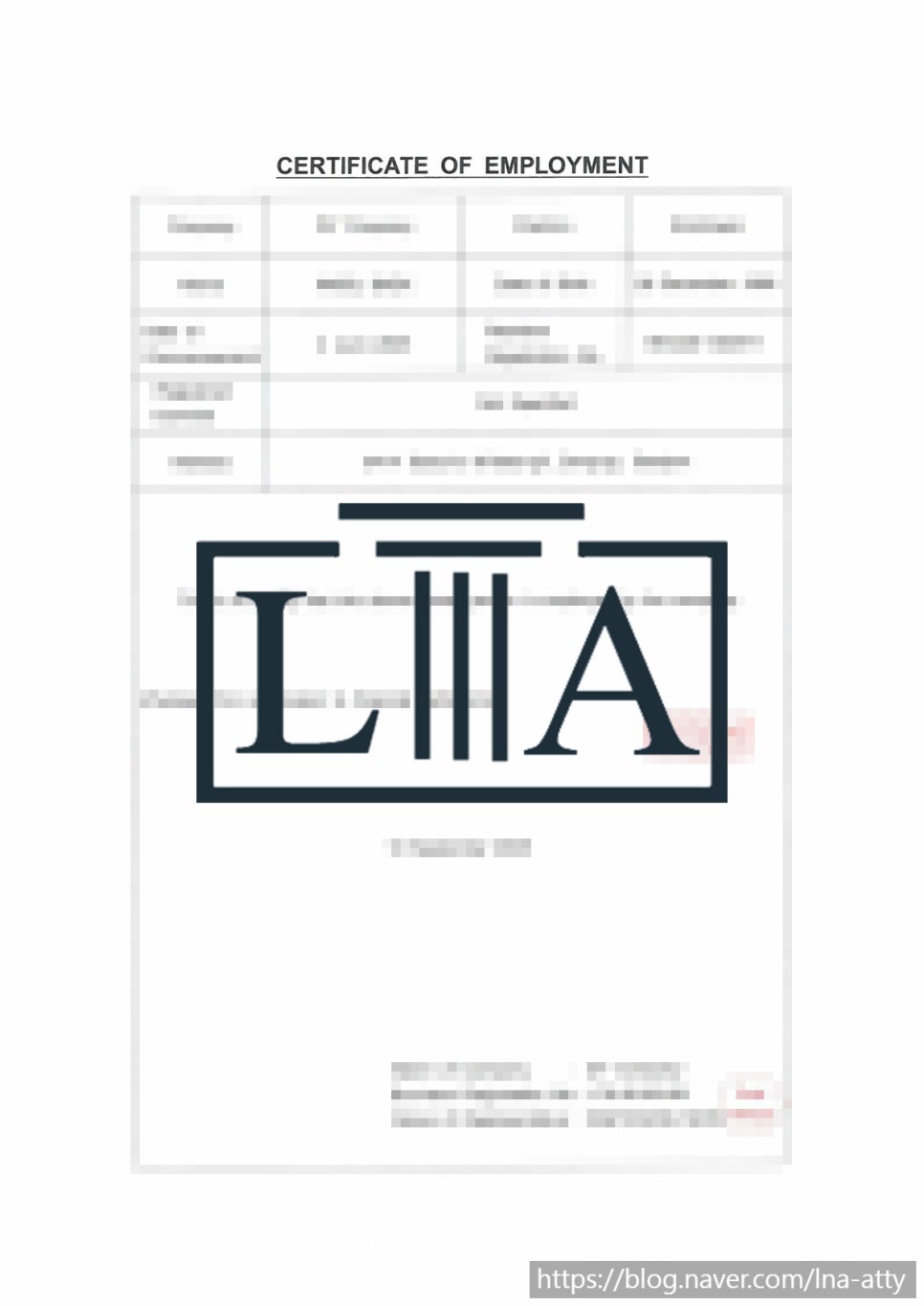
Translator-Identified Translations Foreign Institutions AcceptA Daejeon-based client preparing an Australian work visa application needed a Korean-to-English translation and certification of a Certificate of Employment (재직증명서) — one of the standard supporting documents most work-visa applications require.
Documents a typical work visa application requires
Requirements vary by visa subclass, but most applications ask for some combination of:
- Passport
- Employment / Work Reference Letter (재직증명서, 경력증명서)
- Degree Certificate & Academic Transcript
- English test scores (IELTS, PTE, etc.)
- Police Clearance Certificate
- Health Examination Report
Why the translator's identity has to be on the document
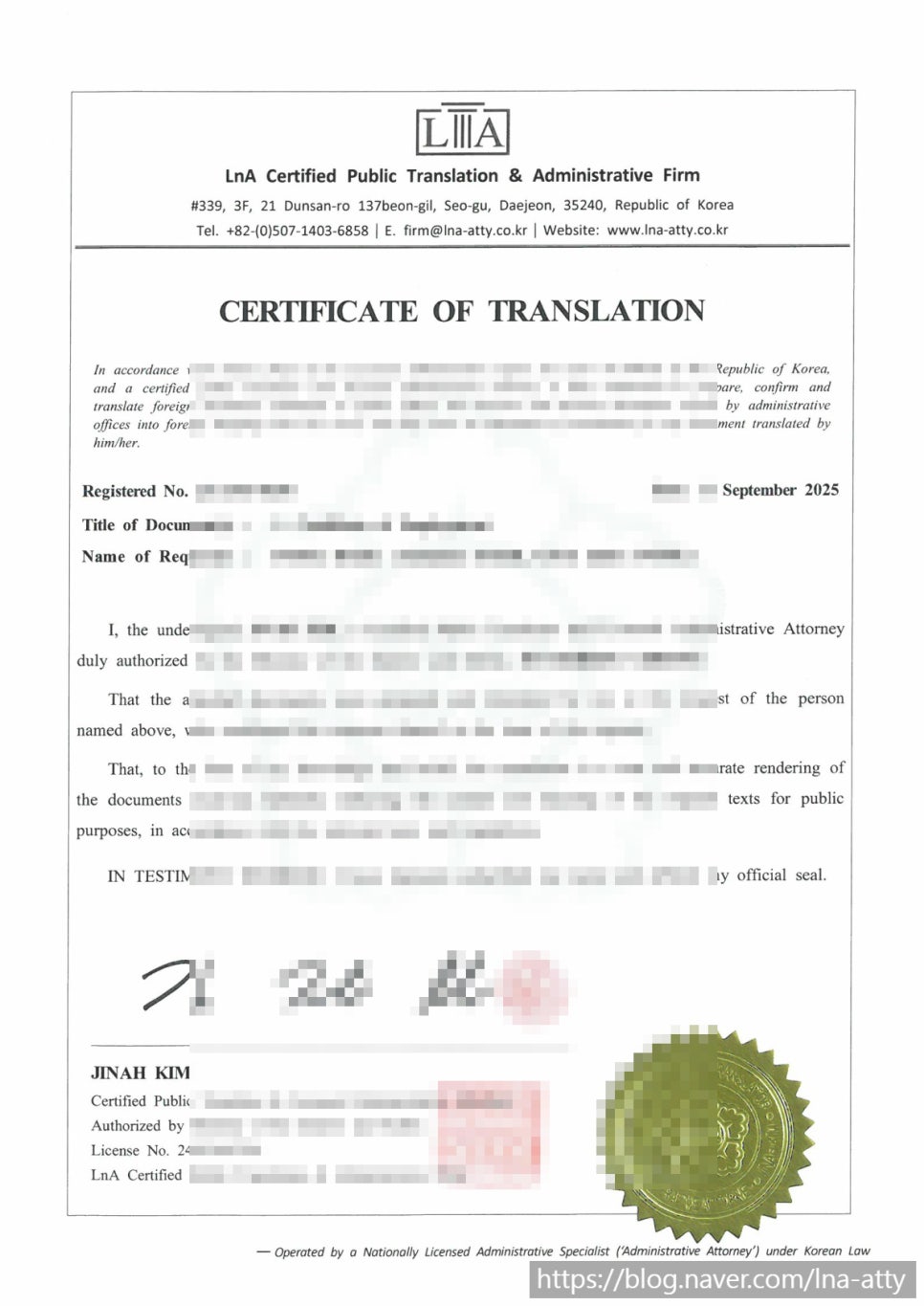
Australia's Department of Home Affairs requires every non-English document submitted with a visa application to be translated by an accredited translator, and — critically — the translation itself must state the translator's name, address, phone number, and qualification. This isn't a formality; it's how the receiving immigration authority verifies the translation is traceable to a real, accountable professional, not an anonymous or machine translation.
In Korea, a 외국어번역행정사 is licensed with exactly this kind of verifiable qualification and legal basis, making them well-suited to producing a translation immigration authorities can trust on sight.
Some receiving countries additionally require the translation itself to be notarized — always confirm the specific visa subclass's requirement before submission.
What this looks like in practice
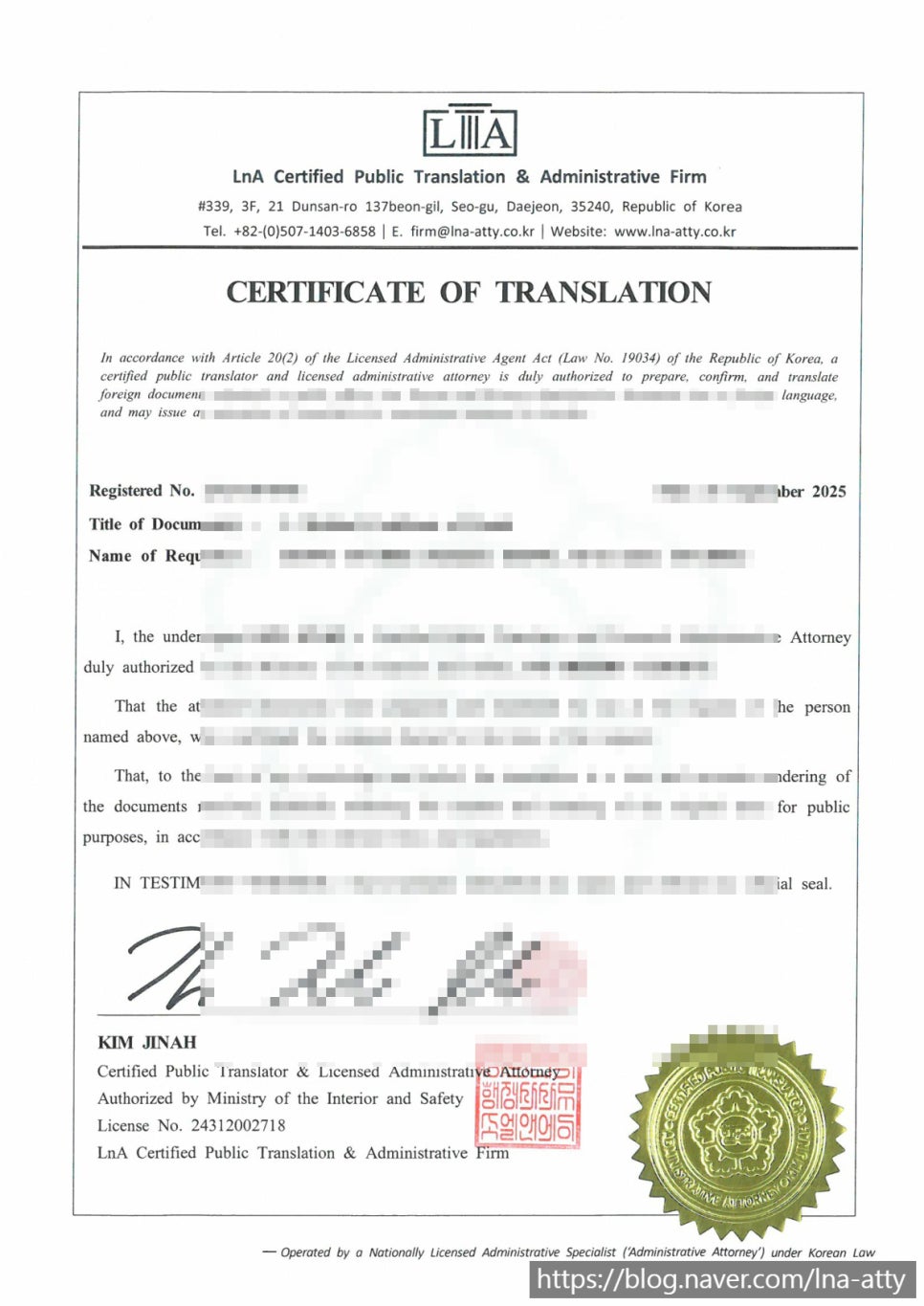
English-speaking countries don't all use identical administrative terminology — Australian government and legal usage differs in places from British, American, or Canadian usage. Before translating, this office confirms the terminology actually used in Australian administrative practice, rather than defaulting to a generic English rendering, and issues the translation together with a 번역확인증명서 (Certificate of Translation).
Why the wording choices matter for visa outcomes
Beyond accuracy, word choice in a visa-submission translation can matter for the outcome itself — phrasing that reads ambiguously or unfavorably to an immigration reviewer, even if technically correct, is worth avoiding where a clearer equivalent exists. Getting this right takes more than bilingual fluency; it takes familiarity with how the receiving country's immigration office actually reads these documents.
Graduate school applications: an Instructor Career Certificate for a Japanese university
A client preparing to apply to a Japanese graduate program needed a certified English translation of an Instructor Career Certificate (지도자경력증명서) documenting their coaching/instructional experience.
"It's Japan" — so why English, not Japanese?
Japan isn't an English-official country, but its universities' admissions rules reflect the international norm anyway. Major graduate school application guidelines — the University of Tokyo, Kyoto University, Osaka University, Hokkaido University, and others — share a common rule:
- Certificates issued in Japanese or English can be submitted as-is
- Certificates in any other language (Korean, Chinese, German, etc.) must be accompanied by a Japanese or English translation
- The phrase "translation into Japanese or English must be submitted" appears in nearly every department's admissions guideline
In practice, for a Korean applicant whose original document isn't issued in English, an English translation + 번역확인증명서 is the most practical combination.
Japan's own 행정서사 (Gyōsei-shoshi) system makes this an easy fit
Japan has its own version of Korea's 행정사 system: the 행정서사 (行政書士, Gyōsei-shoshi) — a licensed national professional who handles document drafting, filing, and administrative-procedure support, structurally very similar to Korea's 행정사. Because of this parallel, Japanese university and government staff are already familiar with the idea of a licensed professional certifying a translation — it's not an unfamiliar concept to explain from scratch.
That familiarity is exactly why a Korean 외국어번역행정사's 번역확인증명서 functions as credible, trust-building documentation when submitted to a Japanese university — it maps onto an institutional structure the receiving side already recognizes and respects.
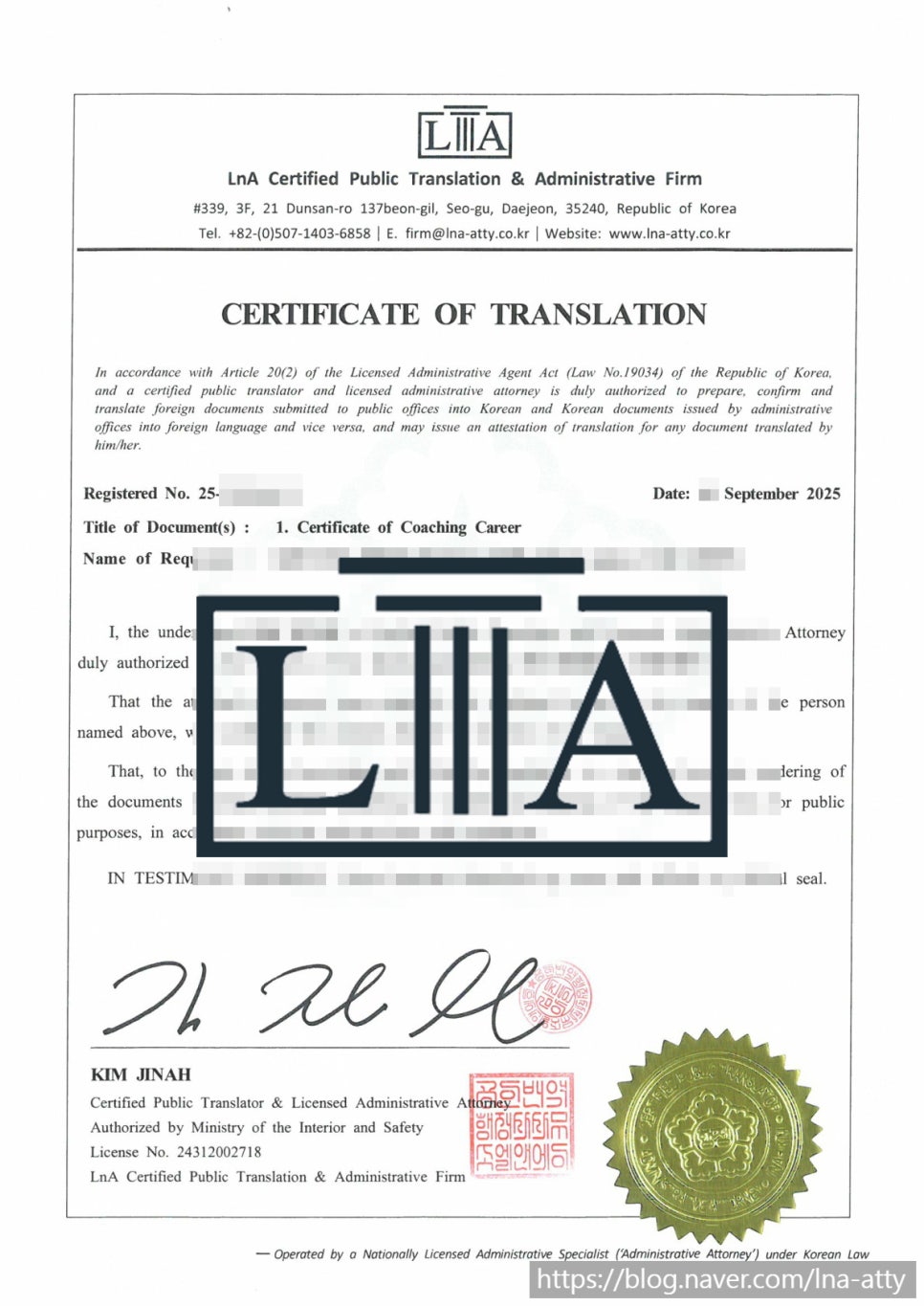
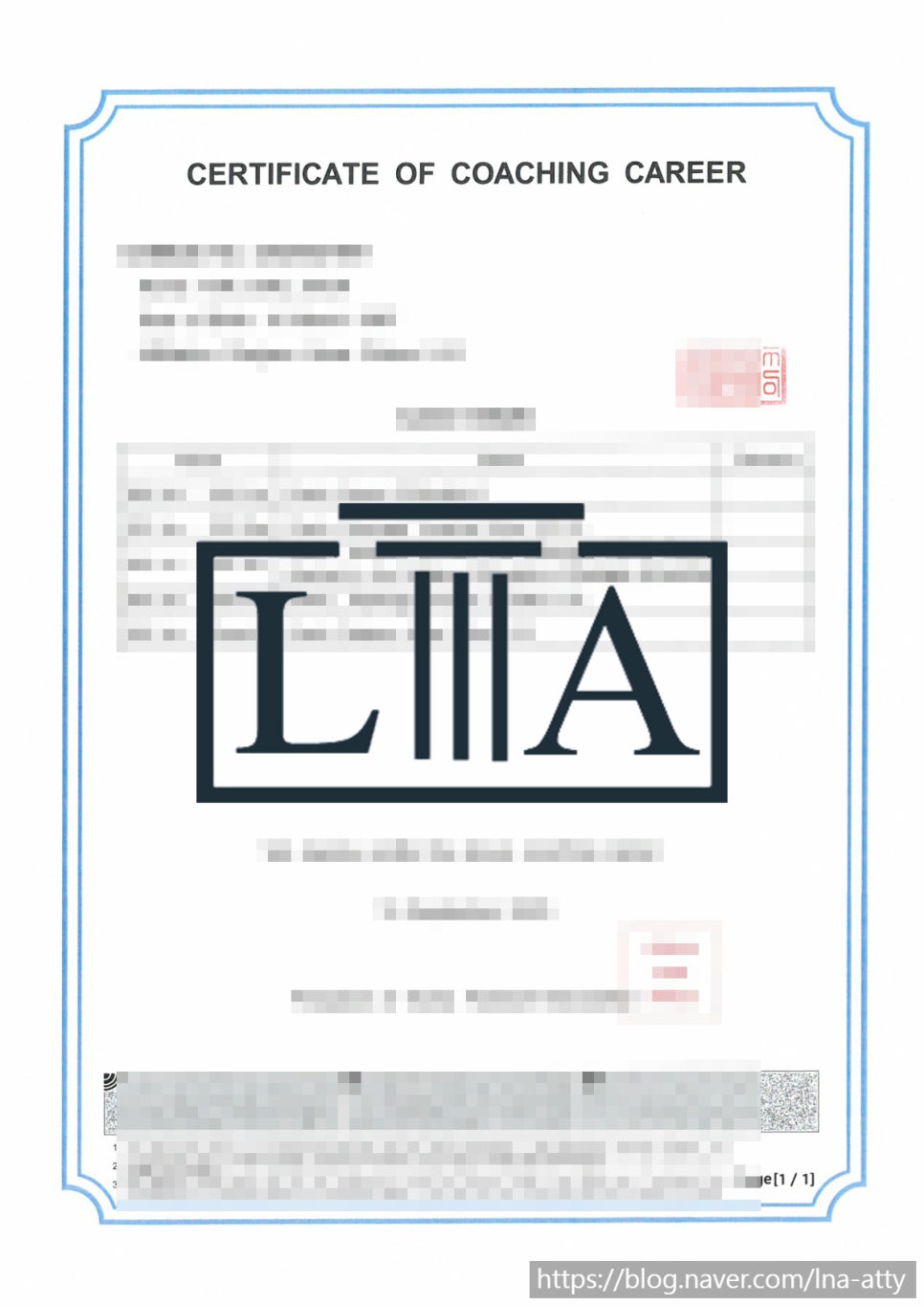
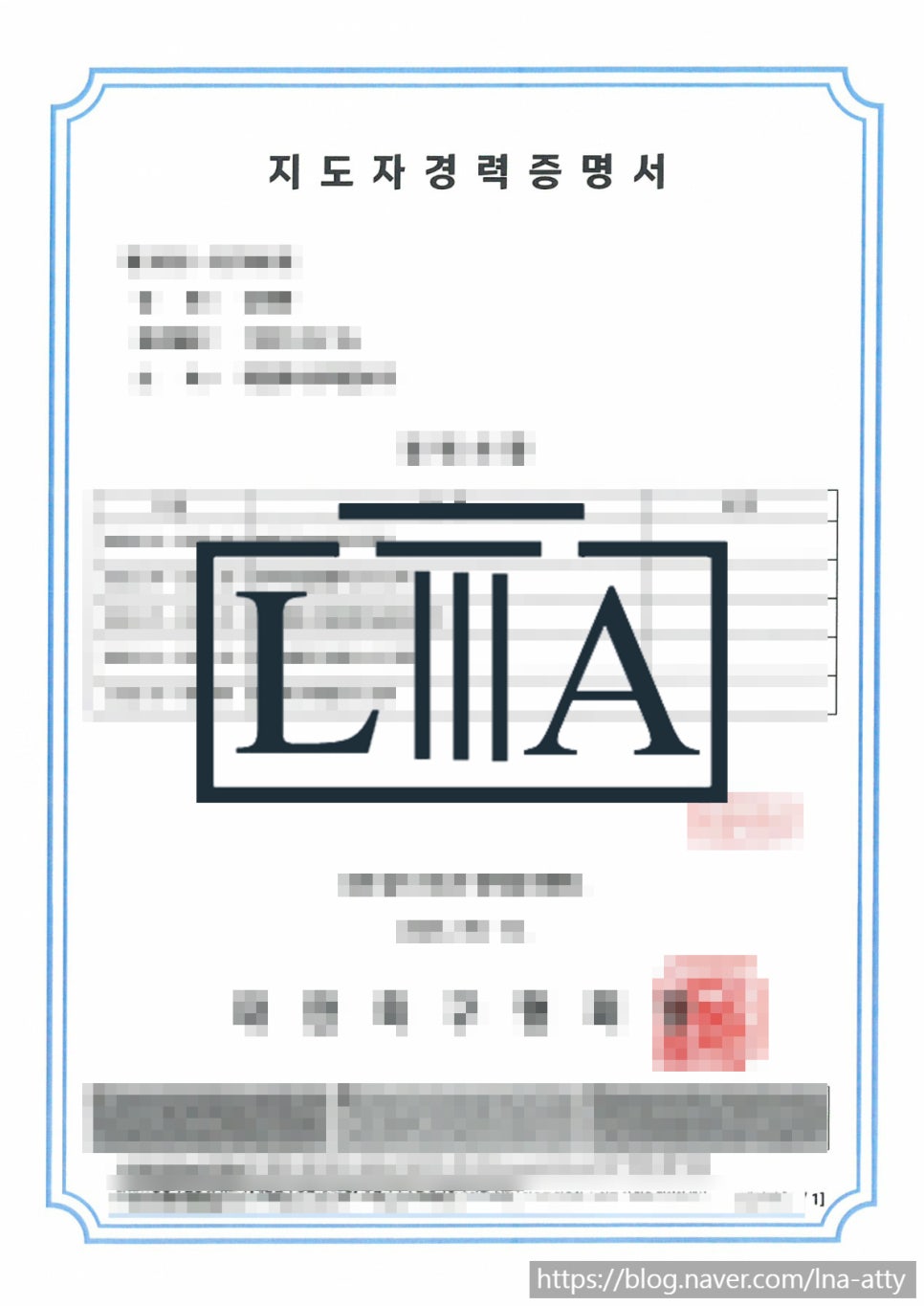
Before applying, always check the specific university and department's admissions guideline for its exact translation requirement — when only a Korean-language original is available, an English translation paired with a 번역확인증명서 is generally the most defensible way to avoid a rejected or bounced-back submission.
Overseas financial institutions: settling a father's foreign account, ID + family documents at once
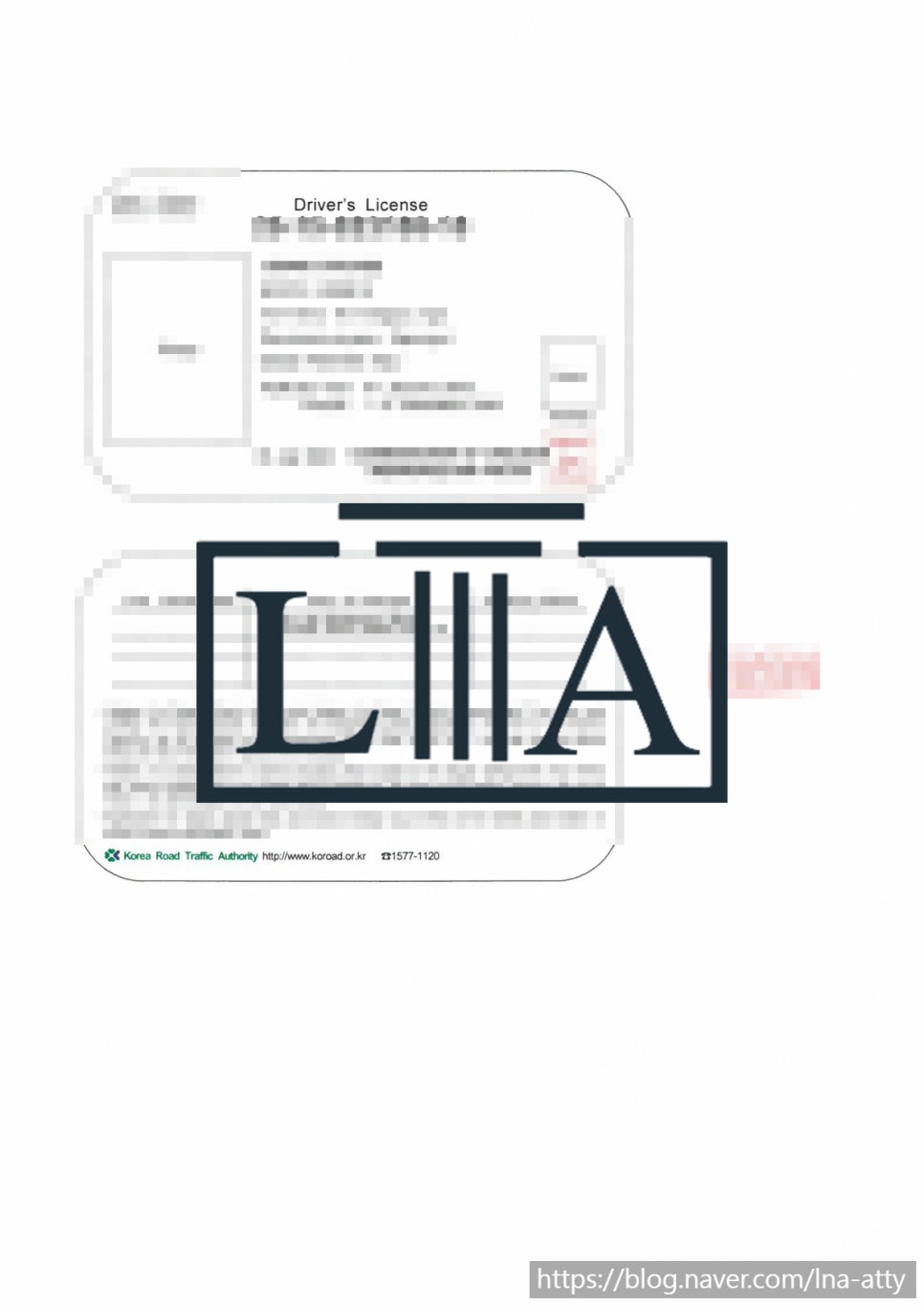
A client handling their late father's overseas account settlement needed a set of documents certified for submission to the foreign financial institution: the client's own 가족관계증명서 (family relation certificate), the father's 기본증명서, and a government-issued ID (driver's license).
Why this submission's requirements were unusually demanding
The receiving institution specified two separate certification requirements:
- Translation certification — explicitly requiring both a Notary Public or Legal Practitioner's certification and a Certified Translator's confirmation
- ID requirement — a Certified True Copy of the government-issued ID, certified by an authorized party
That combination creates a real problem: a Korean notary has no authority to perform copy-certification on a government-issued ID, since an ID is a public document (공문서), not a privately-authored one (사서증서) — the same limitation covered above for foreign birth certificates, just running in the opposite direction here.
How a single 외국어번역행정사 certificate satisfies both requirements at once
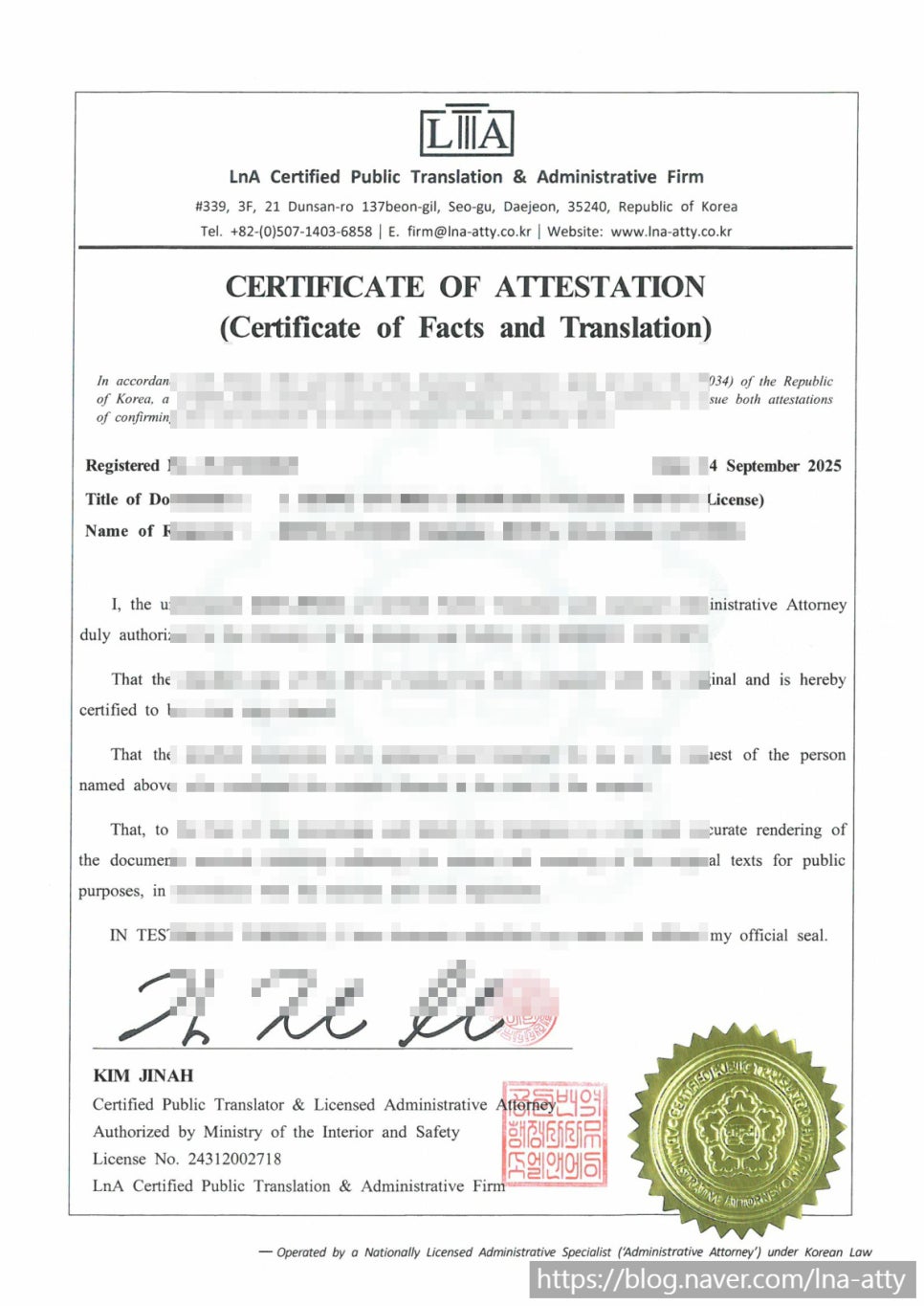
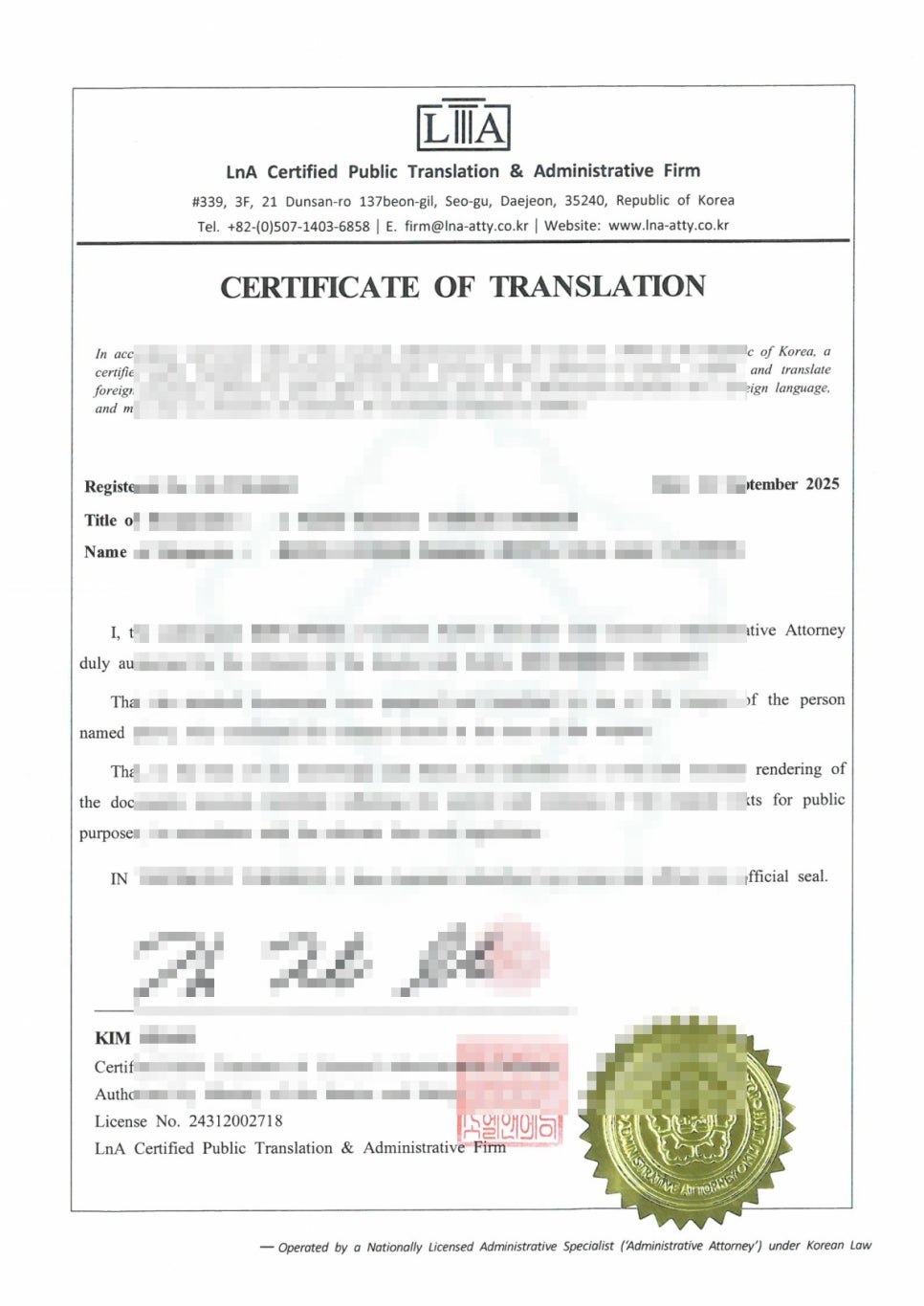
Under 행정사법 제20조, a 외국어번역행정사 is legally authorized to issue 번역확인증명서 (certificate of translation), 원본대조필 (certified true copy), and 사실확인증명서 (certificate of attestation) — functionally covering both the "Certified Translator" role and the "Notary Public / Legal Practitioner" role the receiving institution asked for.
This office handled the two document types differently:
- 가족관계증명서 and 기본증명서 — translated and issued with a standard 번역확인증명서
- Driver's license — examined the original in person, confirmed the copy bound with the translation was identical to it, and recorded that confirmation on a 사실확인증명서 (Certificate of Attestation) — satisfying the "Certified True Copy" requirement and the translation certification requirement in a single document
To minimize the client's in-person visits, all translation and pre-certification work was completed by email in advance — a single final office visit was needed just to present the physical ID for the 원본대조필 step, after which every document was finalized and a scanned copy sent immediately for the client's overseas submission deadline.
"Death Certificate" vs. "Medical Certificate of Death" — a term that can get a submission rejected
A death-related document — the most fundamental document needed to claim a deceased relative's overseas financial assets — needed to be translated for submission to a foreign financial institution.
Korea's death-record system doesn't split into two documents the way English-speaking countries do
Korea has no single administrative document called simply a "death certificate" that independently certifies the fact of death. Instead:
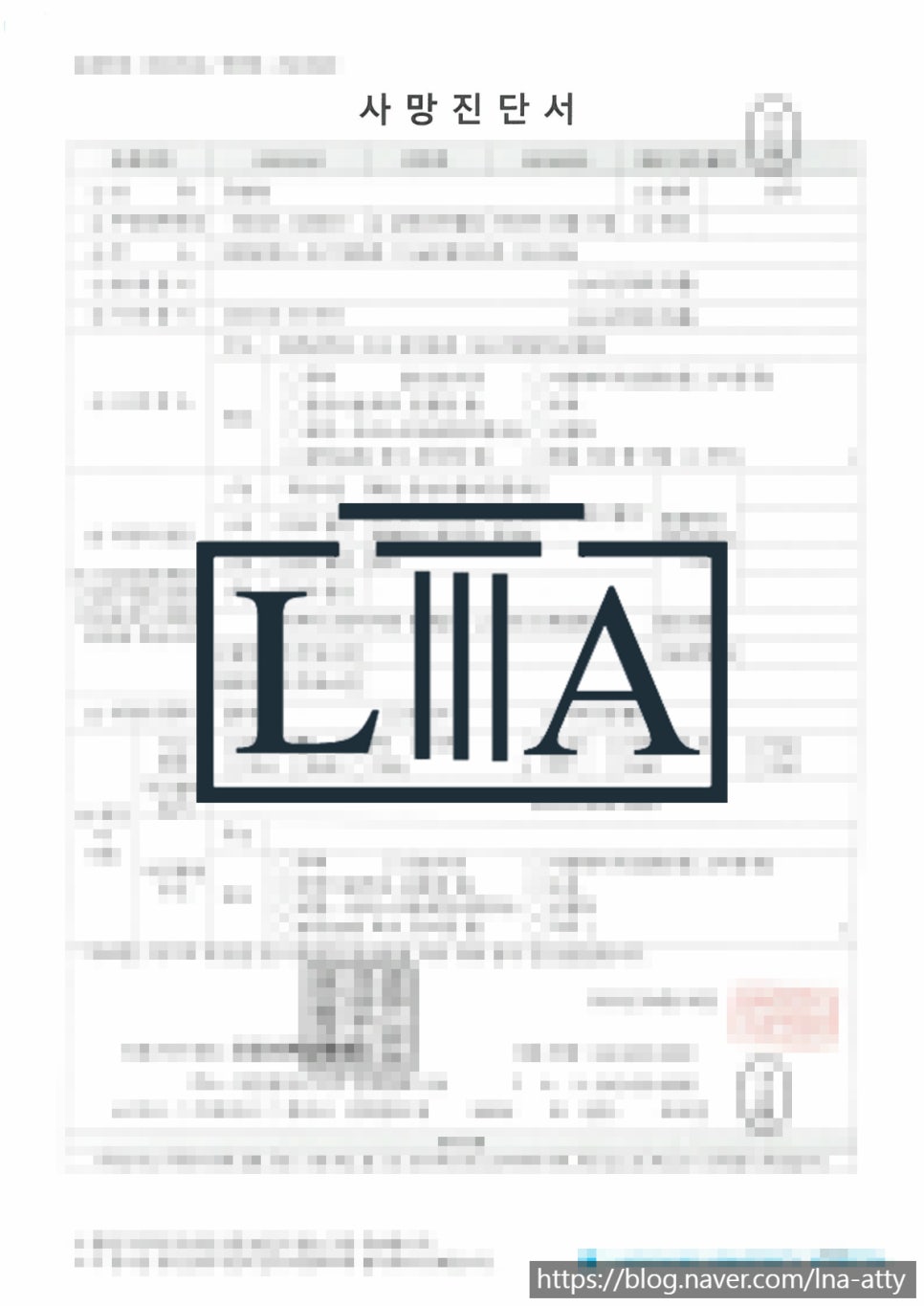
- A 사망진단서 (or 시체검안서) is a medical document a doctor issues, certifying the medical facts — cause and time of death
- The legal/administrative certification of death comes from separate family-relation registry documents (제적등본, 가족관계증명서, 기본증명서), where the death fact is recorded as an entry
English-speaking countries, by contrast, keep these functionally separate:
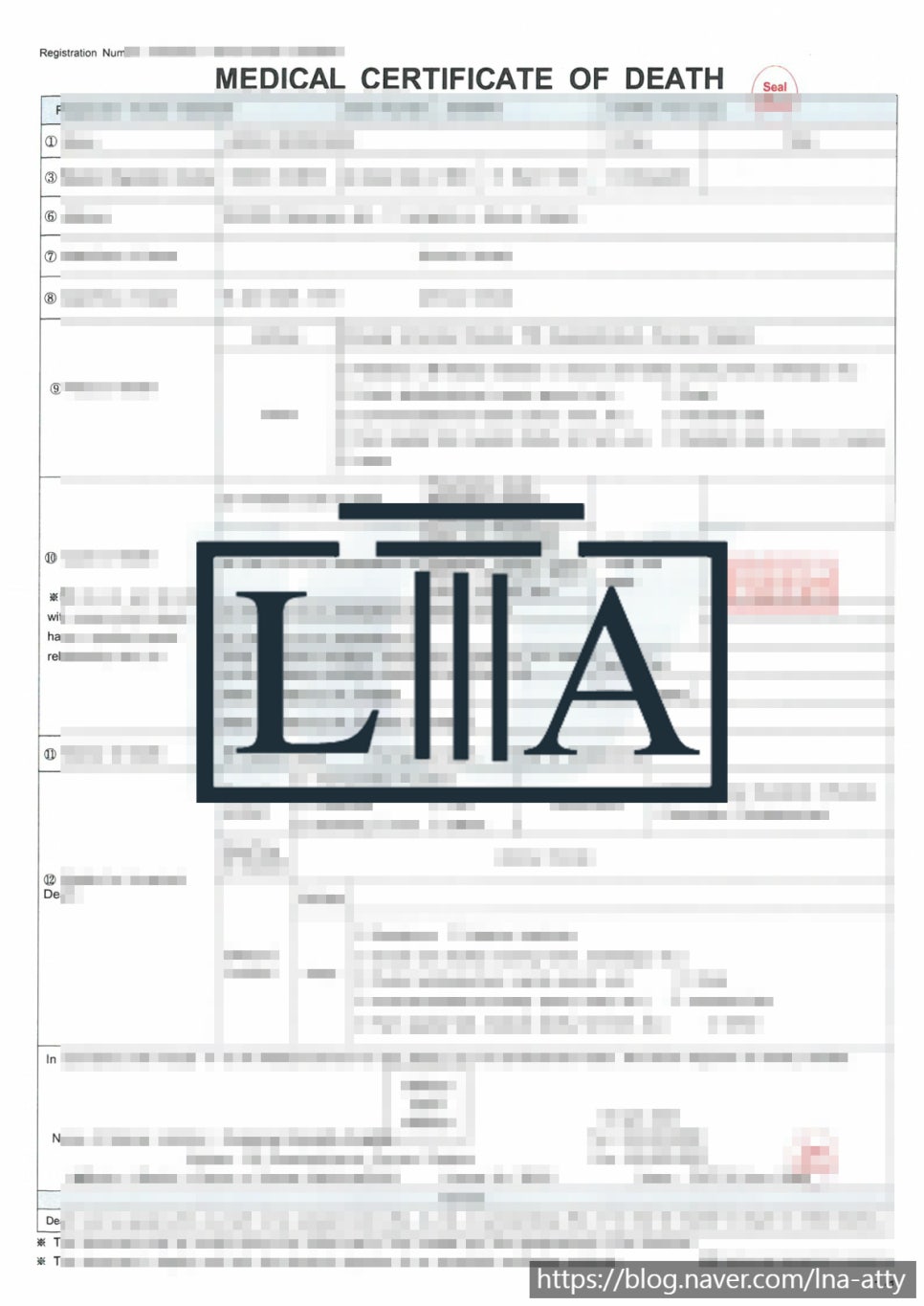
- Medical Certificate of Death — the medical document a doctor completes at the hospital
- Death Certificate — the official registration document a government office issues and registers
Why the wrong term risks rejection
If a Korean hospital's 사망진단서 gets translated simply as "Death Certificate," a foreign receiving institution (bank, insurer, immigration office) can easily mistake it for Korea's official government-registered death record — which it isn't. A certified translation's entire purpose is to prevent exactly this kind of misunderstanding at the receiving end. For that reason, the more accurate default translation for a 사망진단서 is "Medical Certificate of Death" — making clear it's the physician's medical certification of cause of death, not a civil registry record.
Context still governs the final word choice
This isn't a mechanical, one-size-fits-all rule. When the core purpose is proving the fact of death itself — settling an overseas account, filing an insurance claim — "Medical Certificate of Death" is the accurate choice. But if the receiving institution has already explicitly requested the document as a "Death Certificate," or consistency with other already-filed documents makes it necessary, using that term instead can be the more appropriate call. Telling this office the document's intended use, the receiving institution, and the specific situation up front is what allows the translation to be calibrated correctly the first time.
Cause-of-death terminology follows the WHO international standard
The Cause of Death section of a 사망진단서 is written to the WHO's International Classification of Diseases (ICD) — Korea currently uses ICD-10 — and the translation applies the corresponding standardized medical terminology to match.
An insurance claim: outdated terminology and translation ambiguity in a hospital diagnosis document
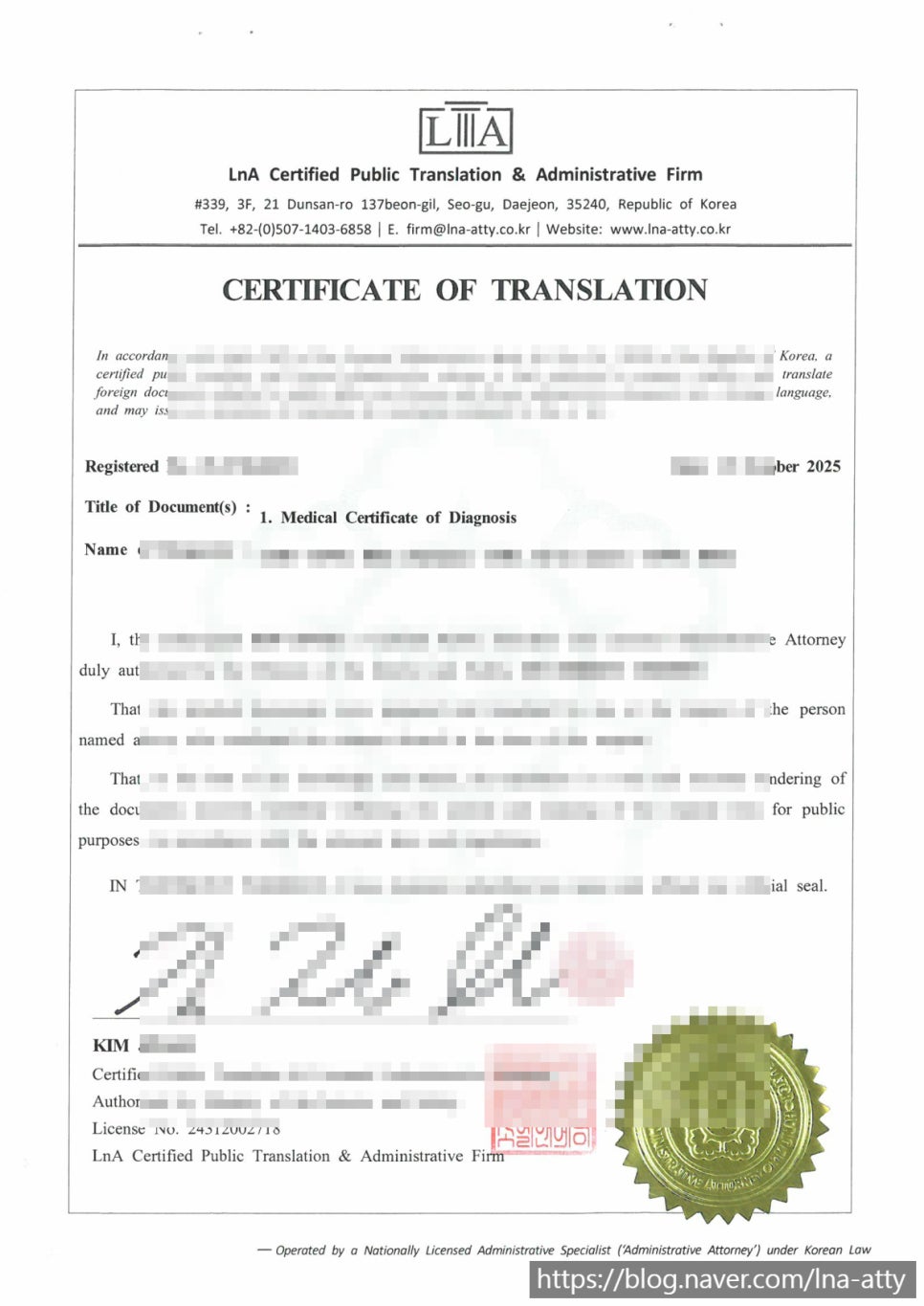
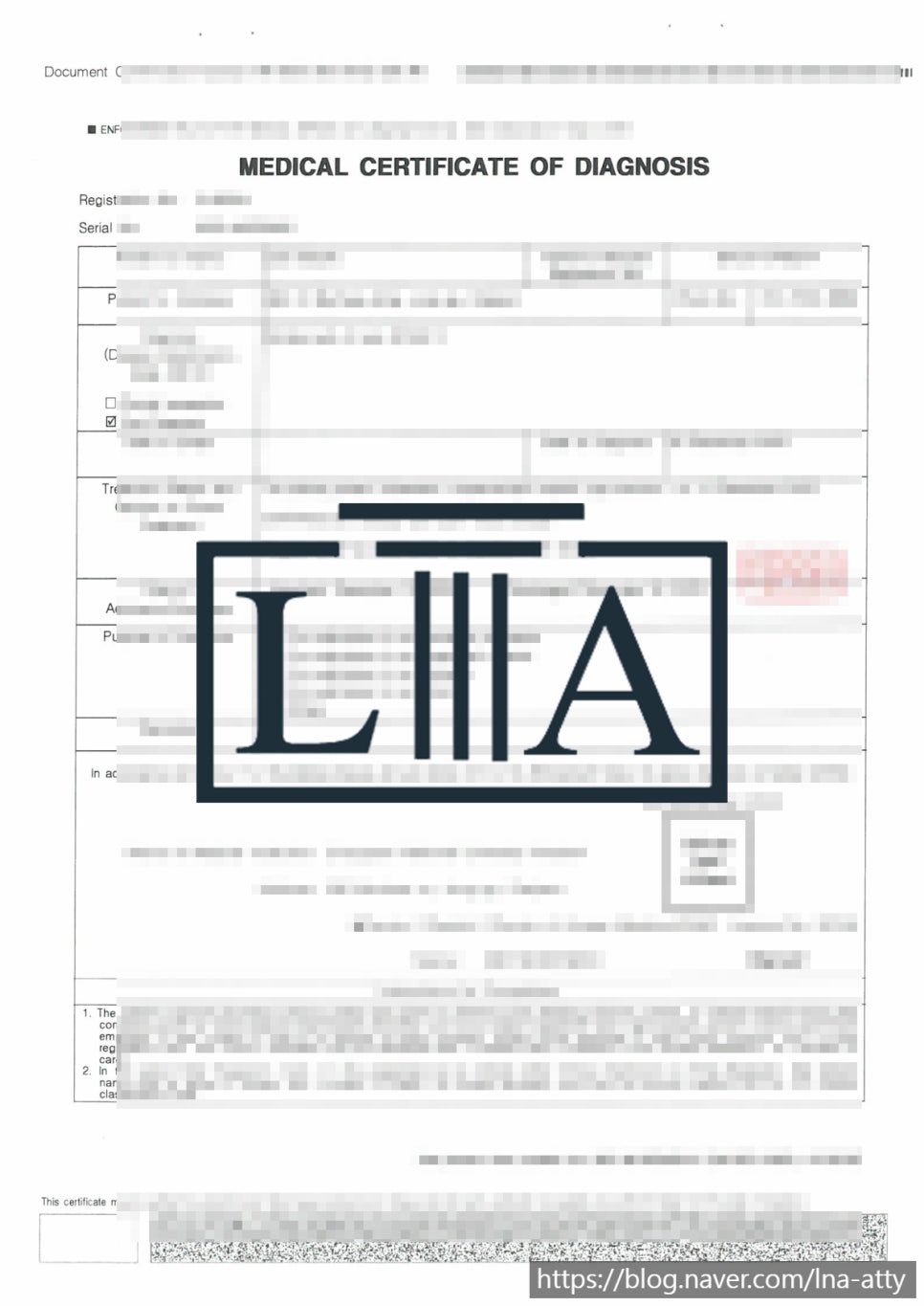
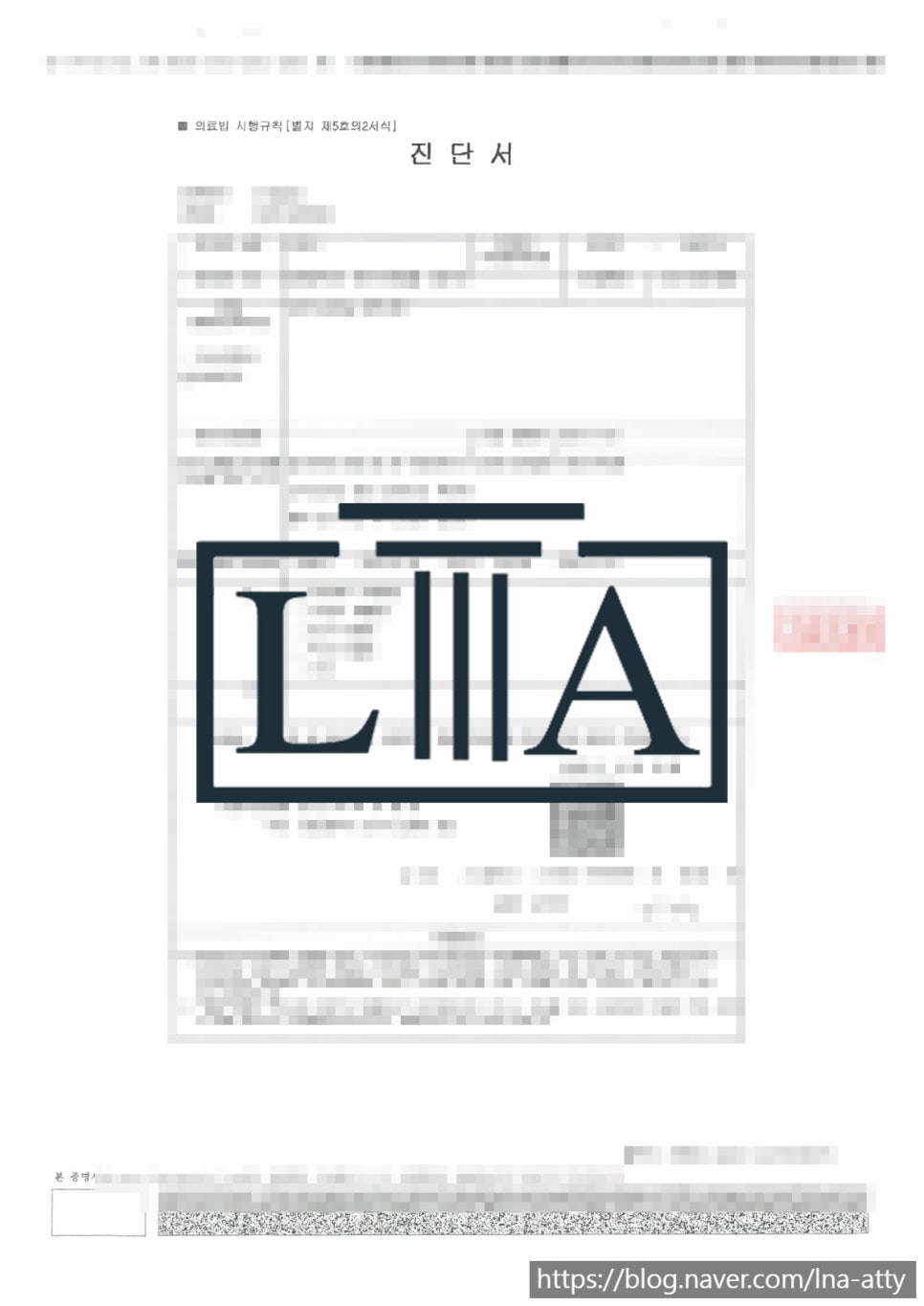
A Korean hospital 진단서 (diagnosis document) needed translation for submission to a U.S. insurance company. Two specific terminology issues stood out as worth getting right for a credible, professionally-received translation.
Retiring "Oriental Medicine Doctor"
Older sample documents and machine translations still frequently render 한의사 (a licensed Korean-medicine doctor) as "Oriental Medicine Doctor." That term is now widely recognized as outdated and carrying racial connotations, and current official usage across the U.S., Canada, Europe, WHO, and WPRO avoids it. Using it in a submitted document risks undercutting the document's professionalism and credibility with the reviewing institution.
Korea's own Ministry of Health and Welfare changed the official English designation from "Oriental Medical Doctor" to "Doctor of Korean Medicine" around July 2022, now reflected on licenses and diplomas. Currently accepted alternatives include:
- Doctor of Korean Medicine (DKM)
- Korean Medicine Doctor (KMD)
- Traditional Korean Medicine (TKM)
- Traditional Korean Medicine Doctor
A certified translation should avoid "Oriental" entirely, using a modern designation that respects Korean medicine as its own distinct traditional medical system.
"Medical Certificate" is technically correct — and too vague
Under Korea's 의료법 시행규칙 제9조제1항 (Medical Service Act Enforcement Rule), the document a physician issues on the prescribed form is officially named 진단서, commonly translated as "Medical Certificate." The problem: in English-speaking countries, "Medical Certificate" is a broad umbrella term covering essentially any official medical document a doctor issues — admission, discharge, sick leave, general health status, and more.
A Korean 진단서, by contrast, is specifically an information-focused document centered on a diagnosis — disease/condition, treatment course, and diagnosis date. Using "Medical Certificate" alone doesn't convey that specific focus, creating a translation gap between what the document actually does and what the English term implies — an insurance reviewer could plausibly mistake it for a generic health-status certificate.
Translating for the document's actual purpose
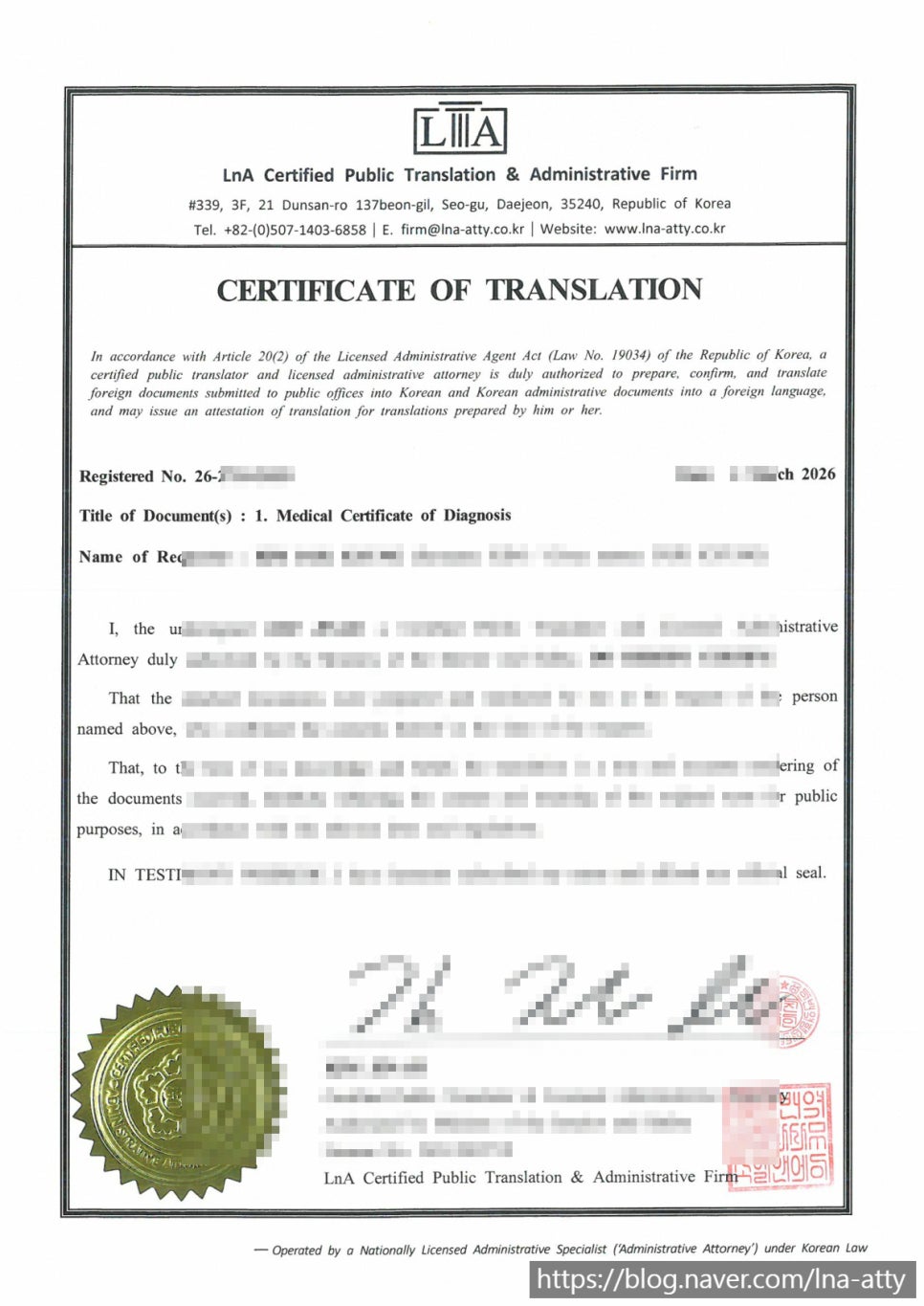
The entire point of submitting this document to a U.S. insurer is proving what condition the patient was diagnosed with. A translation should serve that purpose directly. Without sacrificing the general term's recognizability, adding a diagnosis-specific qualifier makes the document's purpose immediately clear and reduces reviewer confusion:
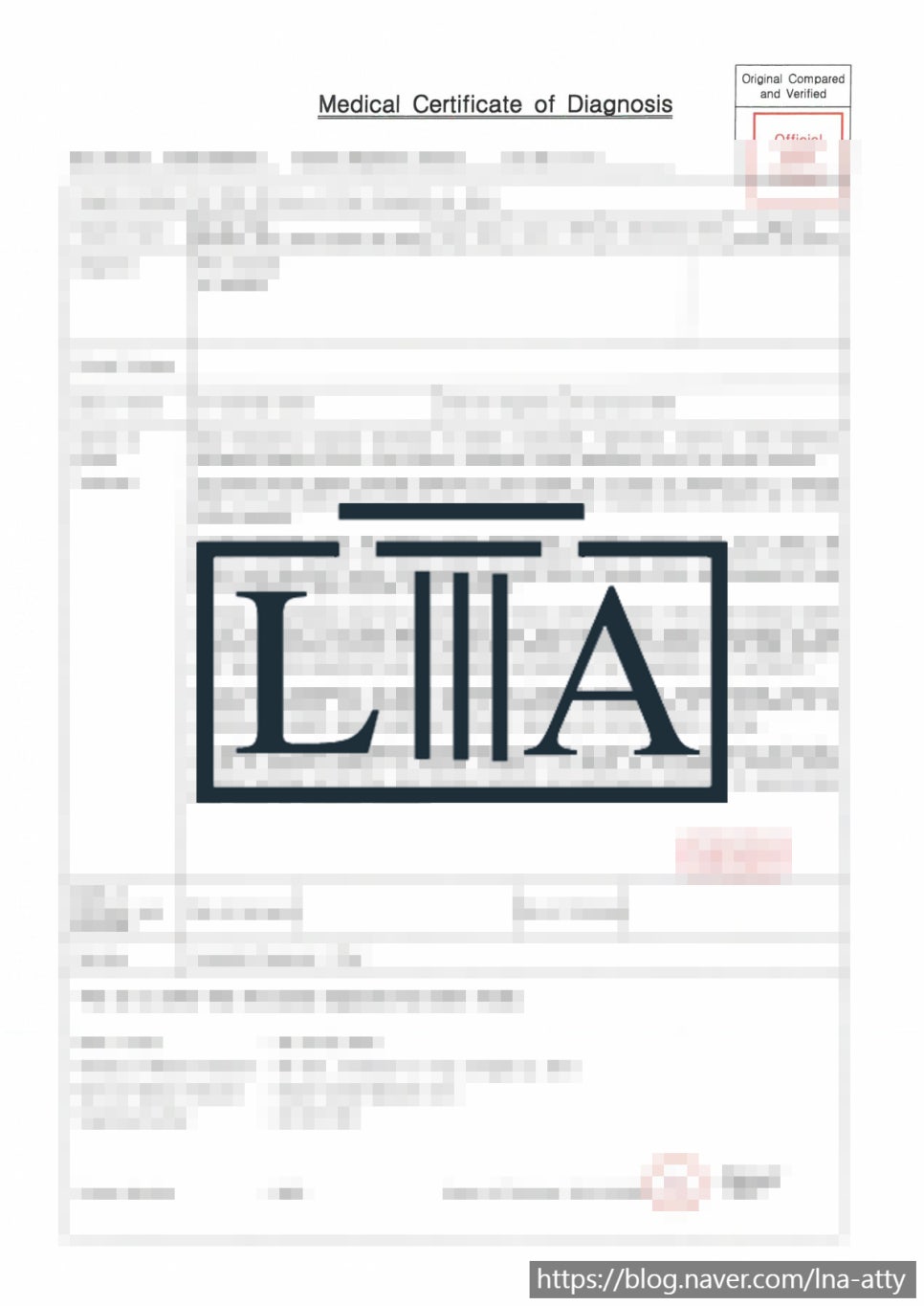
- Medical Certificate of Diagnosis
- Medical Diagnosis Certificate
Either resolves the ambiguity that plain "Medical Certificate" carries — signaling clearly that this document exists to convey diagnosis information, which is exactly what an insurance claim reviewer needs to identify at a glance.
A Vietnam internship visa: which "health certificate" is actually required?
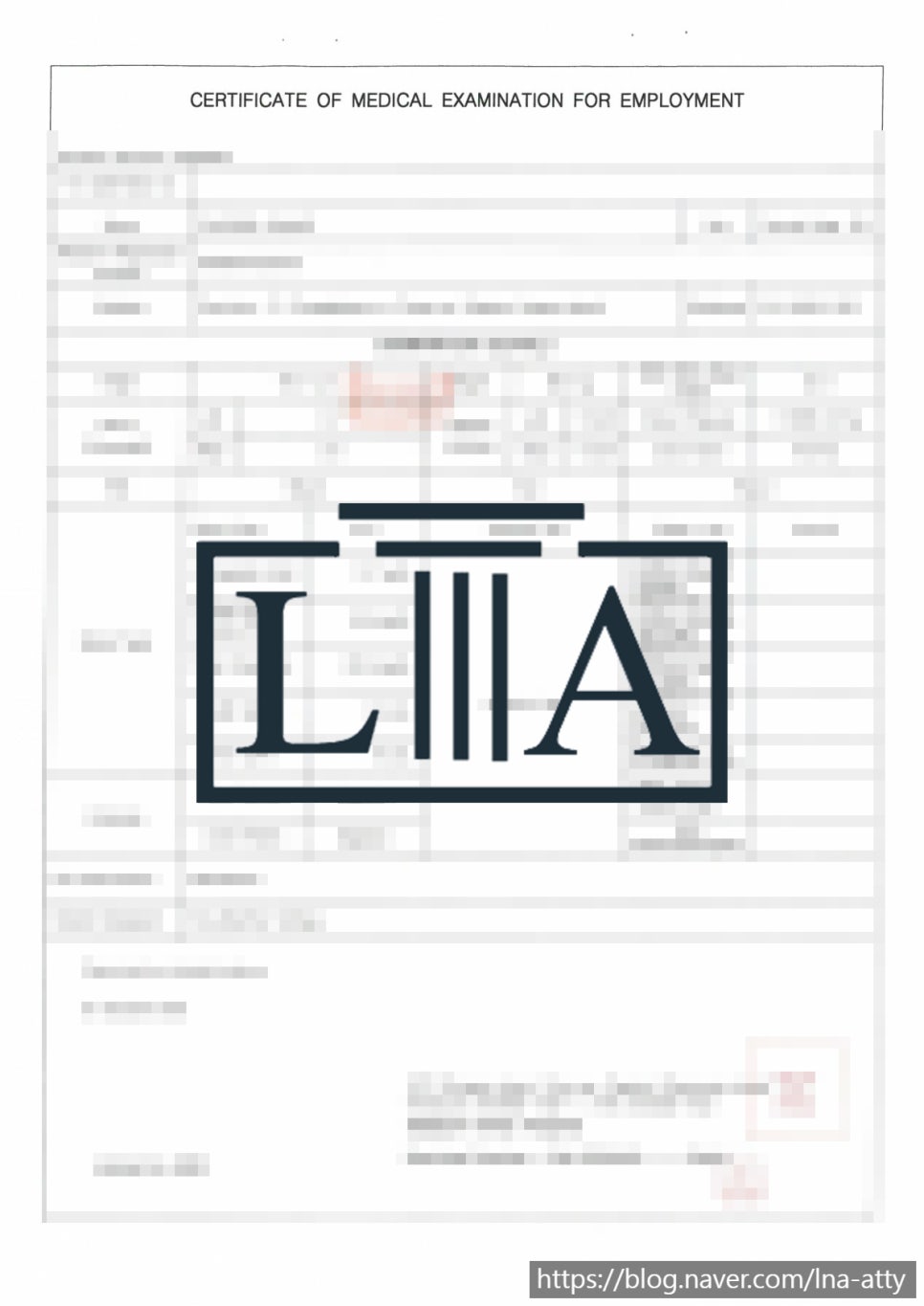
A Korean university student selected for a school-run internship program in Vietnam needed a 채용신체검사서 (employment physical examination report) translated and notarized for their visa application.
Three Korean health documents that get confused for one another
Visa guidance abroad often just says something like "Submit a recent Medical Examination Report / Health Certificate" — vague wording that leaves applicants unsure which Korean document to actually get. In Korea's medical system, these three documents have different purposes, legal bases, and required exam items:
| Purpose | Legal basis | Typical content | |
|---|---|---|---|
| 건강검진결과서 | General health status check (NHIS periodic checkup) | National Health Insurance Act Art. 52 & Enforcement Decree Art. 27 | Basic tests, cancer screening |
| 건강진단서 | Individual health status proof (visa, study abroad) | Medical Service Act Enforcement Rule Art. 9 | Physician examination and clinical opinion |
| 채용신체검사서 | Employment or visa-related health screening | Public Official Employment Physical Exam Regulation + each employer/institution's own requirement | Institution-specific exam items, issued at each receiving party's discretion |
Since the exact receiving institution's requirement is what actually matters, always confirm it before visiting the hospital, and clearly tell the hospital the specific purpose (e.g. "for a Vietnam employment visa application") so the exam items match what's required — getting the wrong document, even with a similar name, risks rejection or a costly, time-consuming re-issuance.
Translation notarization done right — and why "anyone qualified to translate" isn't enough here
For this case, the client provided two original 채용신체검사서 documents (including a friend's), and this office completed the English translation together with 번역공증촉탁 (commissioned translation notarization). Vietnam visa documents typically also require Consular Legalization at the Vietnamese Embassy in Korea — this client's documents still had ample validity remaining and more preparation time ahead, so notarization alone was completed for now, with consular legalization to follow later.
Under the Ministry of Justice's Notarization Office Guidelines, seven categories of people are recognized as having translation competence for commissioned translation notarization:
- 외국어번역행정사
- Someone who passed a qualifying exam administered by the Korea Translators Association, the International Interpretation & Translation Association, or Hankuk University of Foreign Studies 3–5. Someone holding a relevant foreign-language degree
- Someone scoring above a set threshold on the writing section of an English proficiency test like TOEFL
- Someone otherwise recognized as having comparable foreign-language competence
Does having any of these qualifications mean anyone on the list can notarize a translation for an administrative-agency-related document? No. For documents connected to administrative agency business specifically, the law draws a clear line:
- 행정사법 제2조 제1항 제3호 — a 행정사 may perform "translation of documents related to administrative agency business"
- 행정사법 시행령 제2조 제1항 제3호 — specifically defines this as "translating various documents submitted to administrative agencies"
- 행정사법 제3조 제1항 — anyone who isn't a 행정사 may not carry out the business defined under Article 2 as an occupation, except where another law specifically permits it
In other words, translation of documents that pass through or are submitted to an administrative agency falls within the exclusive occupational domain of a 행정사. Apostille certification and consular legalization are themselves administrative acts — official-body confirmations that convert a document into a form acceptable for submission abroad. That makes visa and administrative-purpose translation notarization — intended for submission abroad, routed through a domestic administrative body like an overseas mission or Korea's Ministry of Foreign Affairs — squarely the kind of "translation related to administrative agency business" 행정사법 제2조 제1항 제3호 governs. A category 2–7 qualification alone doesn't authorize someone to perform this specific class of work as an occupation; only a licensed 외국어번역행정사 can.

Converting KRW to USD for a US university scholarship application
A parent's 근로소득 원천징수영수증 (earned income withholding tax receipt) — the core document proving a parent's income — needed English translation for a child's U.S. university scholarship application. The receiving institution specifically requested the Korean-won amounts be converted and displayed in U.S. dollars.
Currency conversion breaks notarization — but not 번역확인증명서
Converting an original document's currency amount using an applied exchange rate is, technically, a numeric alteration — it doesn't satisfy notarization's core requirement of complete identity with the original. As a rule, a notary office cannot notarize a translation that converts currency this way.
A 외국어번역행정사, by contrast, is authorized under 행정사법 to certify translations of documents related to administrative agency business and to confirm facts connected to that work — including the specific exchange rate applied and the calculation method used. That makes a 외국어번역행정사's 번역확인증명서 the only legally valid certification route for a currency-converted translation of this kind.
What to specify before requesting a currency conversion
For maximum credibility, confirm and specify the following before the translation begins:
- Check the receiving institution's requirement — does the specific receiving office (e.g. a U.S. university's financial aid office) require a particular exchange-rate standard or source?
- Default, if unspecified: this office applies the prior year's IRS (U.S. Internal Revenue Service) annual average exchange rate, rounding to the nearest whole dollar from the cents figure.
- The same process applies for conversion into other currencies (EUR, JPY, GBP, etc.) depending on the receiving country, using the same standard and procedure.
What this looked like in practice
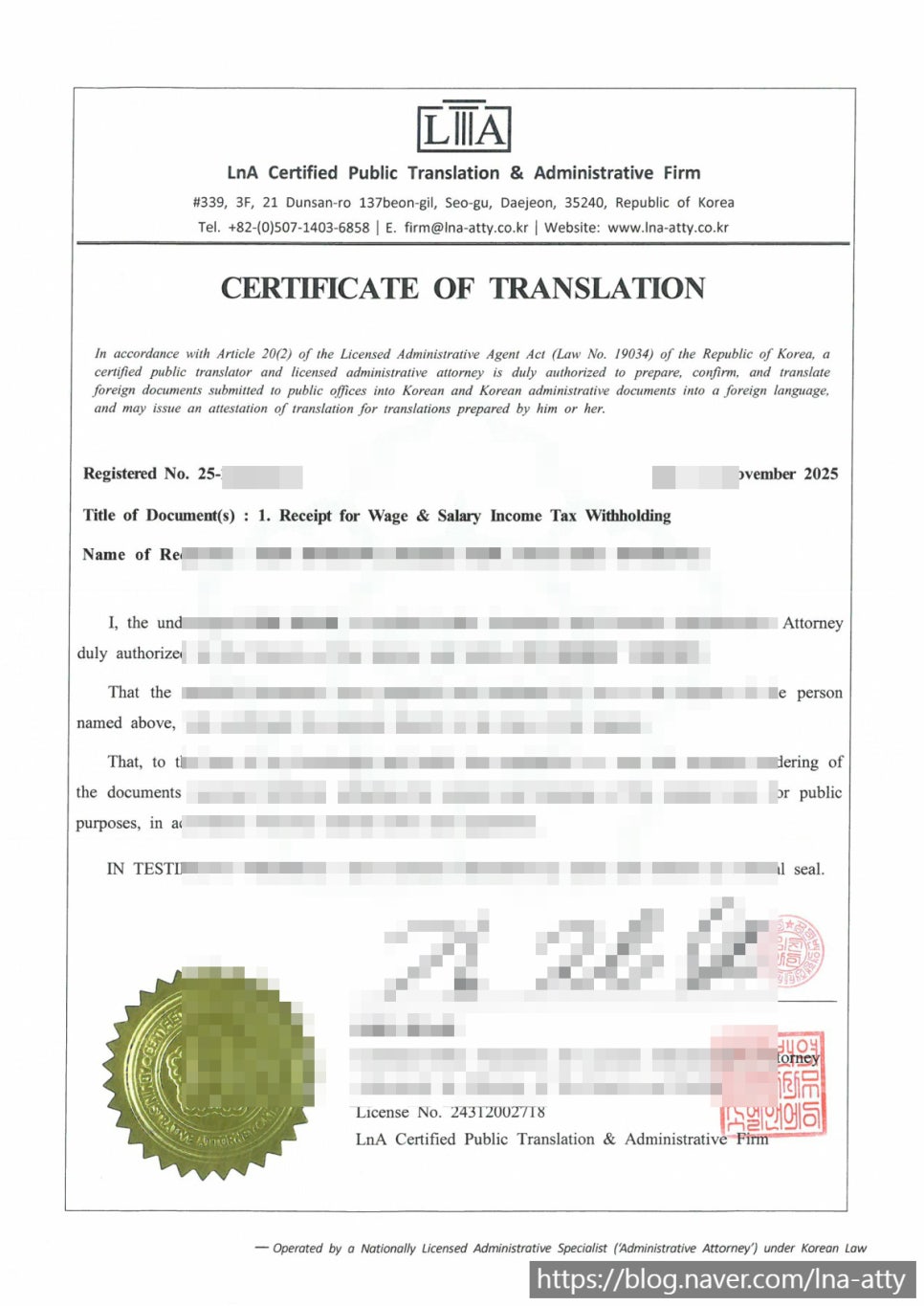
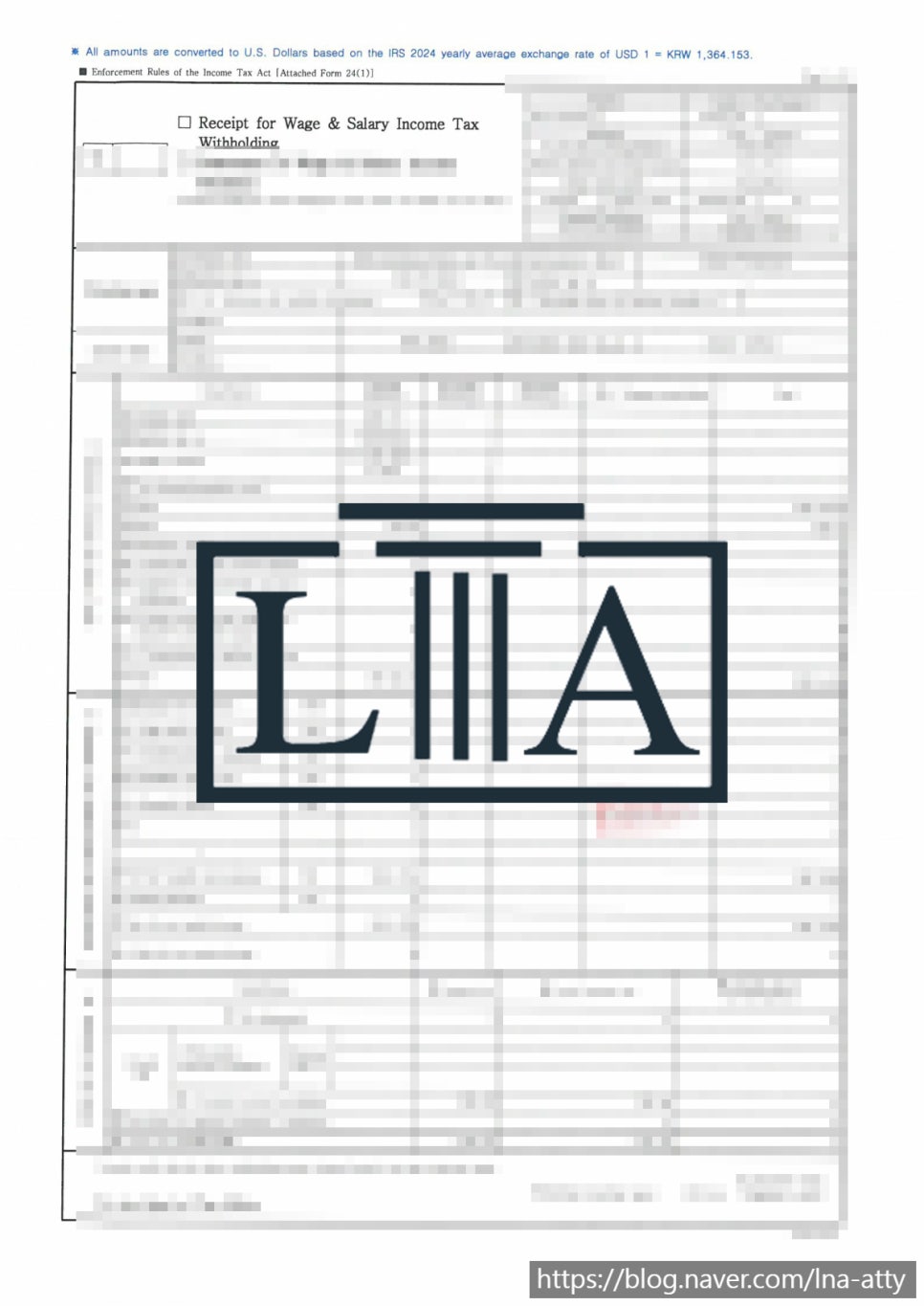
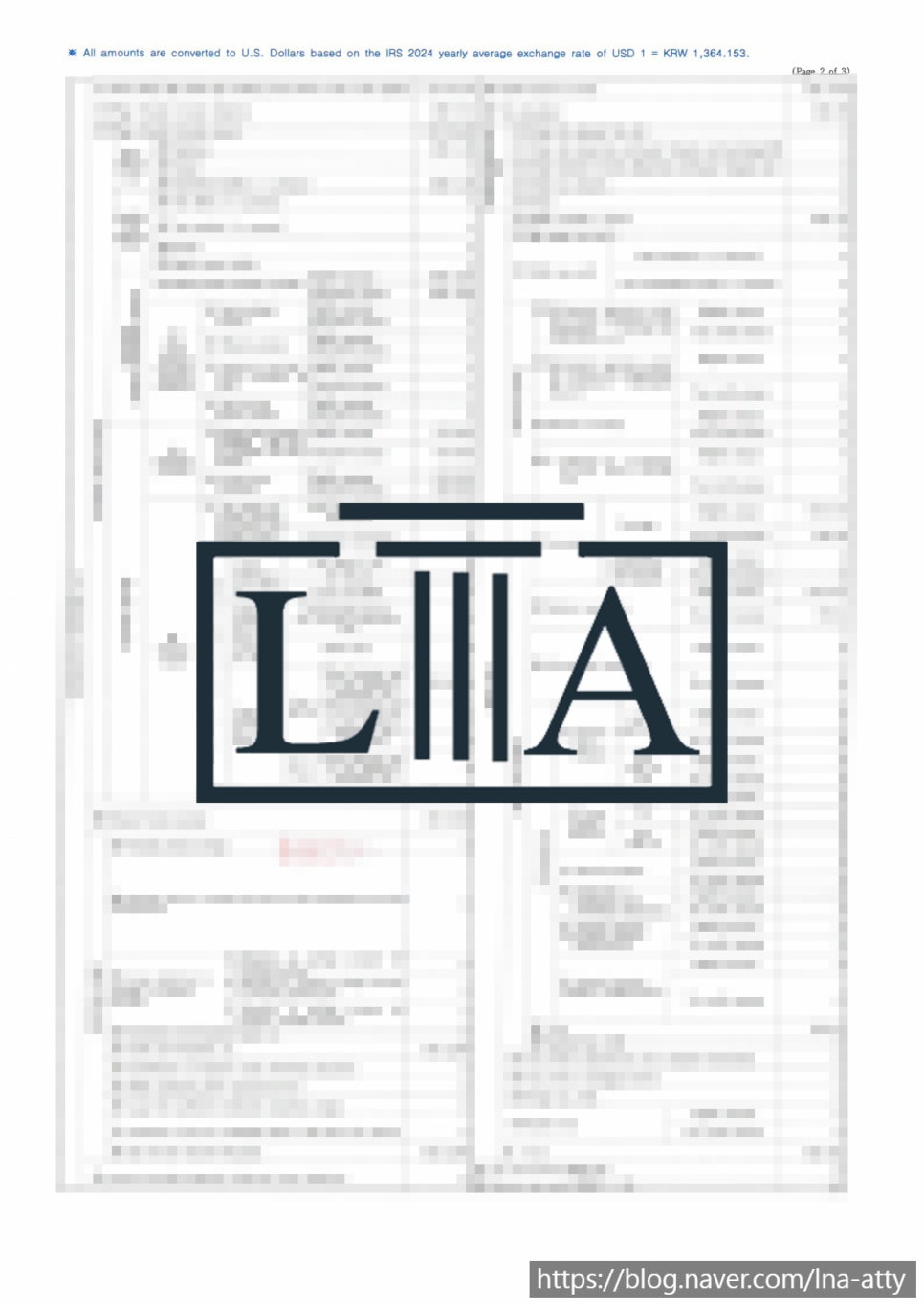
Per the client's request, every KRW amount was converted using the IRS 2024 annual average rate (USD 1 = KRW 1,364.153), rounded from cents to the nearest whole dollar. Every converted figure was carefully checked against the original for a one-to-one accuracy match before the client's final confirmation and the 번역확인증명서's issuance. Each translated page also carried a footnote stating the exact conversion basis, for consistency and easy verification by the receiving office:
"All amounts are converted to U.S. Dollars based on the IRS 2024 yearly average exchange rate of USD 1 = KRW 1,364.153."
New Zealand relaxed its certification rule — but tightened who can translate
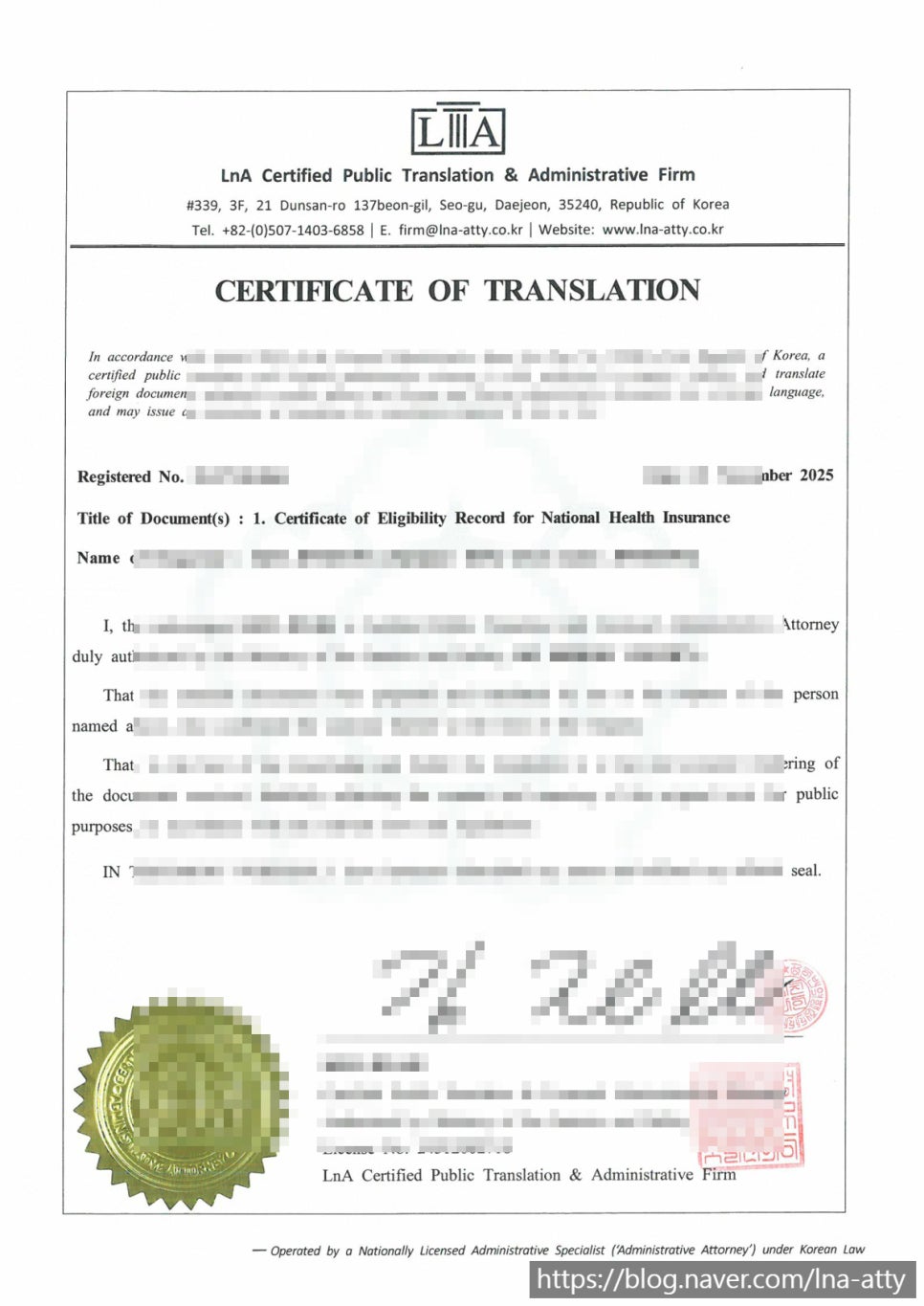
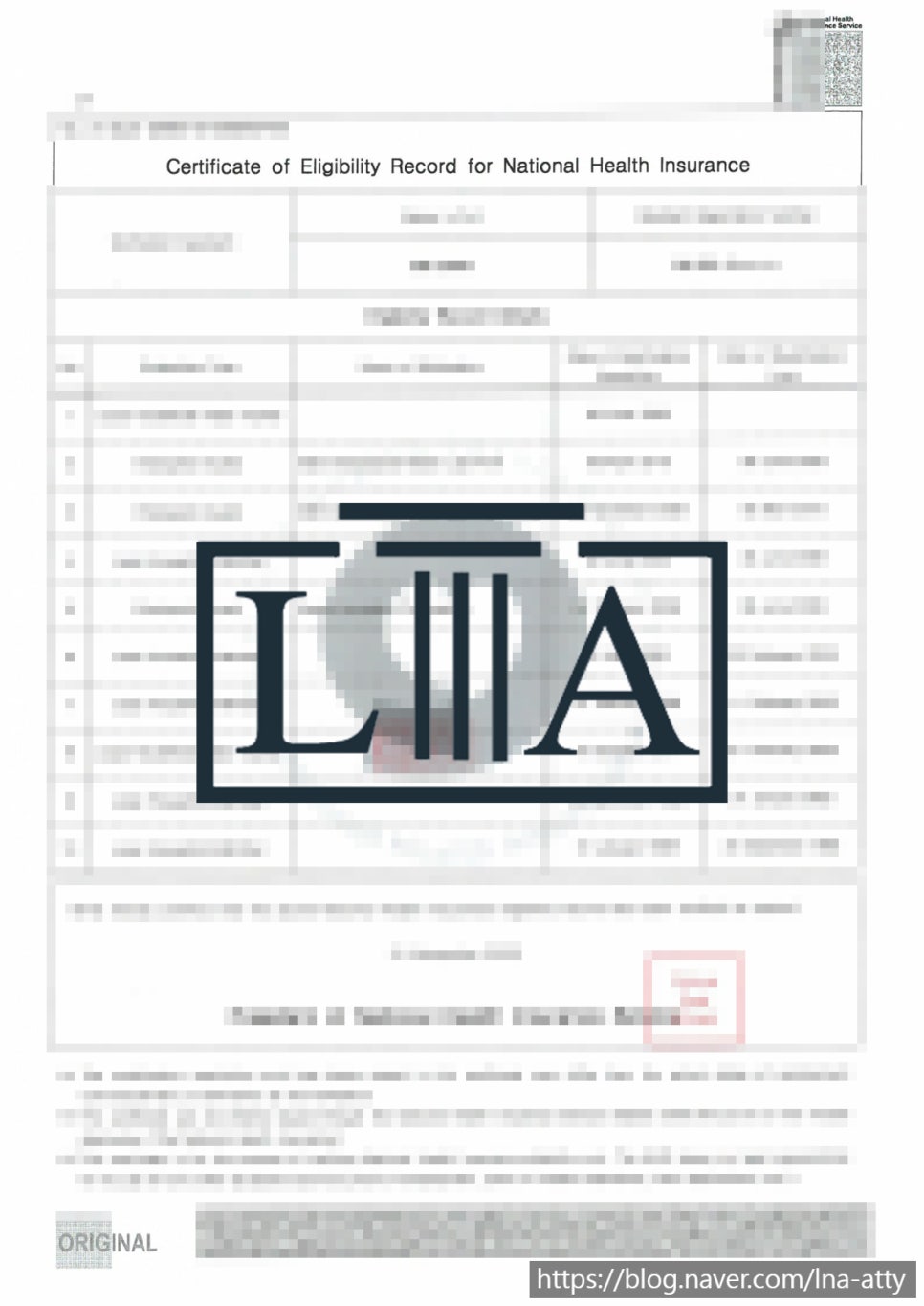
For a New Zealand visa application, a client needed a 건강보험자격득실확인서 (health insurance eligibility confirmation) and a 기본증명서 translated. Neither document is officially mandatory — but for applicants without straightforward income proof, particularly regional (self-employed-category) NHIS subscribers, the health insurance payment history and household composition it shows can serve as supplementary evidence of financial capacity.
What actually changed on May 7, 2025
New Zealand's Immigration department announced, effective May 7, 2025, that visitor visa supporting documents no longer need a "certified" translation — a genuine relaxation of the certification requirement for that visa category specifically.
The part many people misread: relaxing the certification requirement did not relax who's allowed to translate. New Zealand Immigration's own detailed guidance page is explicit that even for documents that don't need formal certification:
- Every non-English document submitted with any visa application needs an English translation
- The following people cannot perform the translation: the applicant themselves, the applicant's family members, or an immigration adviser assisting with the application
- The translation itself must state: who translated it (name, address, phone number) and that translator's qualification or experience
Put together, this means genuinely professional, official translation is still what actually clears a smooth review — for a Resident visa, formal certification remains mandatory outright; even for a Visitor visa, the requirement that translation come from a qualified, experienced third party (not the applicant, family, or adviser) still applies in full.
How this office fits the requirement
A 외국어번역행정사 is a nationally recognized qualification under Korea's Ministry of the Interior and Safety, registered as a full member of the Korea Administrative Agents Association — squarely satisfying New Zealand's "credible third-party official translator" requirement (not the applicant, not family, not an immigration adviser), with a 번역확인증명서 issued under 행정사법 maximizing the document's credibility on top of translation accuracy.
A third variant on 기본증명서's English name
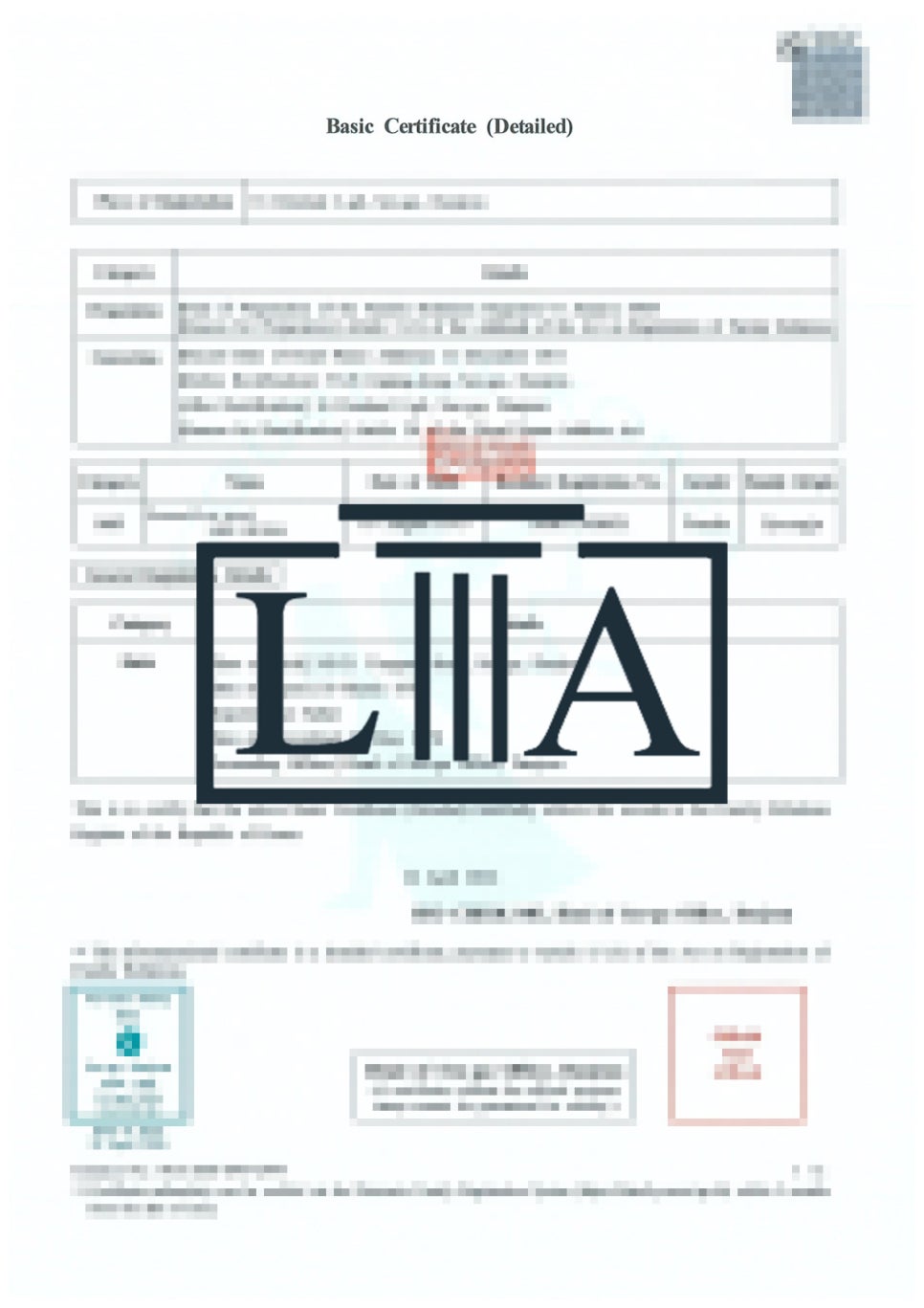
기본증명서 is commonly rendered as "Basic Certificate" or "Identification Certificate" depending on context. Reviewing this specific receiving institution's own official usage, this office found that New Zealand Immigration refers to Korea's 기본증명서 as "Certificate of Identification" — a third distinct variant from the ones already covered above (the U.S. State Department's "Basic Certificate," Korea's own standard glossary's "Identification Certificate"). This office matched that exact term, since checking and matching the specific receiving institution's own established usage — every time, not by default assumption — is what actually prevents unnecessary confusion or delay during document review.
A Vietnamese spouse's F-6-1 marriage visa — translating the Korean spouse's asset documents
A Vietnamese national married a Korean citizen and completed marriage registration in Korea, then began preparing an F-6-1 marriage-immigration visa application. This case's request: certified English translation and notarization of the Korean spouse's vehicle registration (자동차등록원부) and real estate registry certificate (부동산 등기사항전부증명서), for use alongside the marriage registration process in Vietnam.
Why completing marriage registration in Korea doesn't itself grant a residency qualification
A foreign spouse marrying a Korean citizen legally establishes the marital relationship, but that alone doesn't grant a qualification to reside in Korea — marriage registration is a family-relations procedure, while Korean residency is a separate administrative matter governed by visa/status-of-stay rules. Especially when a foreign national married while in Korea on a short-term status (e.g. tourist), the practical, common route is for the foreign spouse to return home and apply for the F-6-1 there.
What an F-6-1 marriage-immigration visa is
It's the visa a foreign national residing abroad applies for to enter and reside in Korea based on marriage to a Korean citizen. In many cases, this means the foreign spouse returns to their home country, prepares the visa application there, and simultaneously handles home-country family-registration and administrative procedures in parallel.
What was translated, and why
This case's translated documents — the Korean spouse's vehicle registration and real estate registry certificate — aren't strictly required documents for an F-6-1 application itself; they function as supplementary proof of the Korean spouse's financial capacity/asset status. The Korean Embassy in Vietnam is Korea's own overseas diplomatic mission, so Korean-issued official documents in their original form can generally be used there directly. In this case, though, the spouse was simultaneously handling Vietnam's own local marriage-registration procedure alongside visa preparation, and the translated asset documents were understood to be intended for broader future use in Vietnam — banking, real estate transactions, and various civil administrative matters — not just the visa file itself.
Translation approach for a non-English-speaking destination
Since Vietnam isn't an English-speaking country, this office translated with an eye toward the documents also being usable as a basis for eventual local (Vietnamese-language) processing down the line — each document's distinct character (vehicle registration vs. real estate registry) precisely matched in the translation, then notarized.
The underlying principle
Setting the translation standard around the submission's actual purpose and the administrative structure it fits into — not just the visa office's minimum checklist — produces a translation that's genuinely usable across the real administrative procedures a client will encounter.
An age discrepancy between two Korean diagnosis certificates, for a US medical leave of absence
A student enrolled at a US university needed a medical leave of absence, which required translating diagnosis certificates (진단서) from two different Korean medical institutions. US universities reviewing a medical-reason leave request often expect objective supporting documentation, making it essential that what a Korean medical institution issued comes across accurately and credibly.
What a US medical leave of absence typically requires
Requirements vary by school and reason, but a US university's medical leave application typically asks for a leave-of-absence application (school's own form), a document confirming the student's identity (passport copy, student ID, etc.), and, if needed, an attending physician's opinion or supplementary explanation. Any document not already in English generally needs a qualified translator's certified translation — the specific receiving institution's requirement should be confirmed in advance.
The discrepancy this office caught during translation
This case involved diagnosis certificates from two different institutions. During careful translation review, this office noticed something: Hospital A's certificate listed the patient's age one way, while Hospital B's (a 한의원, traditional Korean medicine clinic) certificate listed it differently — an apparent age mismatch between the two documents. Both certificates included the patient's name and resident registration number, so confirming they referred to the same person wasn't actually in doubt. But from a foreign university administrator's perspective, an unexplained "age mismatch" could raise unnecessary questions and prompt a request for clarification or additional documents.
How this office resolved it without altering either original
The certificate already using International Age (만 나이) was translated as-is. For the certificate using Korean age (세는 나이, the traditional counting convention), this office added an explanatory note directly after the age figure: "Korea has officially used International Age as the standard for administrative and civil purposes since June 28, 2023. In practice, however, some medical institutions and traditional Korean medicine clinics still record or mix in the traditional counting-age convention based on legacy systems or established habit." This let the translation stay strictly faithful to each original — no alteration, no reinterpretation — while giving the foreign receiving institution the context needed to understand the discrepancy on sight, rather than guess at it.
The underlying principle
A translator's job isn't just moving words from one language to another — it's anticipating the kinds of confusion a document could trigger after submission and addressing them proactively. This case was also time-sensitive, given the client's own submission deadline, so this office completed the translation urgently, had the client do a final review, and issued the certified translation certificate — sending the scanned copy immediately given the time difference and deadline, with the physical original following by next-day courier.
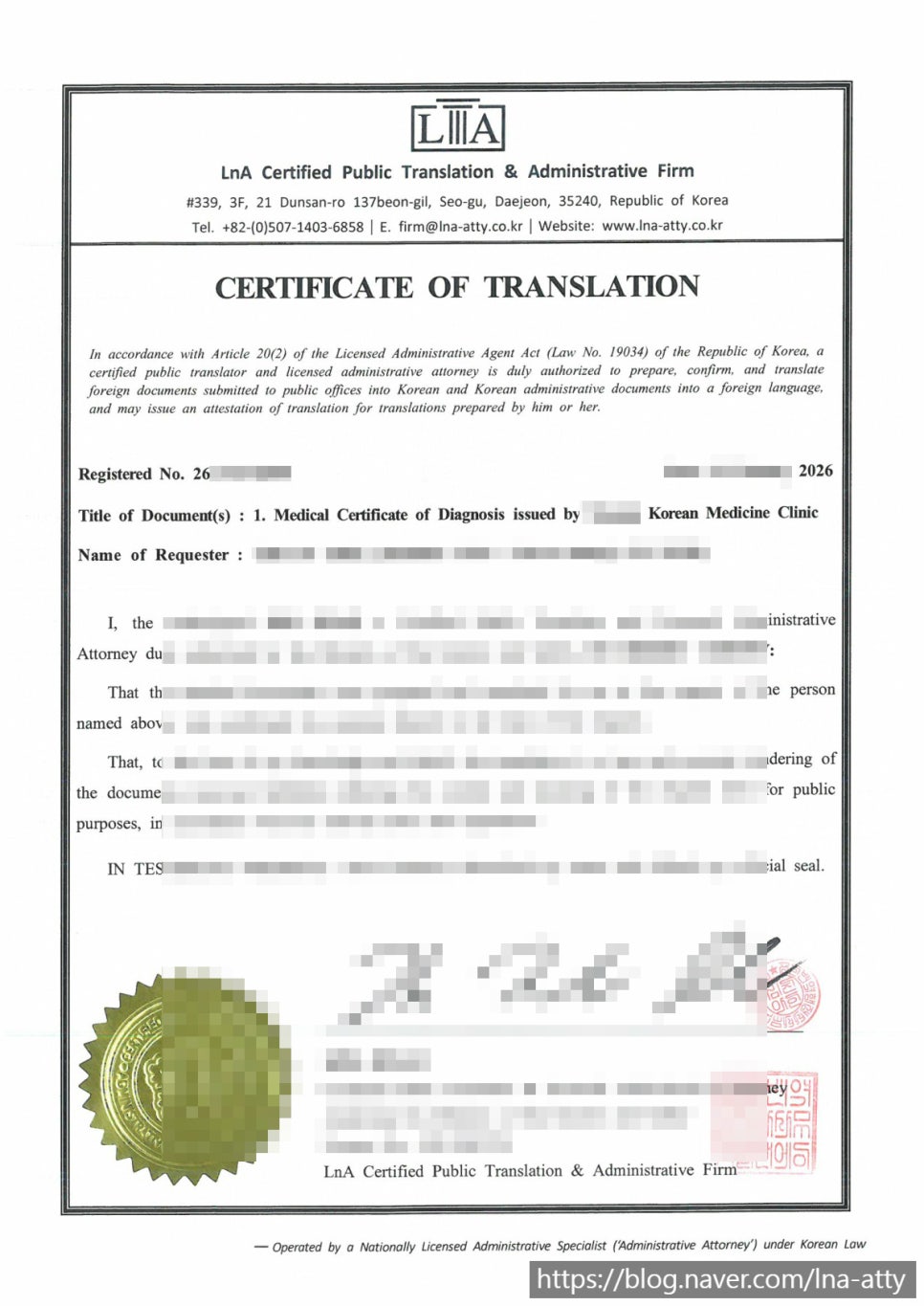
A Canadian citizen's Korean hospital bill, translated for an OHIP reimbursement claim
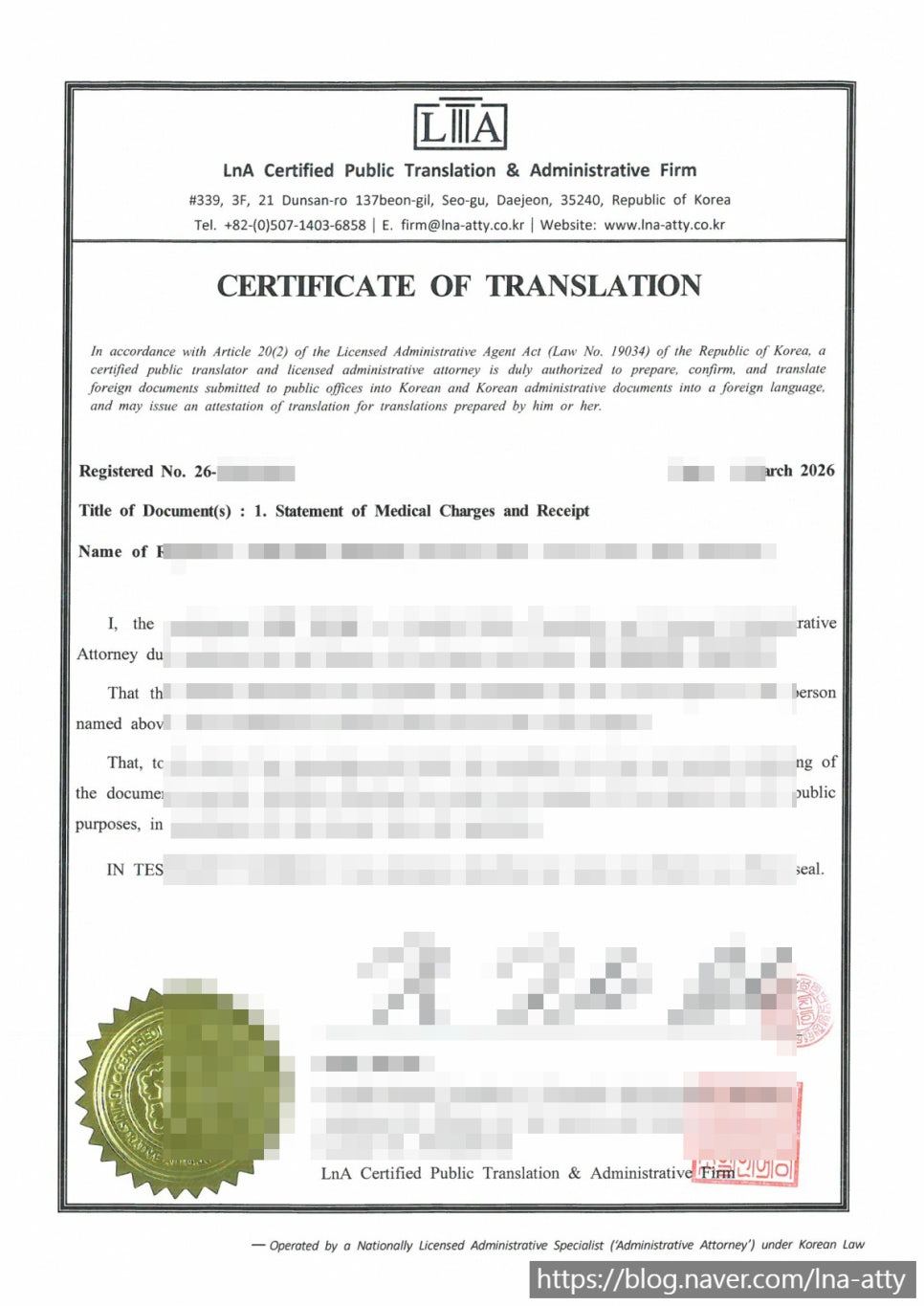
A Canadian citizen visiting Korea underwent knee surgery at a Korean hospital. After returning home, they needed the medical bill/receipt, physician's report, and diagnosis certificate translated to file a reimbursement claim with Ontario's public health plan, OHIP.
When treatment received abroad can qualify for reimbursement
Canada's public health insurance is built primarily around care received inside Canada, but a partial reimbursement can still be claimed for medical treatment received abroad — particularly when a Canadian resident, while outside Canada, needed treatment whose necessity and cost are comparable to what the same treatment would cost inside Canada. The insurer reviews the treatment's medical necessity and the procedure actually performed — which is exactly why the submitted translation needs to reflect Ontario's own administrative/insurance terminology precisely, not just generic English.
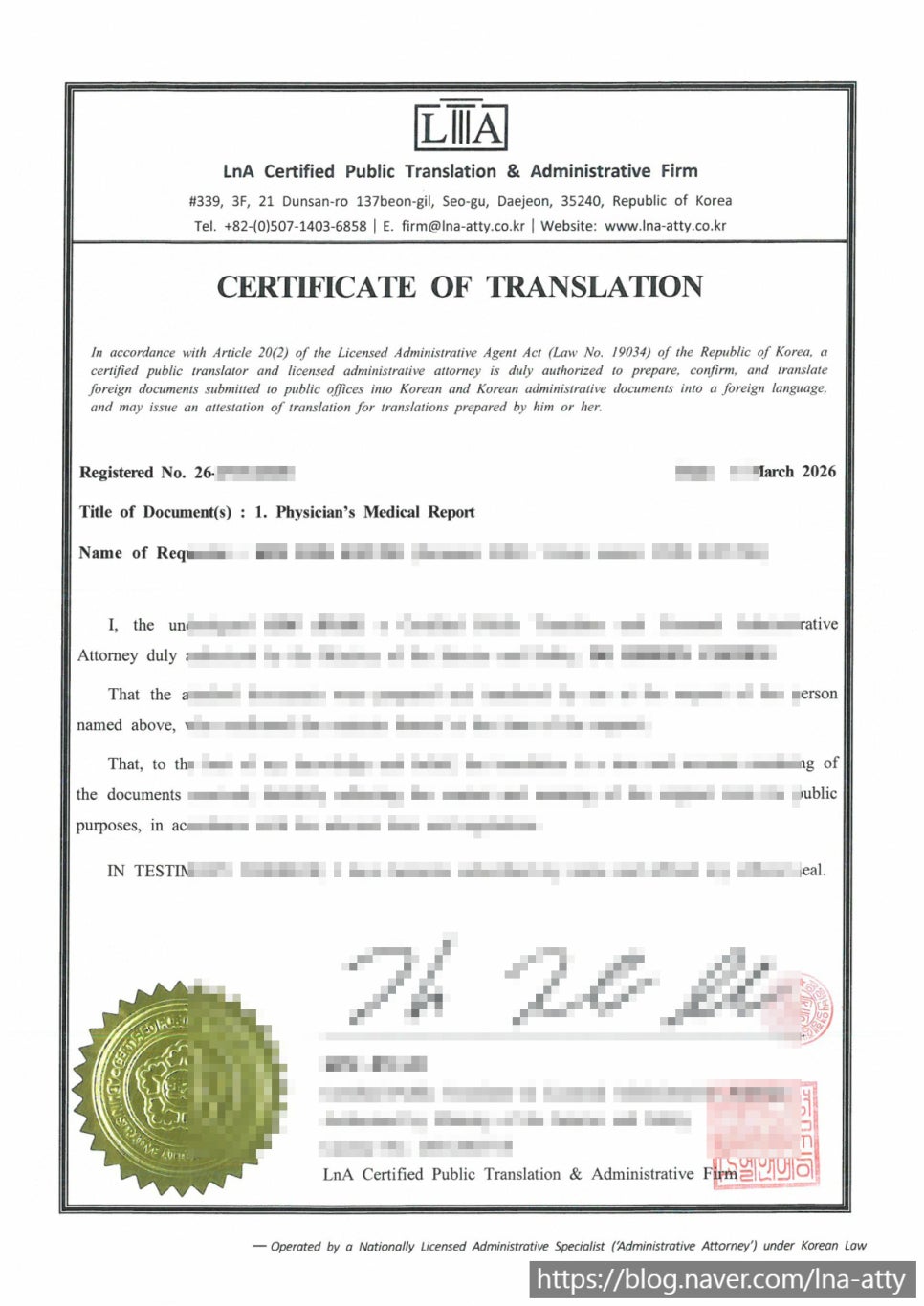
Term choice: "Physician's Medical Report," not "Doctor's Medical Opinion" or "Doctor's Note"
For 소견서 (a Korean hospital's doctor's note/medical opinion document), this office weighed three options: "Doctor's Medical Opinion," "Doctor's Note," and "Physician's Medical Report." "Doctor's Medical Opinion" leans too heavily toward a subjective "opinion," and "Doctor's Note," while common in everyday English, reads as too informal for a submission to a government insurance authority. "Physician's Medical Report" most clearly reflects the document's actual function — the attending physician's own written record of the patient's condition, diagnosis, and treatment plan — so this office adopted that term.
Term choice: "Lavage," not "Irrigation," for 세척술
The surgery itself was named 관절경하 활막절제술 및 세척술 (arthroscopic synovectomy and 세척술). This office researched in depth how to render 세척술 specifically. "Irrigation" refers to washing a surgical site or wound with fluid, while "Lavage" specifically refers to washing out a body cavity or joint space. The client explained that inflammation markers in the knee joint were very high at the time of the visit, prompting the procedure — and the medical opinion itself documented that context. Reviewing relevant orthopedic literature confirmed that joint lavage is the term commonly paired with synovectomy in inflammatory joint-treatment procedures. This office accordingly translated the surgery name using "Lavage." Medical document translation requires weighing not just a word's dictionary meaning, but the specific clinical context it's describing.
Term choice: "Long-Term Care Hospital (as defined under Korean law)," not "Nursing Hospital"
A 요양병원 (a common institution type appearing in Korean medical documents) is one of the trickiest terms to translate correctly. A quick dictionary lookup often surfaces "nursing hospital" as the top suggestion. But in English-speaking countries, facilities using "Nursing" in the name are generally understood as long-term care facilities without full on-site physicians — a materially different institution from Korea's 요양병원, which has resident physicians, provides inpatient treatment, and operates under Korea's national health insurance fee schedule — a legitimate hospital-level medical institution (병원급 의료기관) under Korean law. To avoid confusing the OHIP reviewer, this office used "Long-Term Care Hospital (as defined under Korean law)" — explicitly anchoring the term to its Korean legal status so a Canadian insurance reviewer could understand it without misreading it as a lesser-tier care facility.
The underlying principle
Korean hospital billing statements and receipts have notoriously complex line-item structures, making them one of the more difficult documents to render accurately in English. Thanks to the client allowing sufficient turnaround time, this office was able to cross-check every term and spelling against the Ontario Health Insurance Plan's own working terminology before completing the certified translation.
A second OHIP case: an emergency visit, and why not every document needs translation
A Canadian permanent resident had an unexpected accident while in Korea and visited a hospital, then reached out about which documents actually needed translation for an OHIP reimbursement claim.
What Ontario's Ministry of Health actually reviews
Ontario's Ministry of Health reviews foreign medical-cost reimbursement around three core questions, not simply whether an accident occurred: was the situation sudden and unforeseeable, requiring immediate treatment; was the treatment itself an urgent, time-sensitive necessity; and was the cost itemized and clearly broken down by category. Translating every document that exists isn't automatically the right call for a foreign medical-cost reimbursement claim — this office analyzed the client's specific situation and proposed the optimal document set weighing both the receiving institution's own checklist and cost-efficiency for the client.
A document-by-document breakdown
| Document | Handling | Reasoning |
|---|---|---|
| English diagnosis certificate | Submit as-is | Already an official hospital-sealed document — no translation needed |
| Physician's report, initial emergency record | Translate + certify | The core evidence proving OHIP's two central questions: urgency and medical necessity |
| Itemized medical bill/receipt | Translate + certify | Required — shows the itemized cost breakdown and admission/discharge dates |
| Admission/discharge confirmation | Excluded (optional) | The receipt already clearly shows the admission/discharge dates, so this office recommended skipping it to reduce the client's cost |
Why not translating everything is actually the strategic choice
OHIP's foreign medical-cost reimbursement isn't a full-reimbursement structure based on actual cost incurred — the amount is calculated in a fairly limited way, based on Ontario's own fee schedule. That means preparing translation strategically so that translation costs don't exceed the actual reimbursement itself is genuinely important.
An unexpected snag: the pre-issued English certificate had gaps
The diagnosis certificate the client received had already been issued in English — but it didn't include the patient's resident registration number, and the hospital couldn't reissue it under the correct English name spelling due to an internal system limitation. This office focused on establishing consistency across the document set instead. While the diagnosis certificate lacked a resident registration number, it did carry a Patient No. — cross-referencing that same patient number against the physician's report and the medical receipt let this office reasonably confirm all three documents referred to the same individual. This office advised the client to attach a copy of their passport when submitting the reimbursement claim, along with a specific English explanatory statement bridging the name-identity connection across the document set.
The underlying principle
A foreign medical-cost reimbursement claim requires understanding what the receiving country's insurance system actually values, and the expertise to judge how to logically fill any gaps in the original documents. This office worked carefully to reduce the client's cost burden while still meeting the review's actual requirements.
Same document type, different destination — why the term choice changed
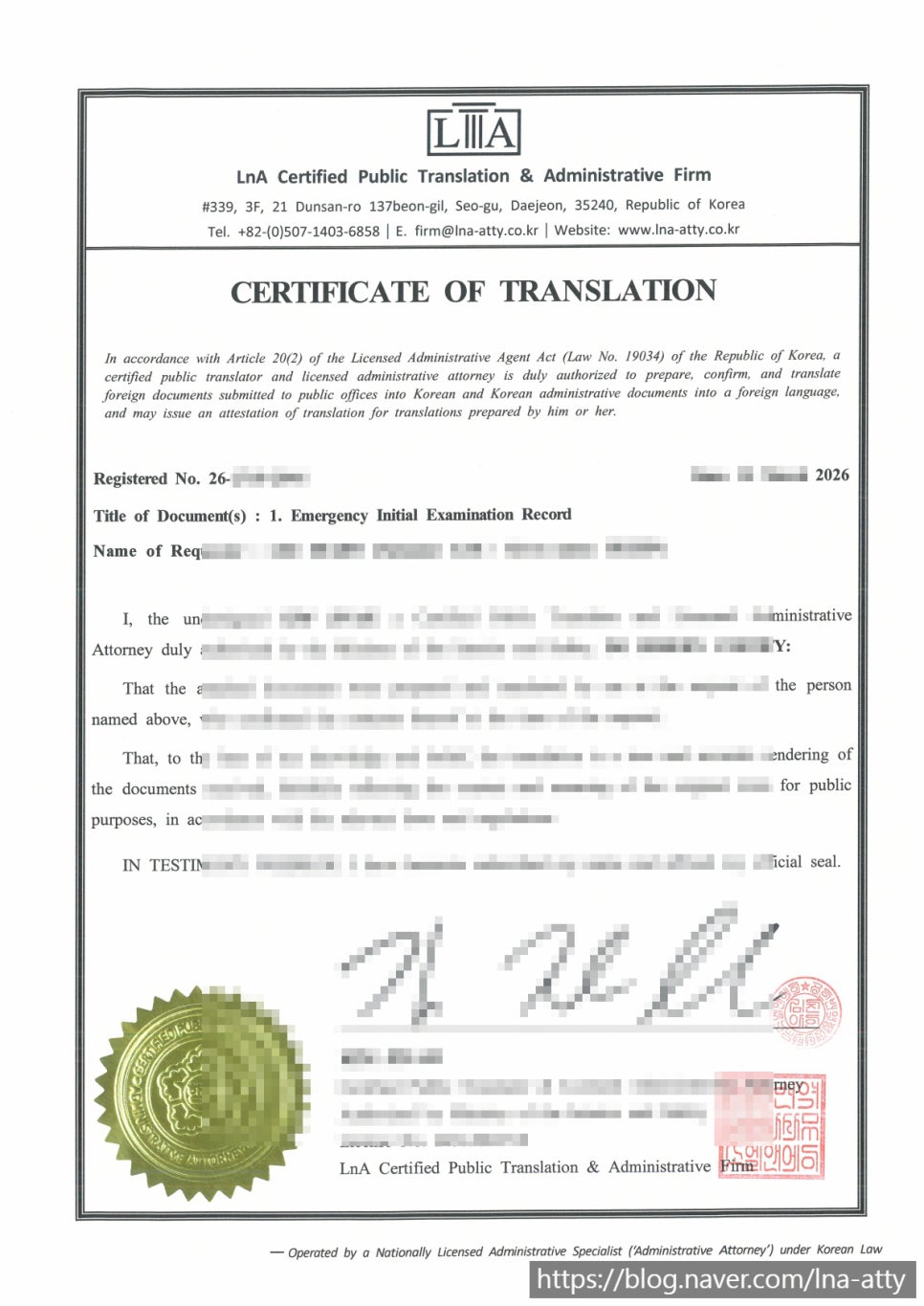
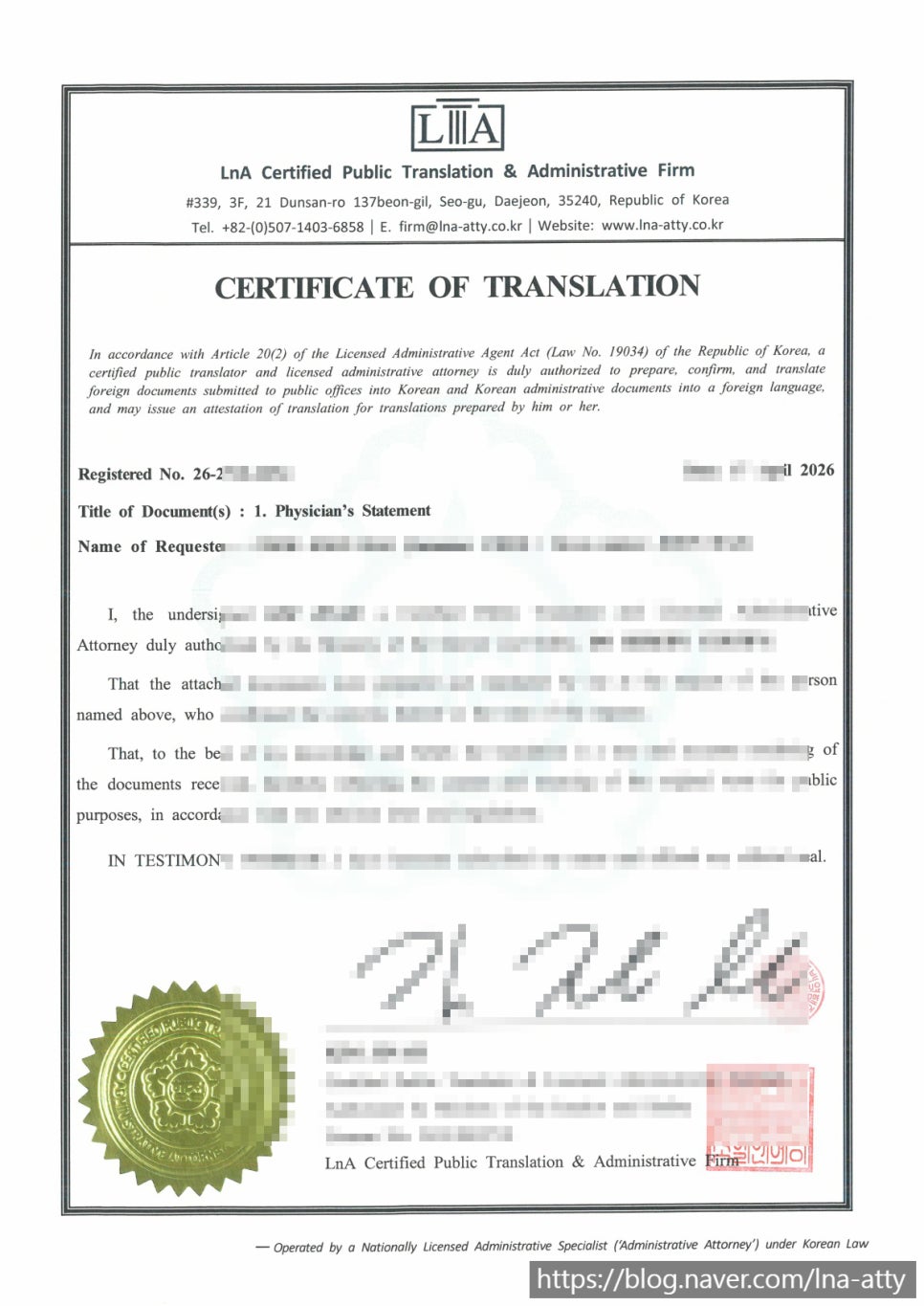
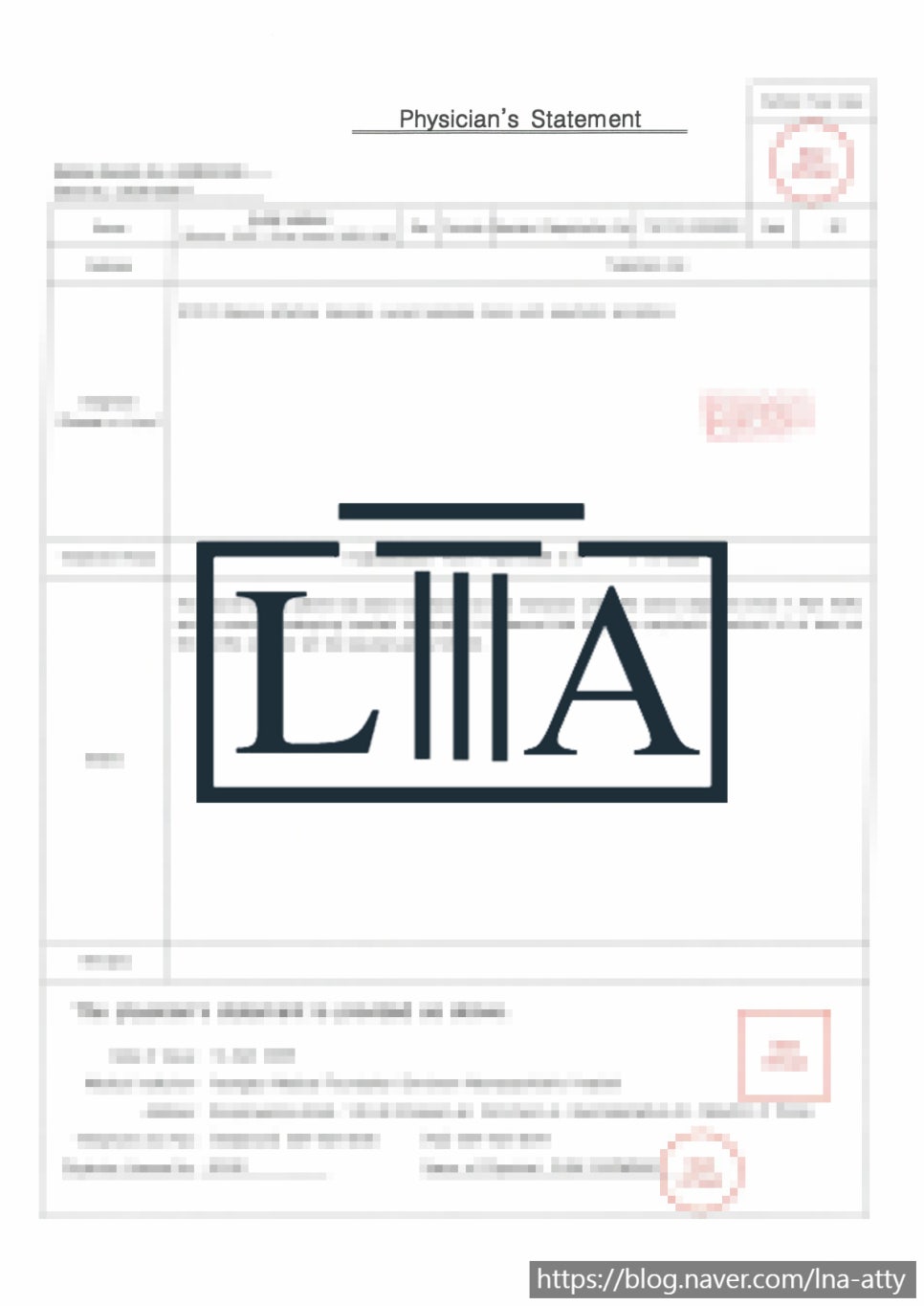
An overseas Korean who had acquired US citizenship was hospitalized long-term in Korea for a health issue, while also handling F-4 visa status paperwork. In the middle of it, their US-based spouse needed to obtain certain US documents (a Name Change certificate, a US criminal record certificate) on the patient's behalf — and needed to prove why the patient couldn't handle it personally. This office urgently translated and certified the Korean hospital's 소견서 (doctor's opinion) and 입퇴원확인서 (admission/discharge confirmation) for exactly that purpose.
When a spouse needs to act on someone's behalf in the US
This kind of proxy need tends to come up when: a name change occurred after acquiring US citizenship, a US criminal record certificate needs to be obtained, or the person themselves genuinely can't handle the US-side process directly. In these cases, US authorities often require additional identity verification or an explanation of the situation — and that's exactly where hospital documents become relevant.
Why a name change adds another layer of verification need
If a surname changed after acquiring US citizenship, both the US and Korean sides need documentation proving that connection. In an urgent situation like a hospitalization specifically, the hospital's own official documents (the doctor's opinion, the admission/discharge confirmation) function as the evidentiary basis for the family member acting on the patient's behalf — proving the patient's current condition and the reason they can't travel/appear in person, and confirming the hospitalization period as fact.
Term choice: "Statement," not "Physician's Medical Report," this time
This office tailors terminology to the specific destination country and purpose. A doctor's opinion translated for Canada's OHIP was rendered as "Physician's Medical Report" (see above). For this case, given the submission was to a US administrative agency, this office instead used "Statement." Even for the same underlying document type, the term that gets accepted most naturally and quickly by a US local government office was the priority — "Statement" conveys the character of "a doctor's official statement/opinion" in a way US administrative agencies recognize readily.
Why certification matters even more for a US-bound submission
Documents submitted to US authorities frequently require verification of both the translator's qualification and the translation's accuracy. This office's certified translation certificate (번역확인증명서) formally attests that the translation faithfully reflects the original.
The underlying principle
Even the "same" hospital document can require an entirely different translation approach depending on its destination and purpose. If a submission is rejected for lacking the right format, the resulting time difference with the US and international courier costs become real opportunity costs — which is exactly why working with a verified professional from the start matters.
A US spouse visa's witness statements — more than a translation job
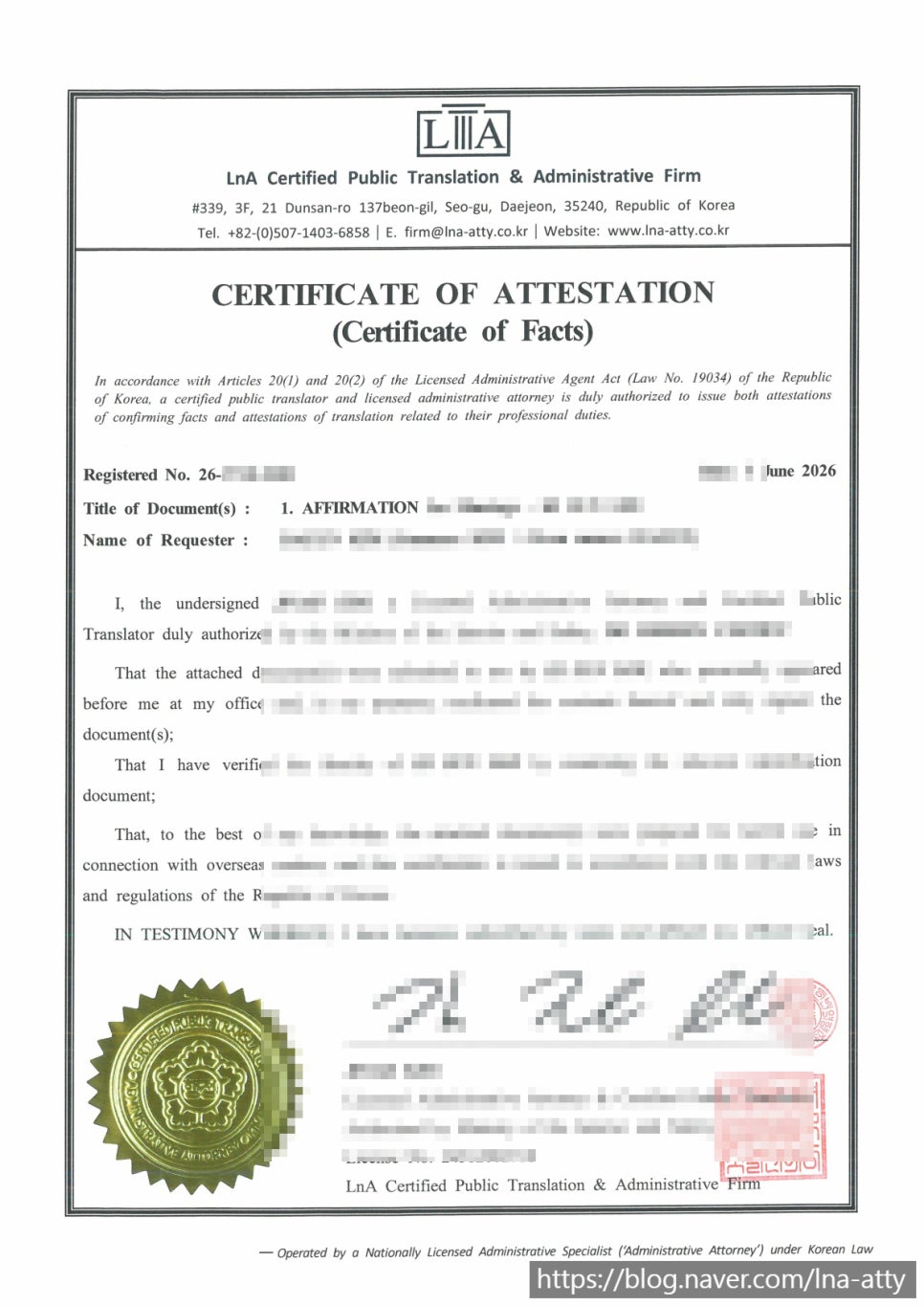
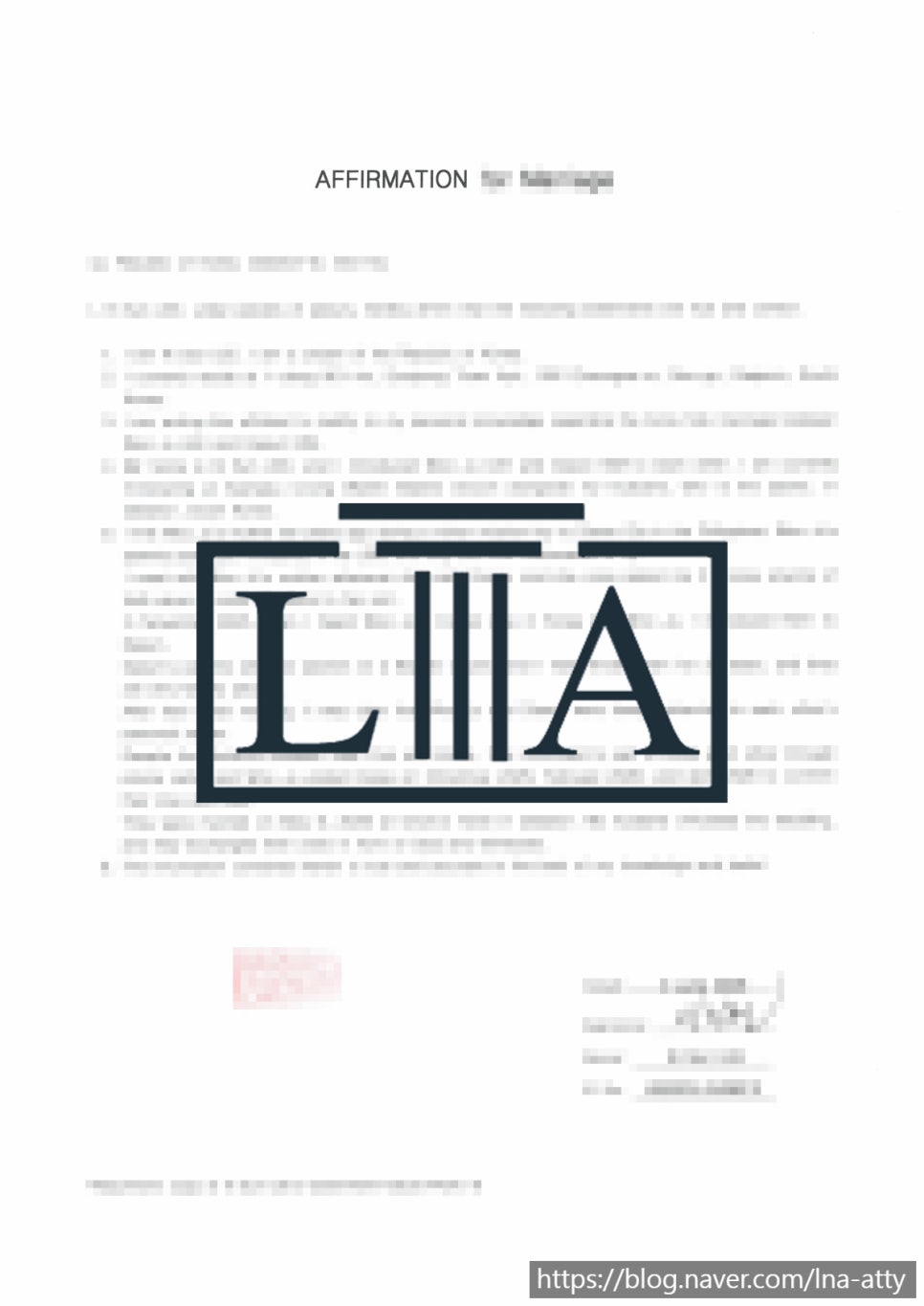
One of the most important review criteria for a US CR-1/IR-1 spouse visa is proving the marriage is bona fide (genuine). Beyond legal documents like a marriage or family relation certificate, a witness statement (Affirmation) from friends or acquaintances who personally observed the couple's relationship and marriage often plays a central supporting role. This case involved preparing wording for witness signatures, a Korean translation for the witnesses' own comprehension, identity verification, and a fact-verification certificate for English-language witness statements prepared for a US spouse visa submission.
What a witness statement is actually meant to prove
The client was preparing English witness statements from acquaintances for a US spouse visa application. The statement's purpose isn't simply describing the fact of marriage — it's a third party independently confirming that the couple is genuinely living as a married couple. This kind of witness statement is a commonly used supporting document in US visa filings, and the credibility and internal consistency of its content matters — a single ill-chosen phrase in a visa document can affect the review outcome, making thorough pre-submission review essential.
What this office actually reviewed and fixed
The bottom of the original English text included wording that didn't quite fit the purpose of a visa submission and fact-verification certificate — this office smoothed it out to match administrative and legal standards. Minor grammatical errors in the English original were corrected, and since the witnesses needed to genuinely understand and agree to exactly what they were signing, the Korean translation's phrasing and context were refined to be clear and precise. Reviewing not just the document's surface but its actual substantive completeness is an important part of building credibility for a document headed abroad.
What the fact-verification certificate documented
- That the declarant presented identification.
- That the declarant's identity was verified.
- That the declarant confirmed the content.
- That the declarant personally signed in front of the 외국어번역행정사.
- That the attached ID copy was compared and matched against the original presented.
In other words, this wasn't just a translation delivered on its own — it was paired with a record of the facts this office actually verified during the document's execution.
Why a witness statement for a US visa needs more than accurate English
A witness statement submitted with US visa documents needs several things considered together: whether the declarant actually understood the content, whether the sentences carry accurate meaning, whether the format fits the submission purpose, and whether identity can be verified. English witness statements specifically are often drafted using machine translation or copied from an online template — which can leave inaccurate meaning or wording mismatched to the submission's purpose. This office's role goes beyond plain translation — reviewing the document from an administrative-agency-submission perspective and organizing it into a form that actually fits the purpose.
How this office finalized it
Once the document was finalized, the declarants visited the office in person. This office first had them fully review the organized Korean translation; after confirming it precisely matched their intended statement, they indicated their agreement. They then signed the final English original document in front of this office. Their IDs were checked to confirm their identity, and the ID copies were compared against the originals presented. This office finally issued the certificate documenting these facts, completing the document package.

A talent-recruitment visa, not a standard work or study visa: Macau's Advance Professionals Programme
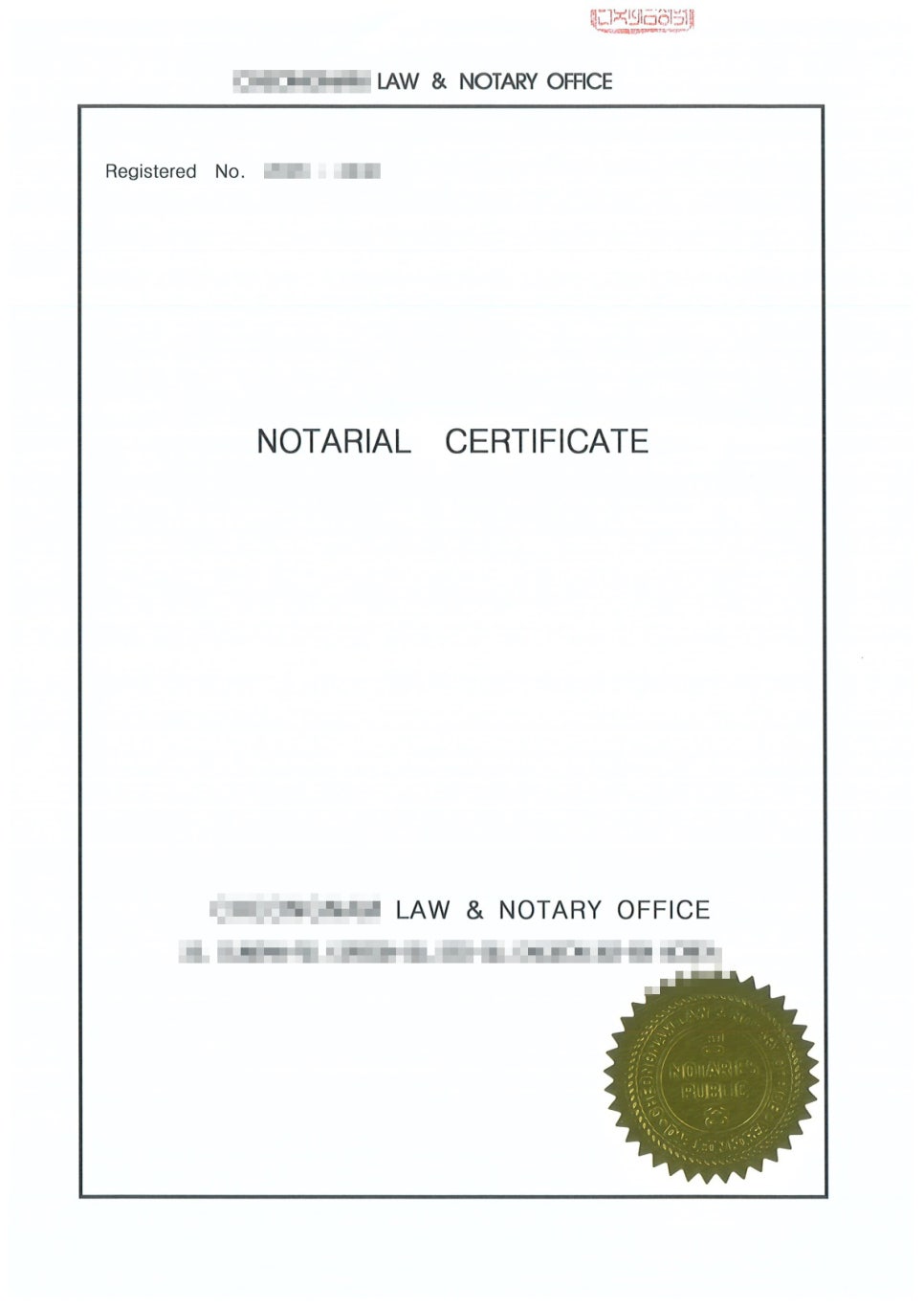
A client applying to Macau's Advance Professionals Programme — a special government talent-recruitment track for experienced professionals in culture, sports, digital media, translation, culinary arts, and other industries — needed a translated and translation-notarized 기본증명서 (Basic Certificate), the core Korean document establishing identity: date and place of birth, and any legal name-change history.
Why this case is worth knowing about even outside the usual visa categories
Macau is actively recruiting global talent for economic diversification, and programs like this one grant qualifying professionals the right to reside and work in Macau based on degree, career experience, and language ability — a real, if less commonly discussed, alternative track outside standard work/study visas. For Korean applicants, the 기본증명서 is the document establishing their fundamental identity for this kind of foreign government screening, alongside other commonly requested documents: 가족관계증명서, 혼인관계증명서, 주민등록등본, and 범죄경력회보서.
Why this document specifically called for translation notarization, not just certified translation
A 기본증명서 carries some of an applicant's most sensitive core personal information — date and place of birth, name-change history — reviewed by a demanding foreign government agency. Given what's at stake if the submission is rejected, this office strongly recommends against machine translation or an unverified translation vendor for a document like this, and instead completed the case as a translation notarization via notarial commission (번역공증촉탁) — the certification method matched to how rigorously this kind of identity document gets scrutinized.
The underlying principle
Exactly which Korean documents are needed, and which translation and certification format applies, varies by receiving country and institution — whether it's a Macau residence permit, a foreign visa, overseas employment, a pension refund, university admission, or any other foreign government submission. Confirming the specific requirement before starting is what keeps a document like a 기본증명서 from being rejected on a technicality.
Translator-Identified Translations Foreign Institutions Accept
Get in touch about thisFrequently Asked Questions
What documents does a work visa application typically need translated?
Common documents include employment/work reference letters, degree certificates and transcripts, police clearance certificates, and health examination reports — whichever of these aren't already in English.
Why does the translator's name and contact info need to appear on the translation?
Foreign immigration authorities like Australia's Department of Home Affairs require it so the translation is traceable to a real, accountable, qualified translator — not an anonymous or machine-generated one.
Is a 외국어번역행정사's translation accepted for foreign visa applications?
Yes — a 외국어번역행정사 is a licensed professional with a verifiable legal qualification, which is exactly what these requirements are designed to confirm. Some visa subclasses may additionally require notarization; this office confirms the specific requirement first.
Does the same English wording work for the US, UK, Canada, and Australia?
Not always — administrative and legal terminology differs in places between English-speaking countries. This office confirms the terminology actually used in the receiving country's administrative practice before translating, rather than defaulting to generic English.
Can word choice actually affect a visa application's outcome?
It can — phrasing that reads ambiguously or unfavorably to an immigration reviewer is worth avoiding even when technically accurate, since immigration officers read these documents differently than a general audience would.