Need Korean family or civil status documents translated abroad?
Certified translation of 기본증명서, 가족관계증명서, 혼인관계증명서, and 제적등본 for pensions, immigration, and family matters abroad — including which document combination actually satisfies a foreign 'birth certificate' request, since Korea doesn't issue one.
The Right Document Combination, Correctly CertifiedForeign institutions — pension funds, immigration authorities, courts — routinely ask Korean nationals for civil status documents like a birth certificate. The catch: Korea doesn't issue a birth certificate.
The documents that typically get requested
- 기본증명서 (Certificate of Basic Personal Information) — proves birth fact and basic identity information
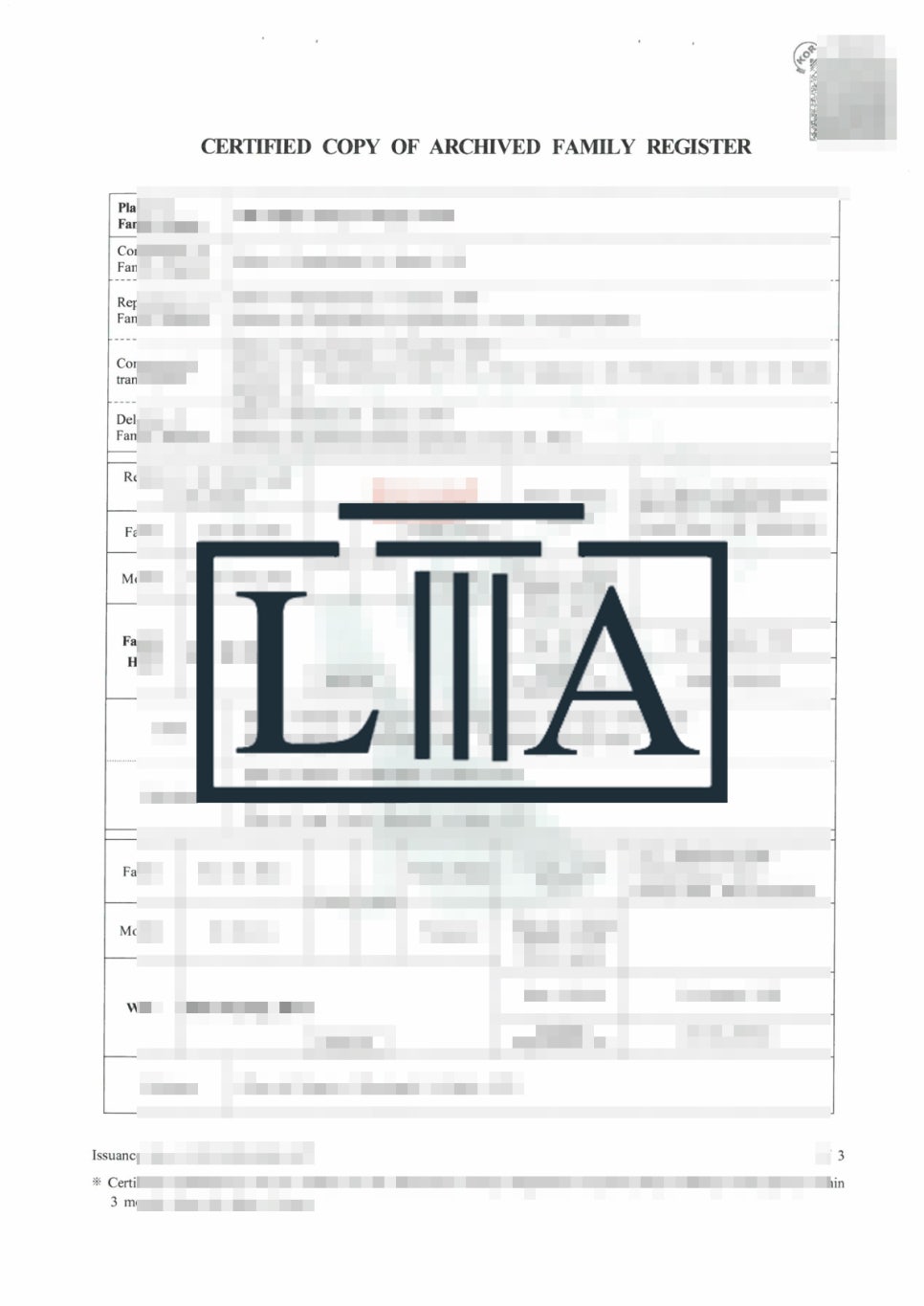
- 가족관계증명서 (Certificate of Family Relations) — proves birth and family relationships (parents, children)
- 혼인관계증명서 (Certificate of Marital Relations) — proves marital status with a spouse
- 제적등본 (Certified Copy of the Former Family Register) — proves historical family-relation changes (death, divorce, loss of nationality) or family-register removal from emigration
Why there's no single "birth certificate" to submit
Korea doesn't have a standalone birth certificate system — birth facts are recorded and maintained in the family relation registry instead. When a foreign institution needs birth fact confirmation, the standard approach is to submit 기본증명서 + 가족관계증명서 together — that combination is what actually establishes the birth fact for a Korean national.
A caveat about the Supreme Court's English 가족관계증명서
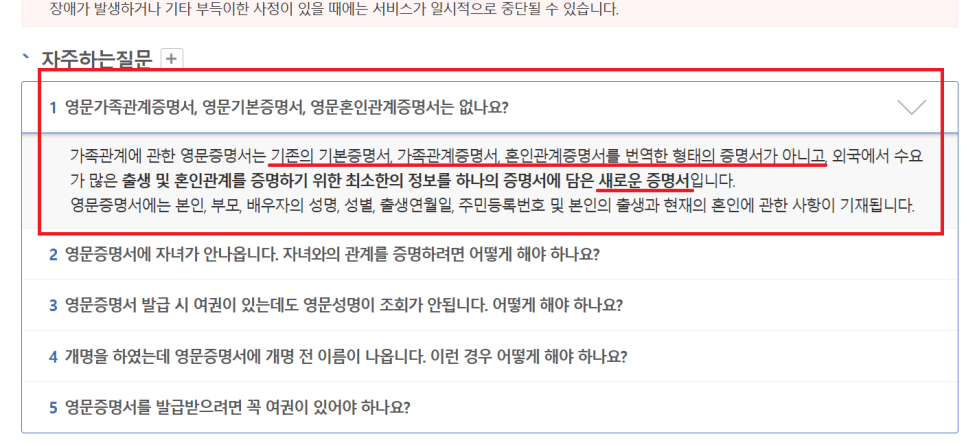
Korea's Supreme Court site issues an English-language family relation certificate directly, and many people assume it can simply be submitted as-is. It depends — the Supreme Court's own site notes this English version is not a direct translation of the Korean-language certificate. Where a complete, precise 가족관계증명서 is required, obtaining the Korean-language original and having it professionally translated is the more reliable route.
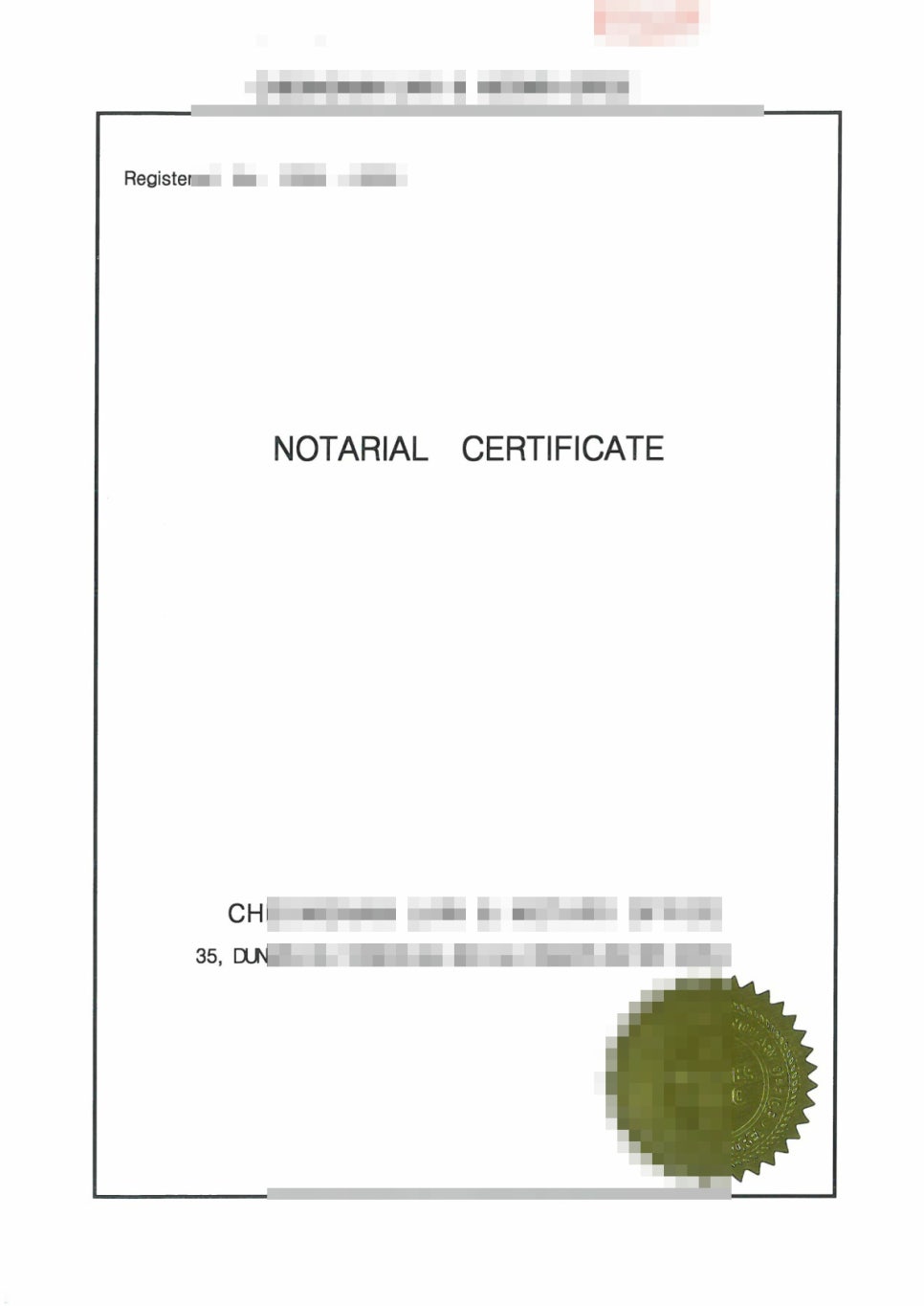
번역공증 (notarized translation) vs. 번역확인증명서 — which one do you actually need?
| Notary office's notarized translation | 외국어번역행정사's 번역확인증명서 | |
|---|---|---|
| Document type | An official document carrying a notary's certification | A private document prepared by a 행정사 (legally effective, but not a public document) |
| What's certified | The translator's statement that they performed the translation | The translator's identity, qualification, authority, and translation accuracy |
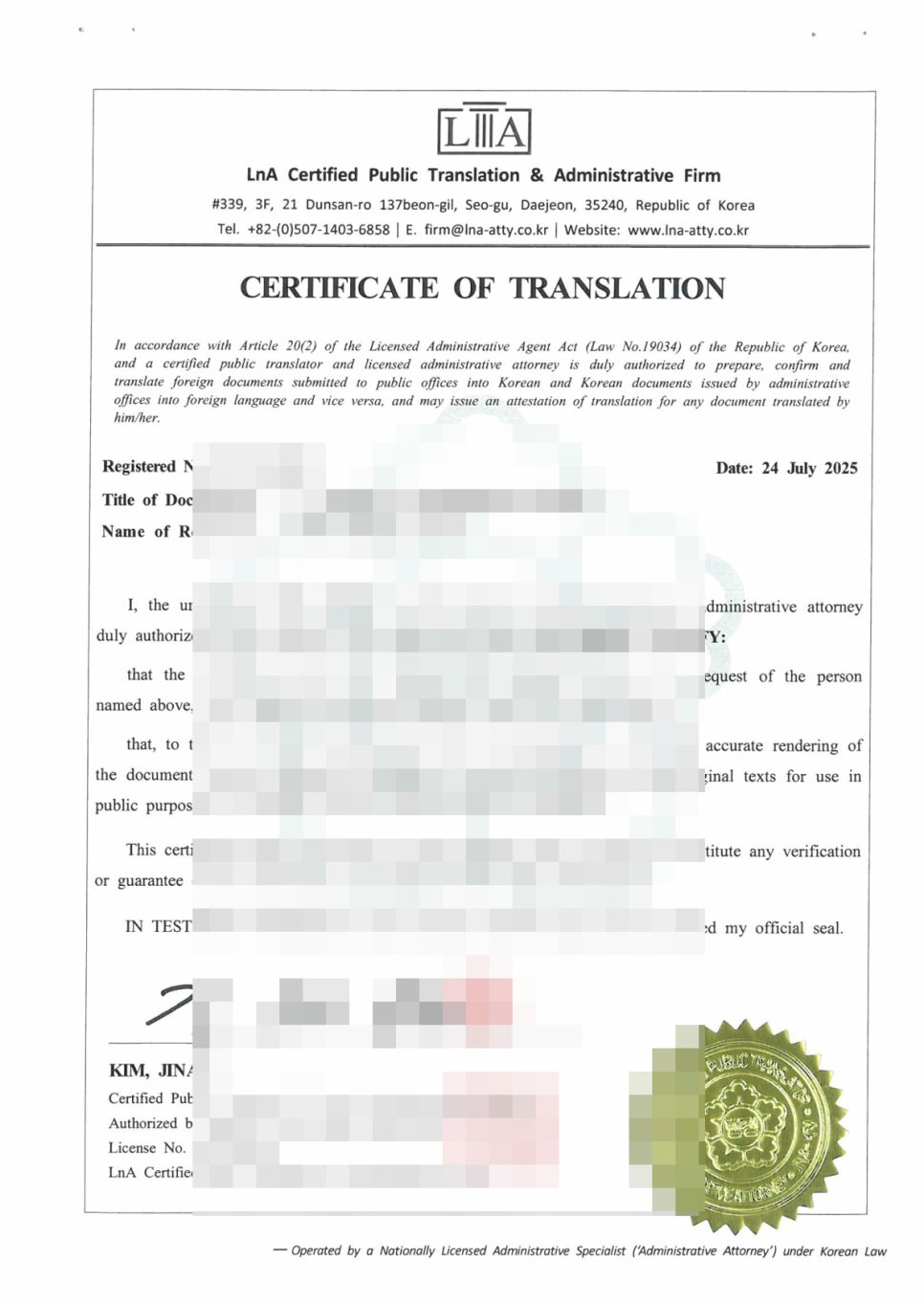
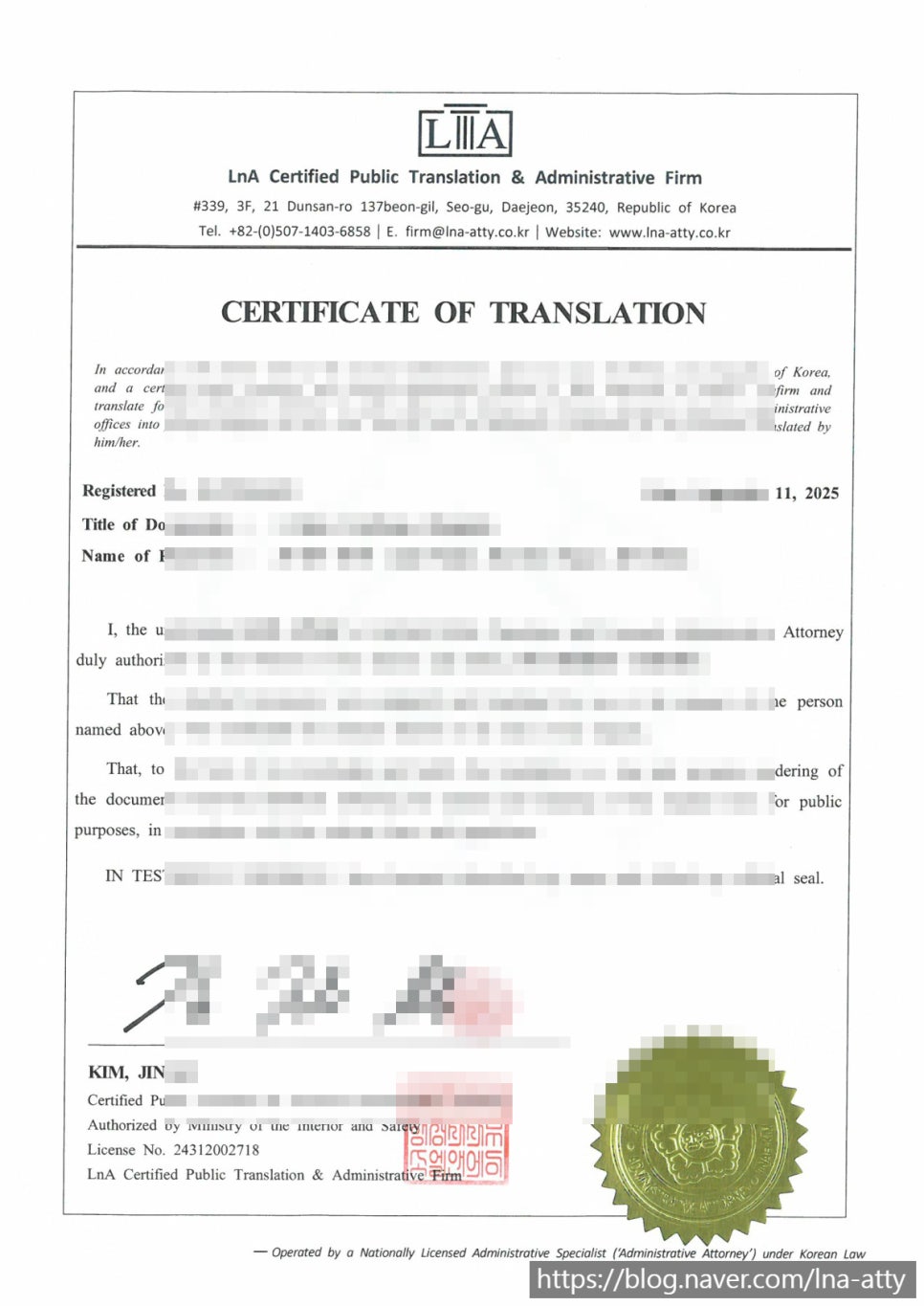
| Translator credentials on the document | Usually not stated | Name, license number, office name, and the legal basis for the qualification, all stated |
The practical difference: a notarized translation doesn't put the translator's specific qualifications on the document itself, while a 번역확인증명서 does — along with an accuracy attestation.
Which to choose:
- If the receiving institution requires a formal public document, or the translated document needs an apostille/embassy legalization chain → notarized translation
- If the receiving institution wants certified translation with a verifiable, qualified translator's identity behind it → 번역확인증명서
This is a more specific answer than "notarization generally isn't required" — the right choice genuinely depends on what the receiving institution asks for, and this office confirms that before choosing the certification path.
기본증명서 also proves a legal name change
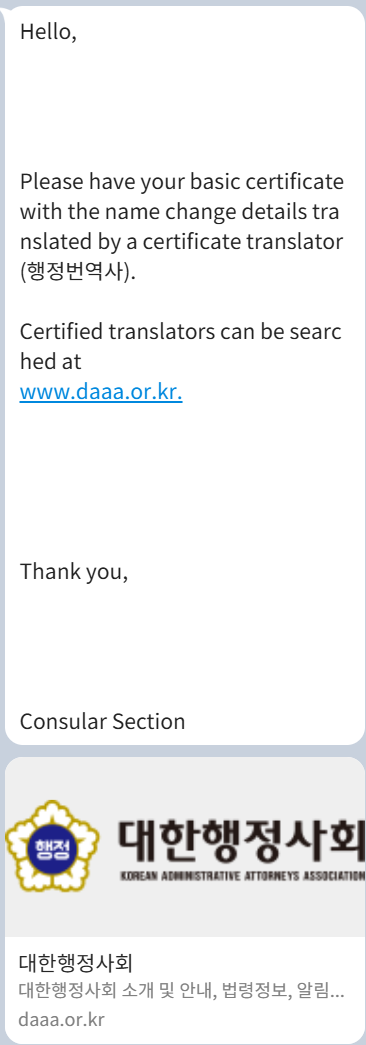
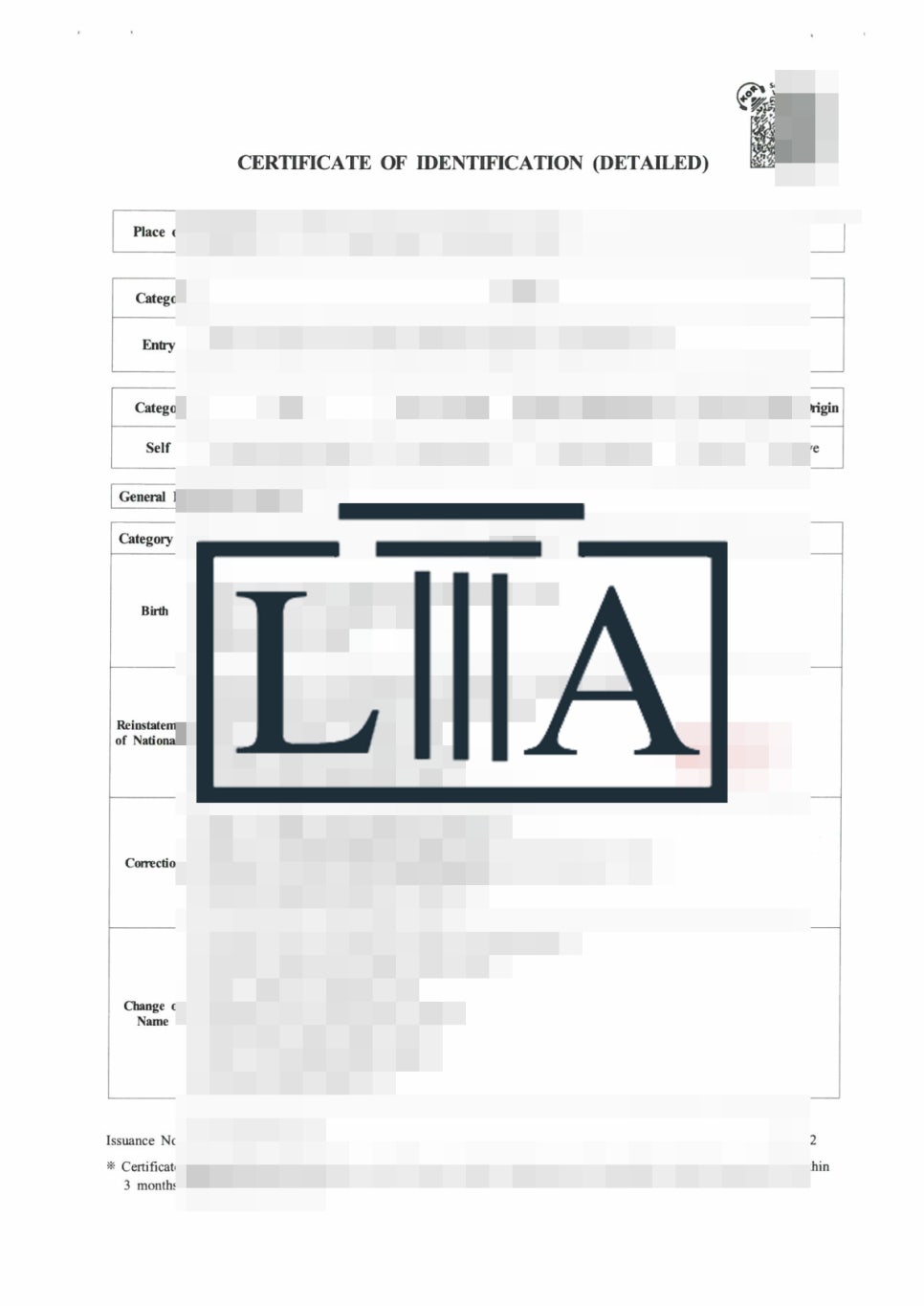
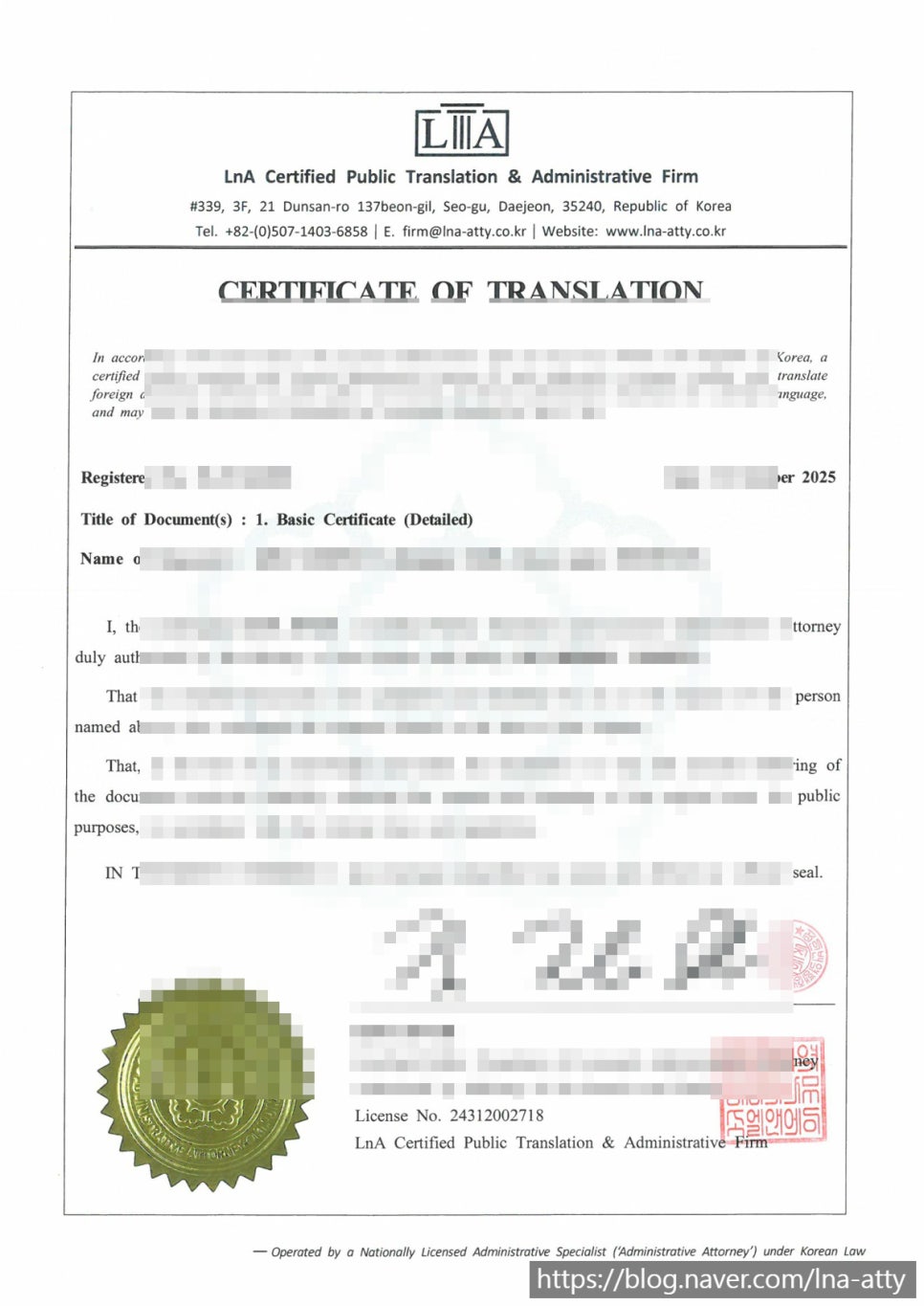
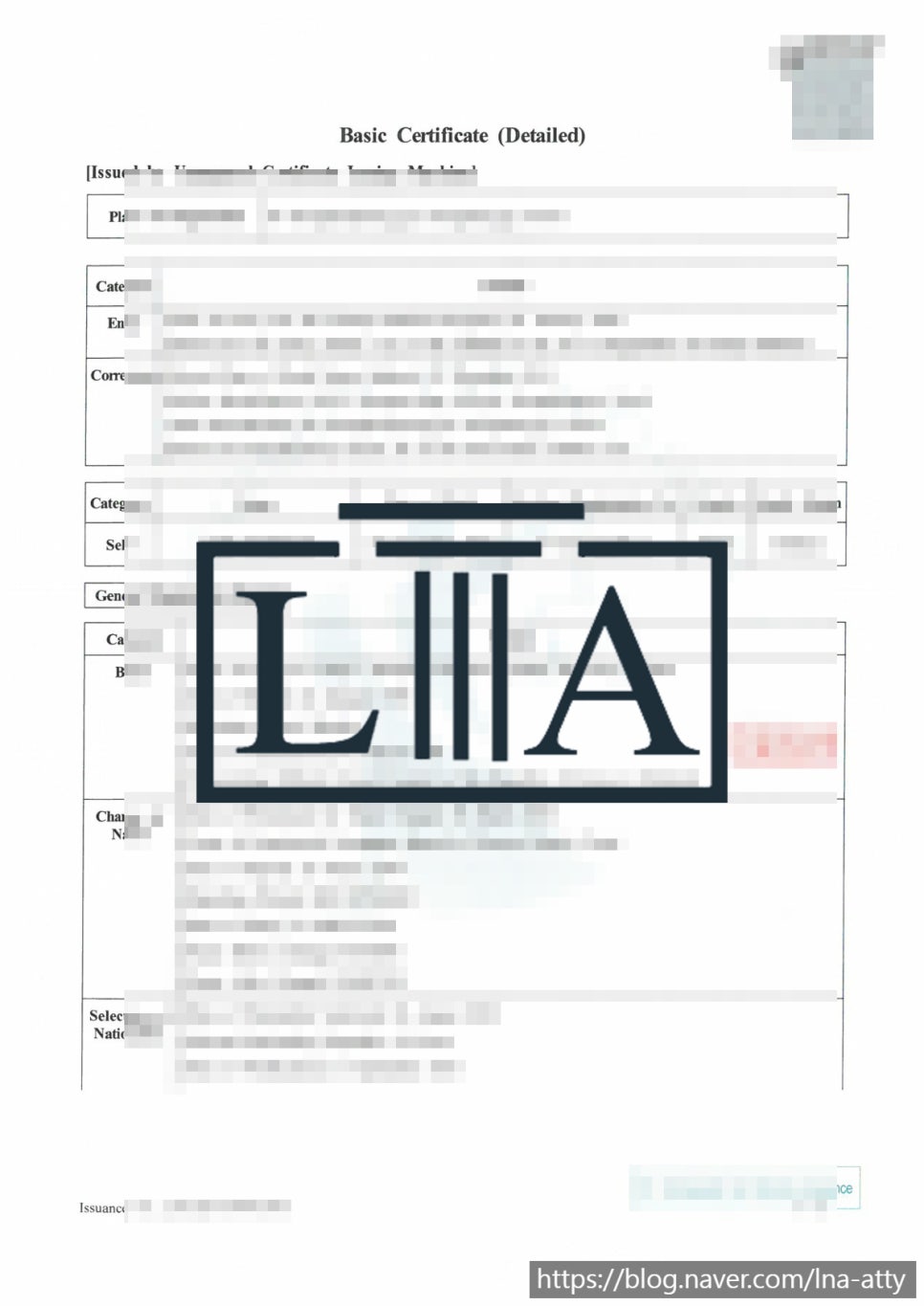
Beyond birth-fact confirmation, 기본증명서(상세) is also the document Korean nationals use to prove a legal name change abroad — for example, a Canadian passport renewal where a past name change needs to be verified. A Canadian embassy case handled by this office required exactly this: a detailed 기본증명서 showing the before/after names, certified-translated and issued with a 번역확인증명서, confirmed against the client's passport-format name before translation.
Nationality documents: renunciation, restoration, and pre-2008 records
Beyond birth and marriage, this document family also covers nationality status changes — a common case is a former Korean national who lost Korean citizenship by naturalizing abroad, later restored it, and now needs to renounce their foreign citizenship (e.g. Canada).
To renounce Canadian citizenship through IRCC, an applicant with a Korean nationality history typically needs certified translation of:
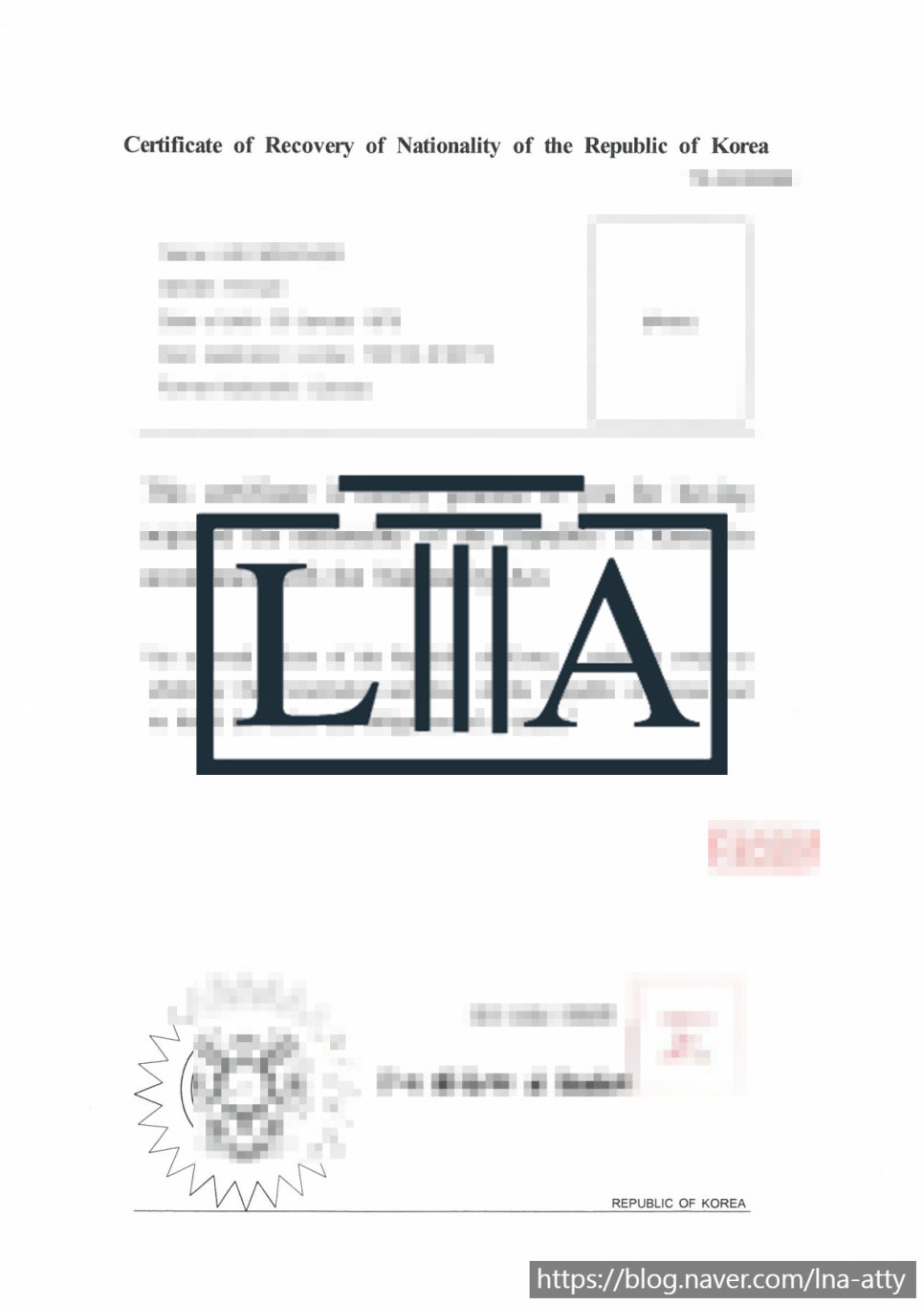
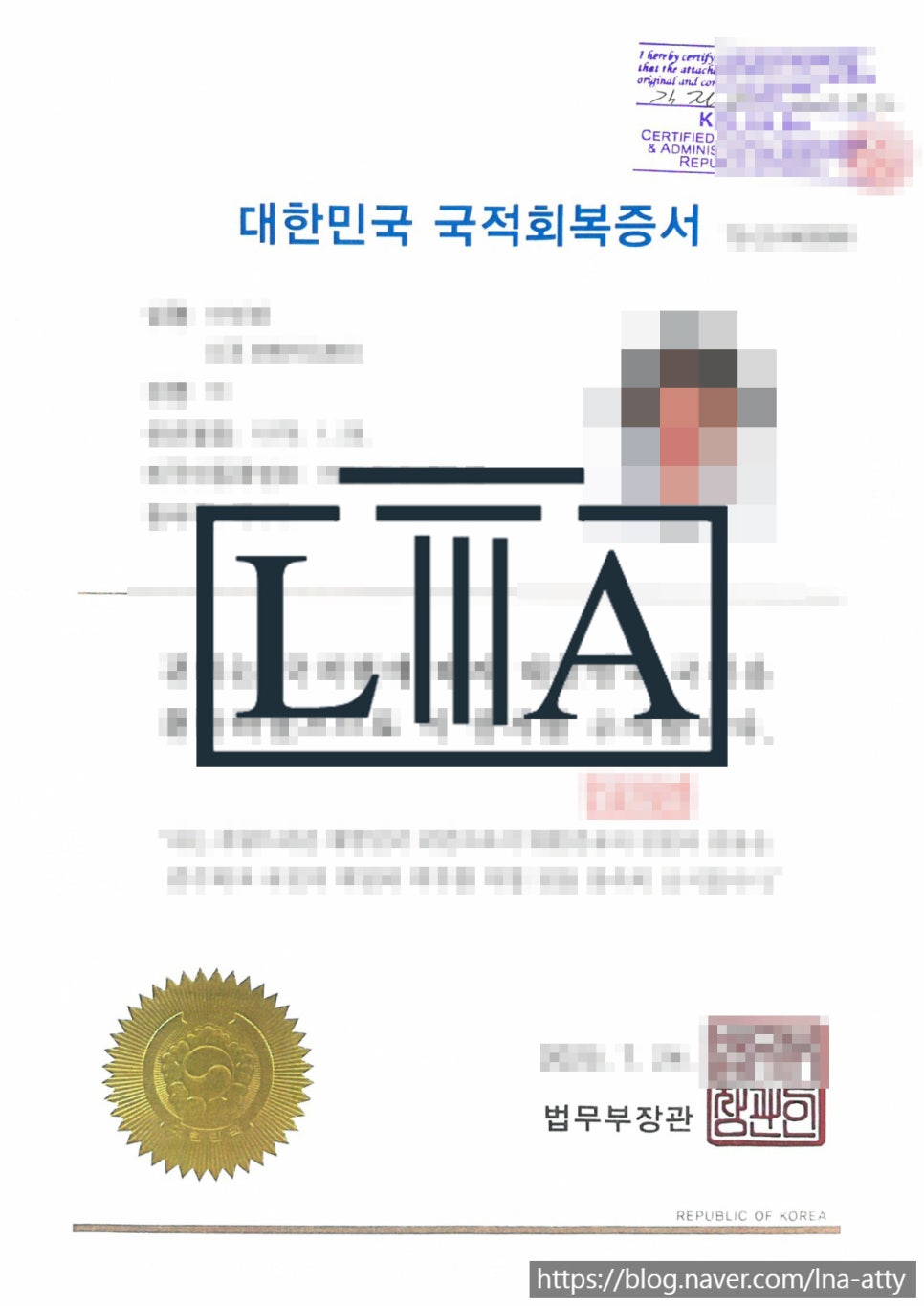
- 국적회복증서 (Certificate of Nationality Restoration) — proves Korean citizenship was restored
- 외국국적동포 국내거소신고증 (Domestic Residence Report Certificate for Overseas Korean Nationals) — a residence-registration document for overseas Koreans
- 기본증명서 or 제적등본 — proving the nationality history: originally Korean → lost Korean nationality upon acquiring foreign citizenship → later restored Korean nationality
기본증명서 vs. 제적등본 for nationality history: 기본증명서(상세) usually captures nationality loss and restoration history — but for a nationality-loss declaration made before 2008, the record may not have carried over completely to the newer family relation registry system. In that case, the now-closed 제적등본 (which holds the old family register records) is what actually documents the historical status change.
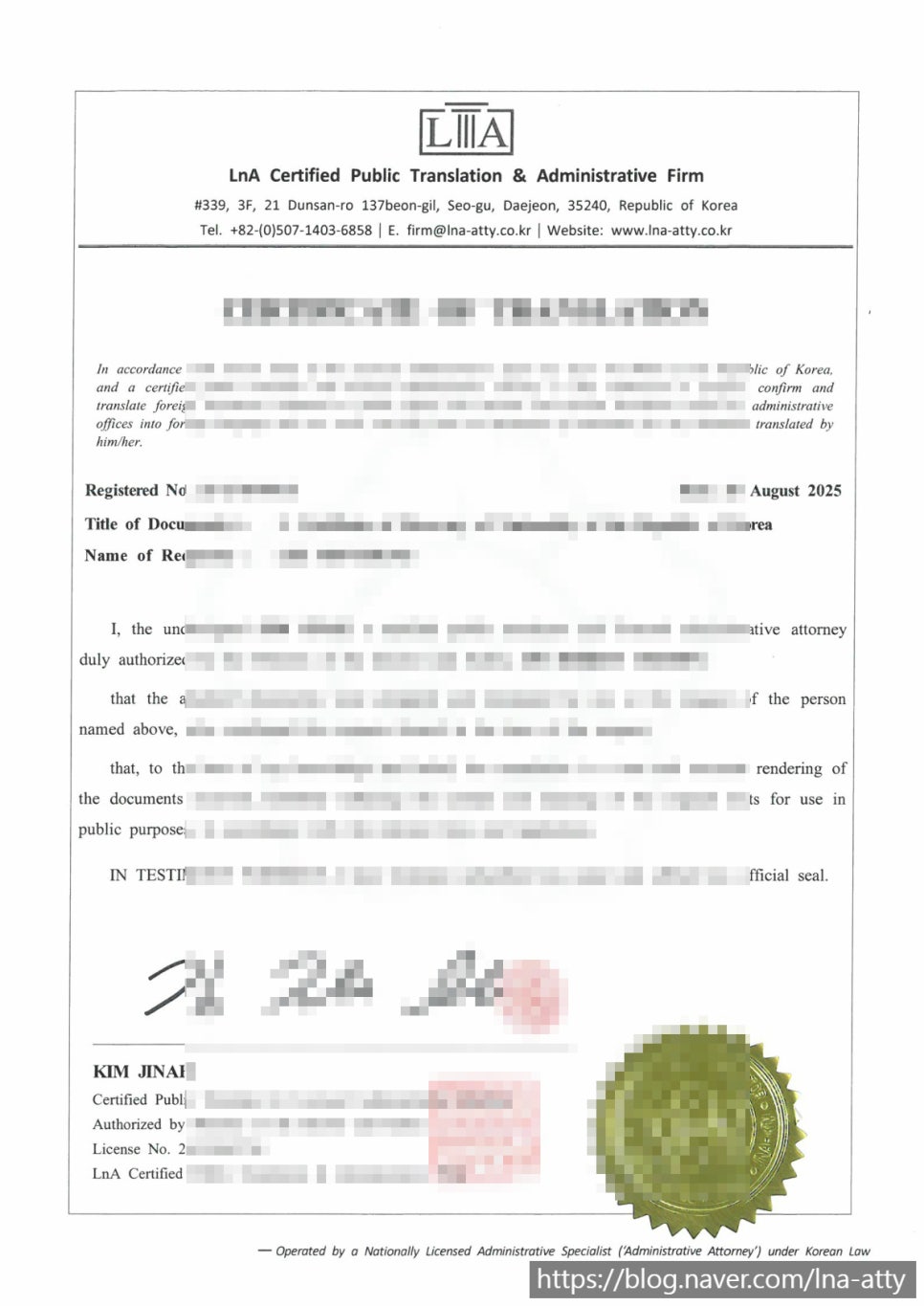
Canada's embassy in Korea specifically requires both a certified translation and a 번역확인증명서 from a 외국어번역행정사 for this kind of nationality documentation — accuracy matters directly here since these documents establish personal legal status, and even a minor mistranslation can delay an already multi-step process.
Getting a "closed" registry document — for a child who's no longer a Korean national
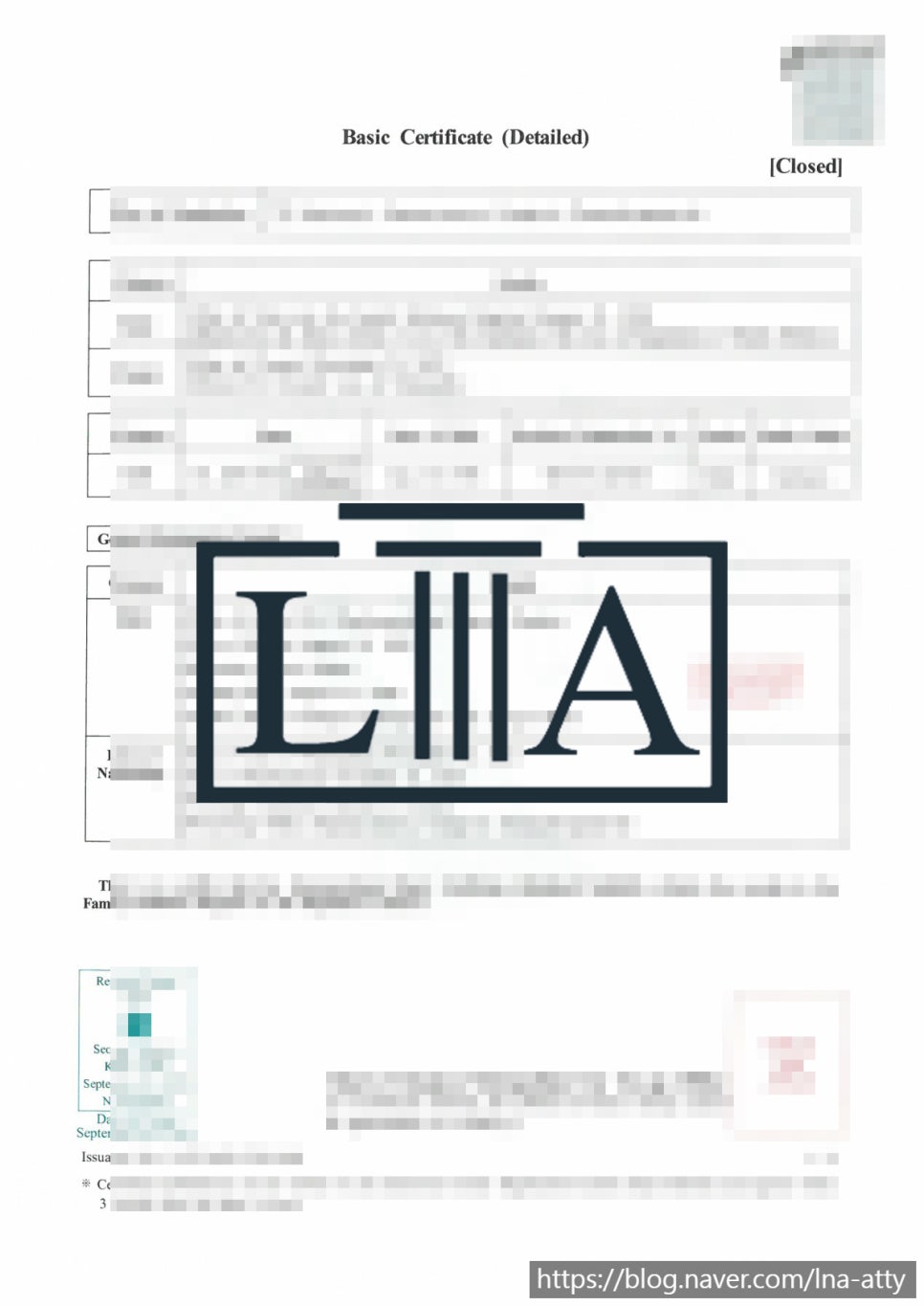
A U.S. work visa applicant who had renounced Korean citizenship after acquiring Canadian citizenship needed a 기본증명서 (Certificate of Basic Personal Information) and 가족관계증명서 (Certificate of Family Relations) to satisfy the U.S. embassy's birth-certificate-substitute requirement — since Korea issues no standalone birth certificate.
Why the request called for "closed" documents, and who can even get them
Once someone loses Korean nationality, their family relation registry entry is marked closed (국적상실) — and because a person who's no longer a Korean national can't complete the identity-verification/certified-login steps Korea's system requires, online issuance of a closed registry certificate is blocked.
Under Article 14 of the Act on Registration of Family Relations, a lineal blood relative can request these certificates without the registered person's power of attorney — this holds true even after the registry is closed due to nationality loss. In this case, the applicant's father visited the local registration office in person with his own ID and obtained the child's closed 기본증명서 and closed 가족관계증명서 directly.
A genuine translation judgment call: "Identification Certificate" or "Basic Certificate"?
Choosing the most credible English name for 기본증명서 required weighing two different, both-legitimate sources:
- The Korea Legislation Research Institute's standard glossary and the Supreme Court's own official English-language portal both use "Identification Certificate"
- The U.S. State Department and U.S. Embassy in Korea, however, consistently refer to it as "Basic Certificate" in their own guidance
No single Korean authority has final legal say over the official English name for a Korean legal document — the Ministry of Government Legislation, the Korea Legislation Research Institute, and the Ministry of Foreign Affairs' usage are treated as the closest thing to a standard, by convention. But translating for actual submission means also weighing the receiving country's own administrative practice. Since minimizing confusion for the reviewing visa officer and maximizing the document's acceptance chances mattered more here than following the domestic-standard term, this office translated 기본증명서 as "Basic Certificate" — matching the term the U.S. Embassy itself already uses.

What USCIS actually requires for a translated vital record
A Korean national applying for a U.S. green card while residing in Korea needed a certified translation of their 혼인관계증명서 (Certificate of Marital Relations) — one of the identity-verification documents in a U.S. permanent-residency application.
The 3-step green card process, and where vital records fit
A U.S. green card application generally moves through petition (eligibility review) → immigrant visa processing (final approval) → green card issuance. Under U.S. immigration law, an immigrant visa functions as a one-time entry permit — once the applicant enters the U.S. on it, the visa's role ends and the applicant becomes a Lawful Permanent Resident (LPR). The identity-verification document set for this process commonly includes a valid passport, 기본증명서(상세), 가족관계증명서(상세), 혼인관계증명서 (if applicable), a divorce certificate if applicable, and a police/investigation record certificate for foreign entry/stay purposes — on top of the petition itself and financial and medical documents.
USCIS's actual translation requirement, straight from the source
- USCIS Policy Manual (Volume 1, Part E, Chapter 6) requires a full English translation of any foreign-language document, where the translator certifies that the translation is complete and accurate and that they're competent to translate from the source language.
- 8 CFR § 103.2(b)(3) (U.S. federal regulation) requires the same: a complete and accurate English translation, plus the translator's certification and a certification of competency.
- The U.S. State Department additionally specifies the translator's certification must include their name, signature, address, and date.
Why "just anyone" translating isn't actually safe, even though USCIS doesn't require a specific license
"Certified Translation" means very different things depending on the country and the specific receiving institution — there's no universal standard, so what counts as acceptable always depends on the specific receiving agency's own rules. The U.S., as a nation built on immigration from every language background, can't realistically require a government-licensed translator for every language — so USCIS instead places full liability for translation accuracy on the individual translator who signs it.
Is self-translation (translating your own document) allowed? USCIS's Policy Manual doesn't explicitly bar it, requiring only a "competent" translator's certification. Even so, immigration attorneys and practitioners strongly recommend third-party translation in practice — this comes from a different section of USCIS's own guidance: the Policy Manual's interpreter-at-interview section (Volume 7, Part A, Chapter 5, Section C) states that "generally, a disinterested party should be used" as an interpreter. While that specific rule targets interview interpreters, not document translation, it signals USCIS's broader preference for objectivity and freedom from conflict of interest — the same principle a reviewing officer is likely to apply informally to a submitted document's translator, too.
A 외국어번역행정사 performs the translation under a specific national law (Korea's 행정사법), carrying direct legal responsibility and authority for the translation's accuracy — a fundamentally different footing than a personal favor from an acquaintance, and a real basis for being recognized as a "professional, accountable third party."
Beyond the formal requirement: why expertise still matters
USCIS doesn't specify translator credentials, but it has little tolerance for translation errors. Visa documents carry terminology and formatting deeply rooted in a specific country's administrative and legal system — understanding that administrative/legal context, and precisely cross-matching names, place names, date formats, and the names of courts or agencies against the original so a reviewing officer can verify them easily, is work only genuine expertise reliably gets right. USCIS also requires every element of the document translated — including stamps, signatures, and seals — a requirement non-professionals commonly overlook.
If USCIS ever needs to reach the translator to verify something and finds an unreachable contact or an unqualified signer, that alone can deepen an officer's doubt about a submission. A translation carrying a clearly stated qualification and legal accountability demonstrates it's the product of a nationally-recognized professional, not a personal declaration — giving the reviewing officer the highest practical level of confidence and legal credibility, something a general translation service or AI translation alone can't provide.
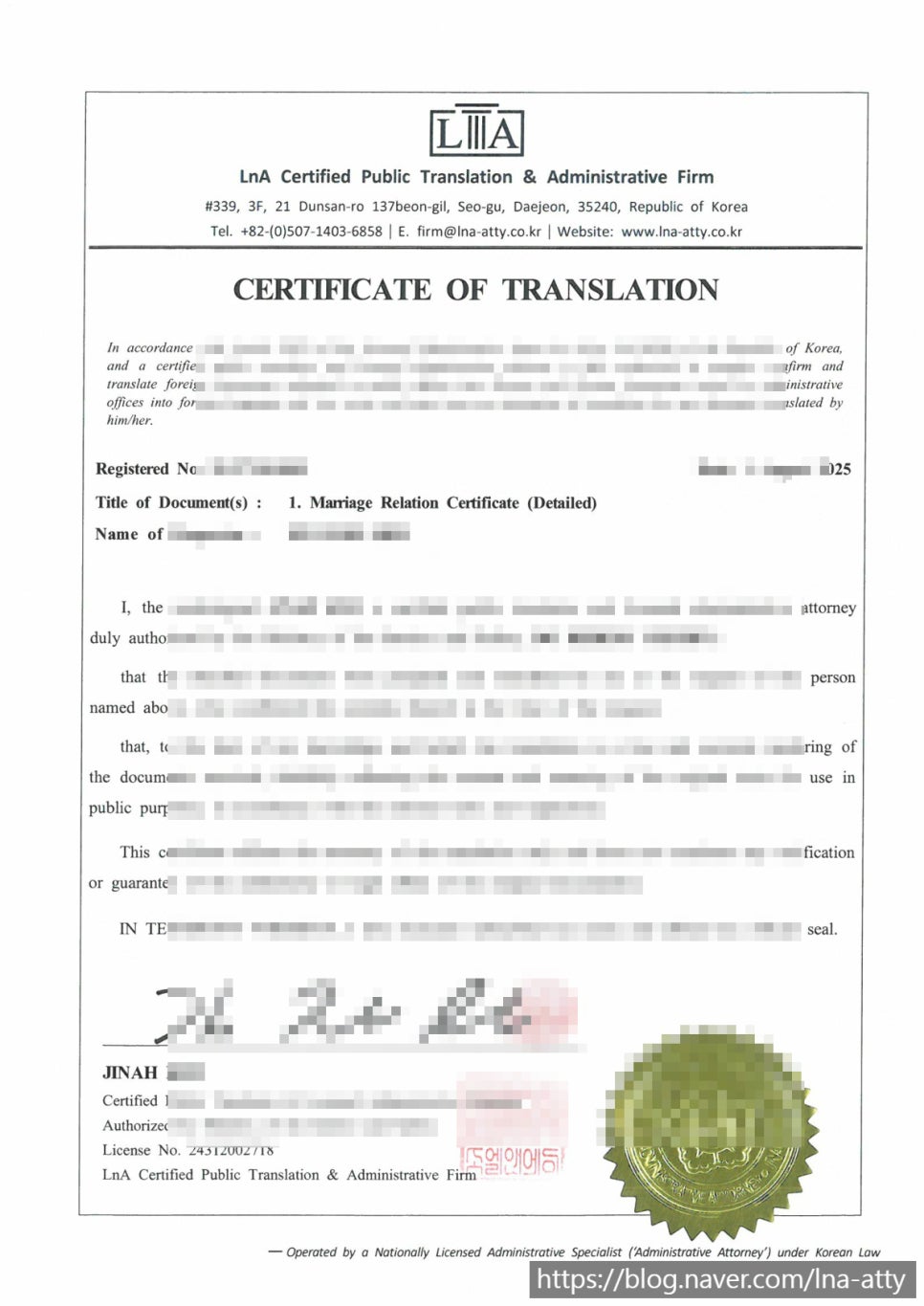
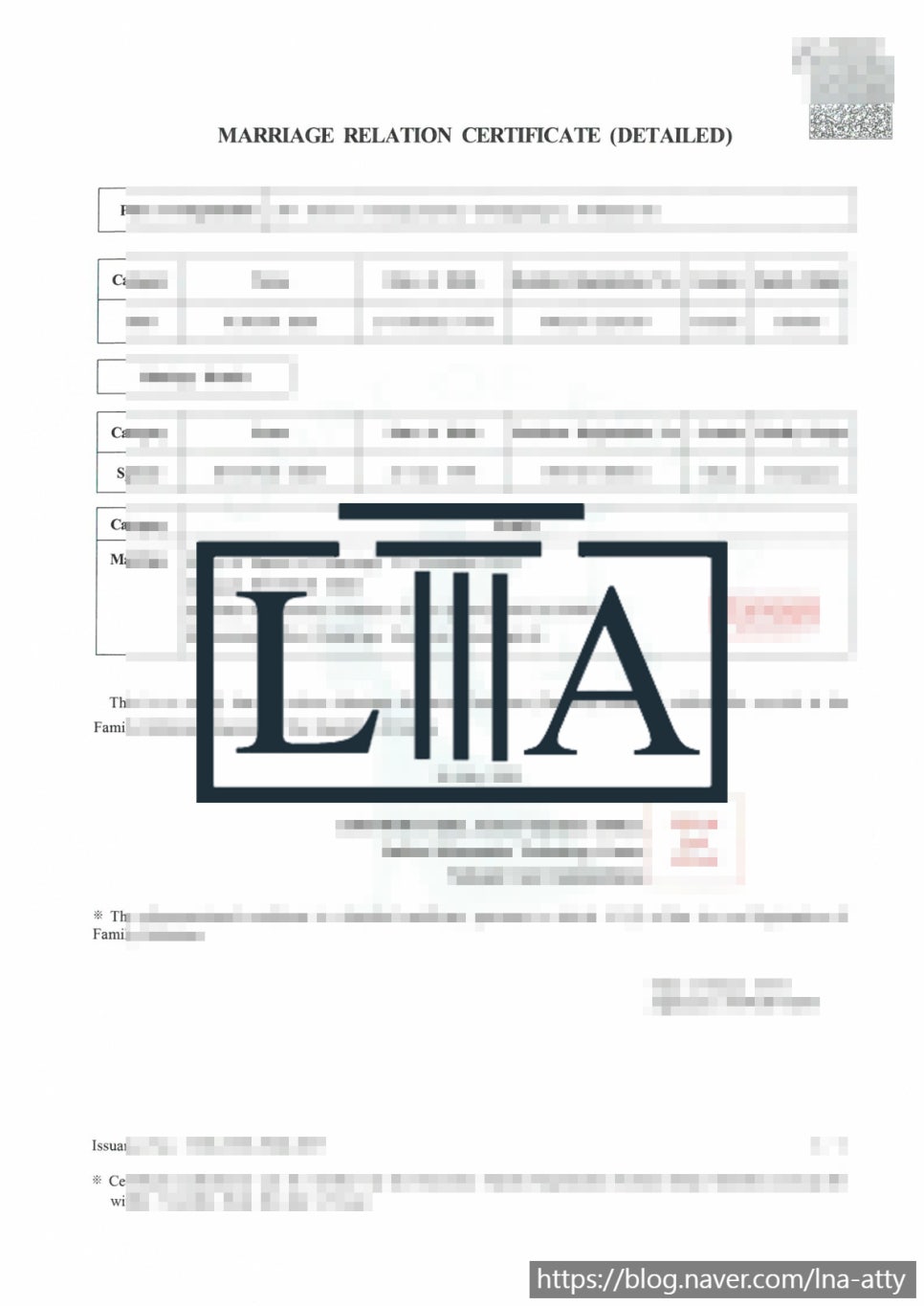
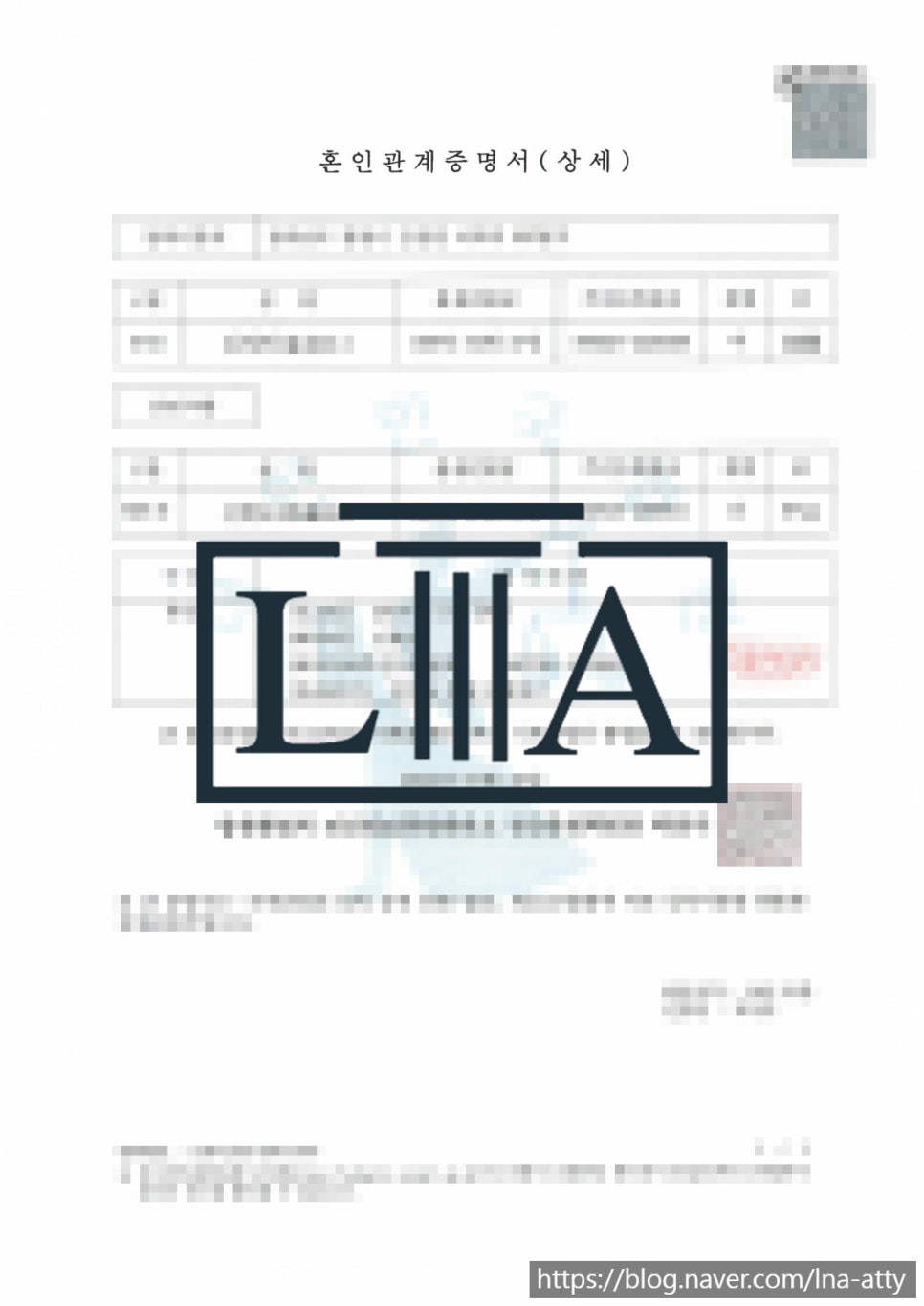
Renouncing Canadian citizenship as a born dual national, newly appointed as a civil servant
A client born in Canada to Korean parents — a 선천적 복수국적자 (jus soli dual national from birth) — had just passed Korea's national civil service exam. Appointment as a Korean civil servant requires holding sole Korean nationality, so the client needed to renounce Canadian citizenship and requested translation and certification of the necessary documents.
What a 선천적 복수국적자 is, and the nationality-selection deadline
A child born to Korean parents in a jus soli country like Canada acquires both Korean nationality and the birth country's nationality simultaneously from birth. Under Korea's Nationality Act, such a person must choose one nationality before turning 22 (for men subject to military service: by March 31 of the year they turn 18, or within 2 years of completing military service obligations if selecting later). The three paths are:
- Choose Korean nationality, renounce the foreign one — foreign nationality renunciation completed first, then a Korean nationality selection declaration
- Choose the foreign nationality, give up Korean nationality — a Korean nationality departure declaration
- Keep both — a foreign-nationality non-exercise pledge, promising not to exercise the foreign nationality while in Korea (not available to dual nationals whose dual status arose from birth tourism)
Canada's own renunciation document checklist
For a Canada-born dual national renouncing Canadian citizenship, Canada requires: Application Form CIT0302, the original Canadian birth certificate or citizenship card/certificate, a color copy (both sides) of the Korean 주민등록증 proving Korean nationality, a valid signed ID (Canadian or Korean passport), an English-issued Korean resident registration transcript (주민등록등본), a recent photo, and a CAD 100 fee.
Canada's own Ministry of Foreign Affairs names the Korean professional qualification directly
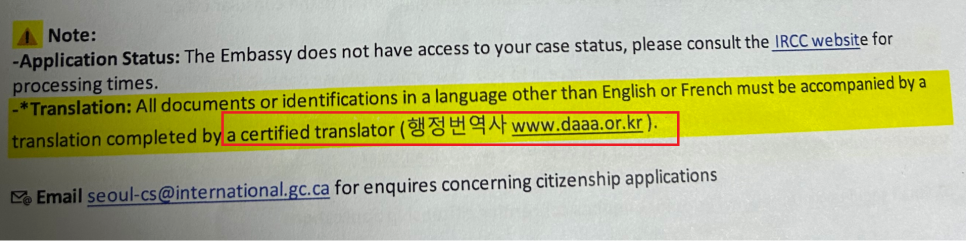
At the bottom of the official checklist the client received from the Canadian Embassy in Korea — reflecting Canada's Ministry of Foreign Affairs' own official guidance — the translation requirement is explicit: any document not in English or French must be translated by a "certified translator," with the guidance specifically parenthesizing "(행정번역사, www.daaa.or.kr)" — a direct reference to Korea's 대한행정사회 (Korea Administrative Agents Association), whose official site lets anyone verify a registered full member 행정사.
In other words, Canada's own foreign affairs ministry officially recognizes Korea's 외국어번역행정사 licensing system as the most trustworthy certified-translation authority for this purpose — a level of explicit, citable foreign-government endorsement most translation credentials never receive.
What actually got translated
Three documents were translated and certified: the 주민등록증 (Korean national ID card), a 공무원시험합격증명서 (civil service exam pass certificate, needed to justify an expedited renunciation timeline against the client's upcoming appointment date), and a 기본증명서 (needed because a past legal name change meant the name on the Canadian birth registration no longer matched the client's current Korean name — the 기본증명서 established that both names belonged to the same person).
Updating a UK eVisa account after a Korean legal name change
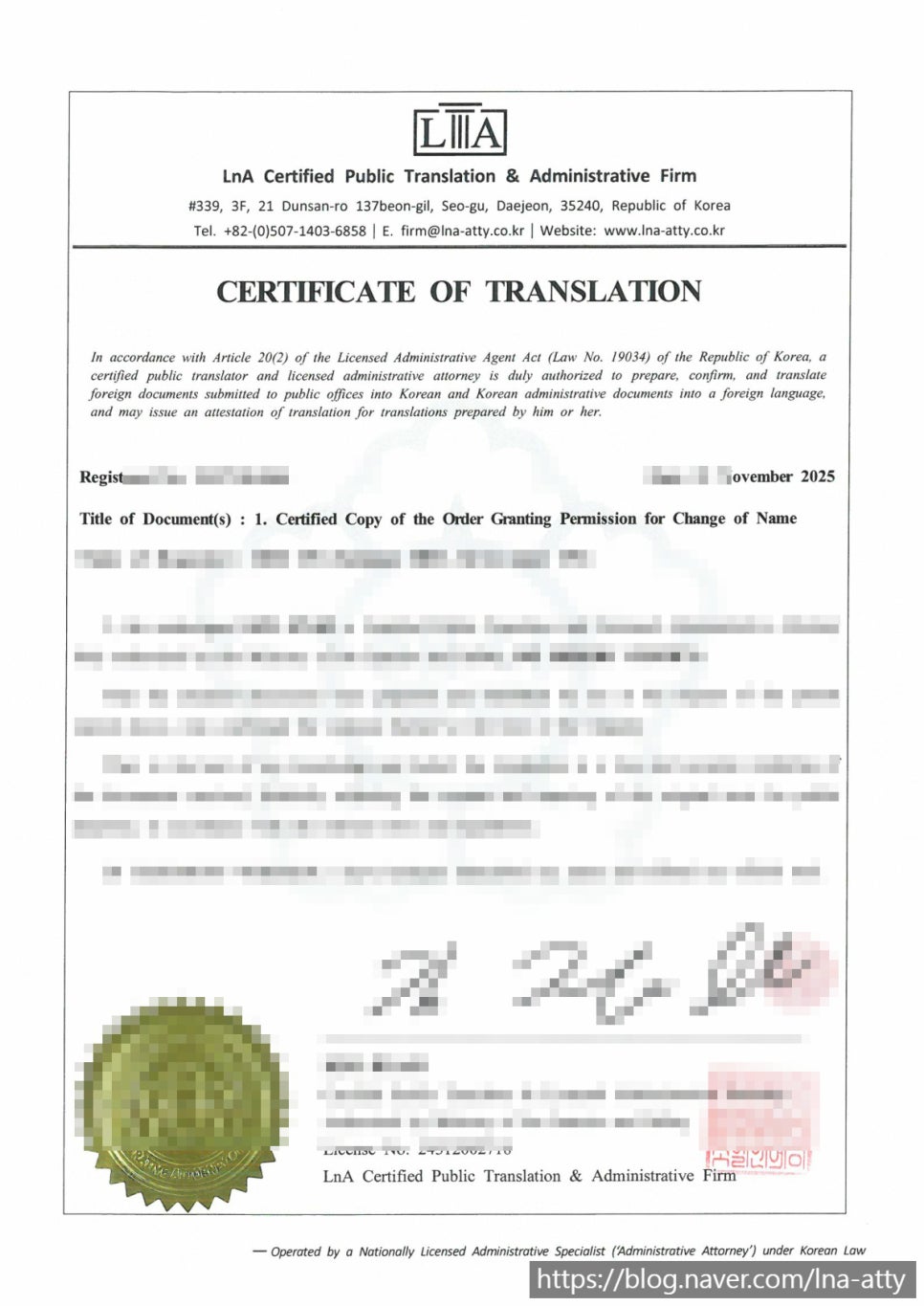
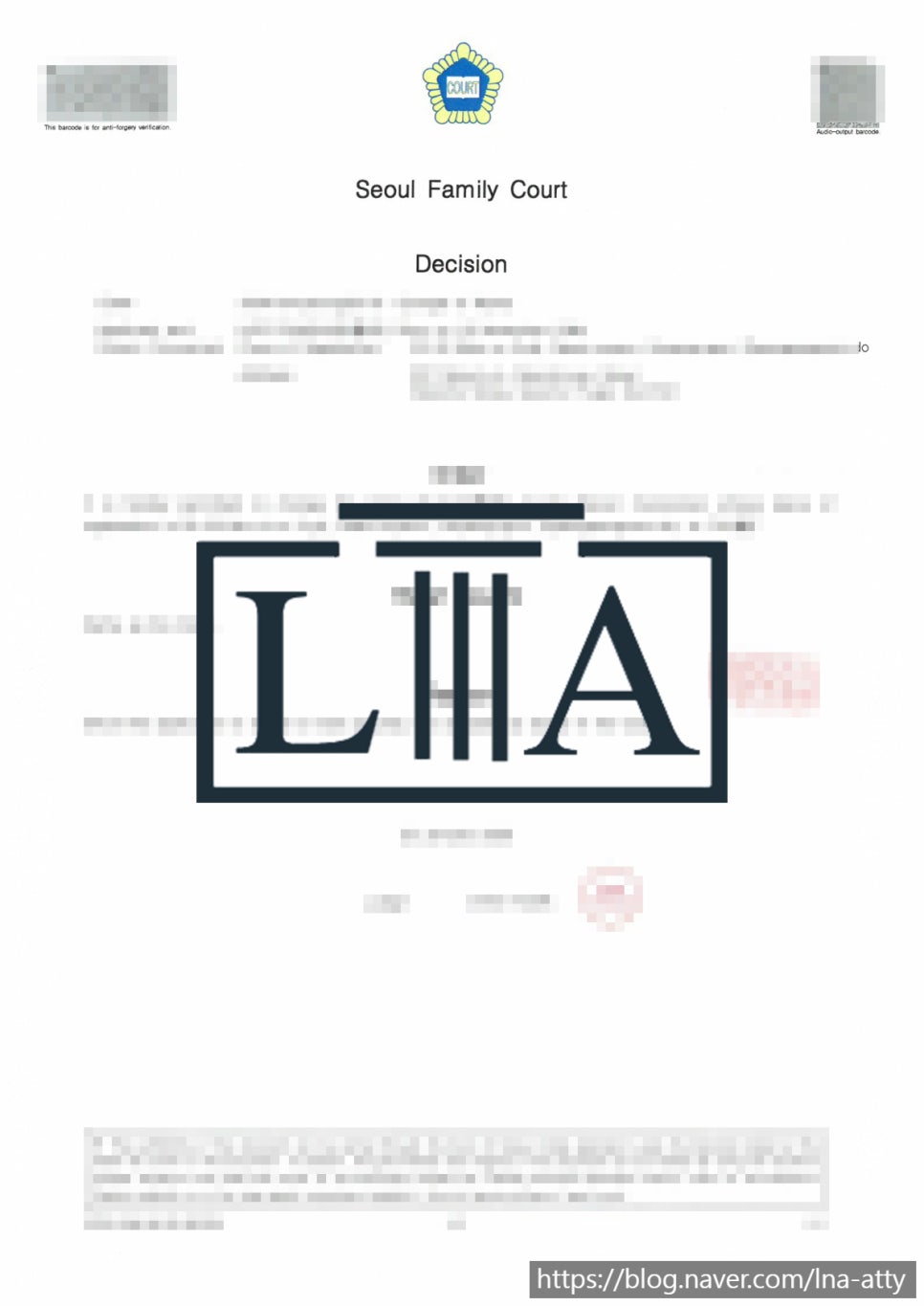
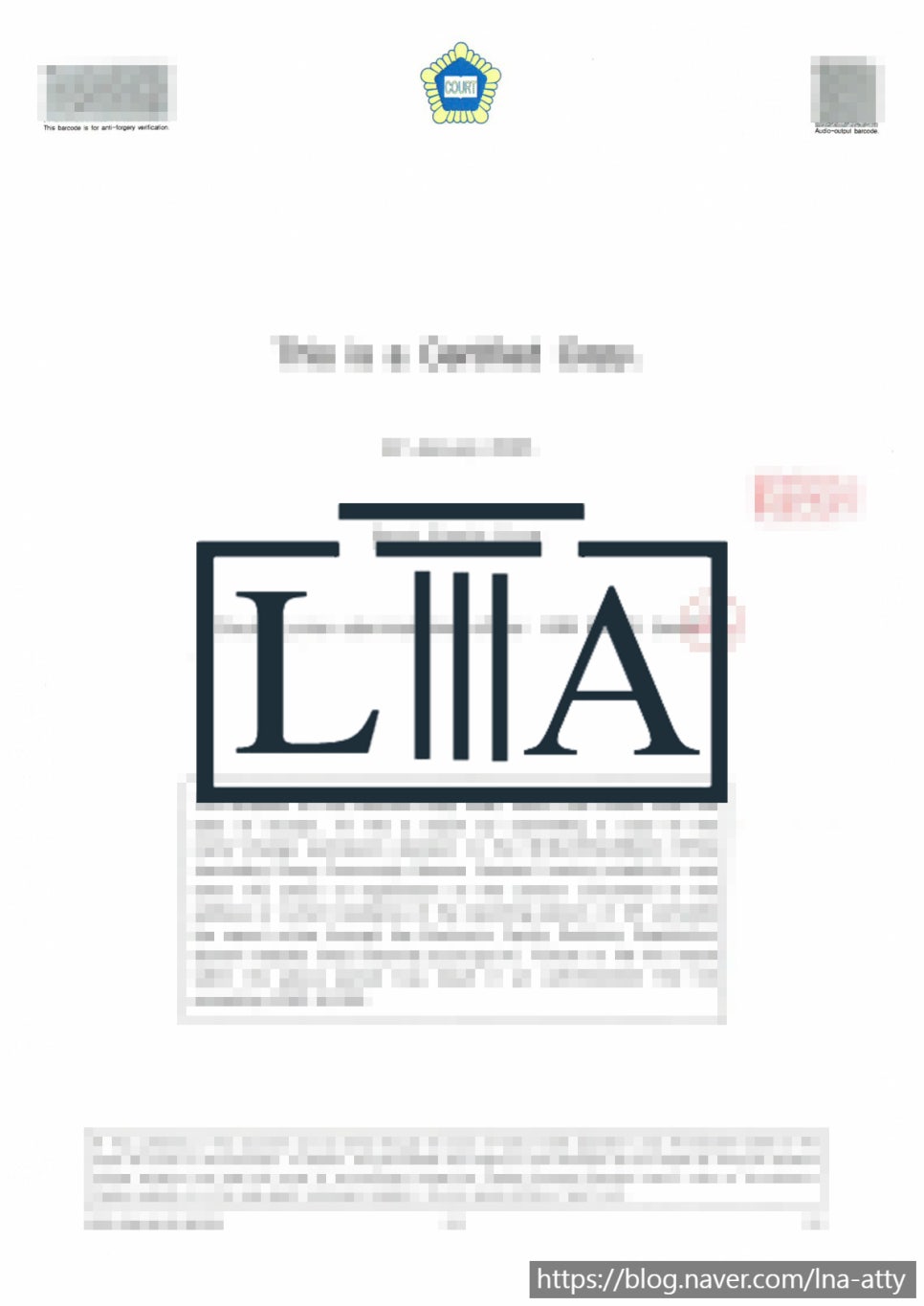
A UK permanent resident who had already completed a Korean court name-change procedure needed the supporting documents translated and certified to report the change to their UKVI eVisa account. A name change takes effect domestically, but a UK visa/status account needs that update reflected right away too.
What UKVI typically wants for a name-change update
- 개명허가결정등본 (transcript of the name-change permission decision) — the single most important document, the court's own certification of the legal name change
- 기본증명서(상세) — records both the pre- and post-change names, establishing continuity of identity across the change
- New passport copy — the current ID showing the new name
- Old passport copy — the prior passport tied to the existing eVisa/status record
(Individual cases may need additional documents or steps.)
UK's own official "Certified Translation" format requirement
UK government guidance is explicit that a translation submitted to UKVI must be a "Certified Translation" in form, not just accurate in content — the translation itself must state:
- The translator's name and signature
- The translator's contact information
- The date of translation
- A statement confirming the translation accurately represents the original document
A 외국어번역행정사's 번역확인증명서 satisfies every element of this UK government requirement, providing a legally credible translation backed by statutory authority.
For this case, the 개명허가결정등본 and 기본증명서 — the two most critical documents for the name-change update — were translated and certified on the client's timeline; high-resolution double-sided scans (including the 번역확인증명서) were emailed immediately for online reporting convenience, with the physical originals following by next-day express mail.
Turning a client's own rough explanation letter into a submission-ready document
A naturalized Korean citizen preparing to invite their parents from the Philippines to help with childcare needed a 기본증명서 and a supplementary "Explanation Letter" translated and notarized. The client had a name-change history after naturalization, which made consistency between the Korean and Philippine documents especially important.
Content isn't enough — format matters just as much
The client had drafted the Explanation Letter themselves. It contained the actual relevant facts, but lacked the formal elements a submission requires — a signature, a date — so it couldn't be submitted as-is despite the substance being sound. This office ran an in-depth consultation to re-confirm the facts precisely, organized the core facts clearly, removed content that didn't serve the submission's actual purpose, and restructured the whole thing into a format the receiving institution could readily understand — turning it into a proper fact-confirmation statement.
Why this matters more than plain translation
There's a real gap in completeness and persuasiveness between a document drafted by a layperson and one restructured by a professional through consultation into a submission-ready format. This is exactly where a 외국어번역행정사's role as someone designing the document to genuinely fit its submission purpose — not just translating it — shows up most clearly. Once the Explanation Letter was finalized, this office had the client sign it matching their passport signature before proceeding with translation.
Why identity consistency matters even more with a naturalization/name-change history
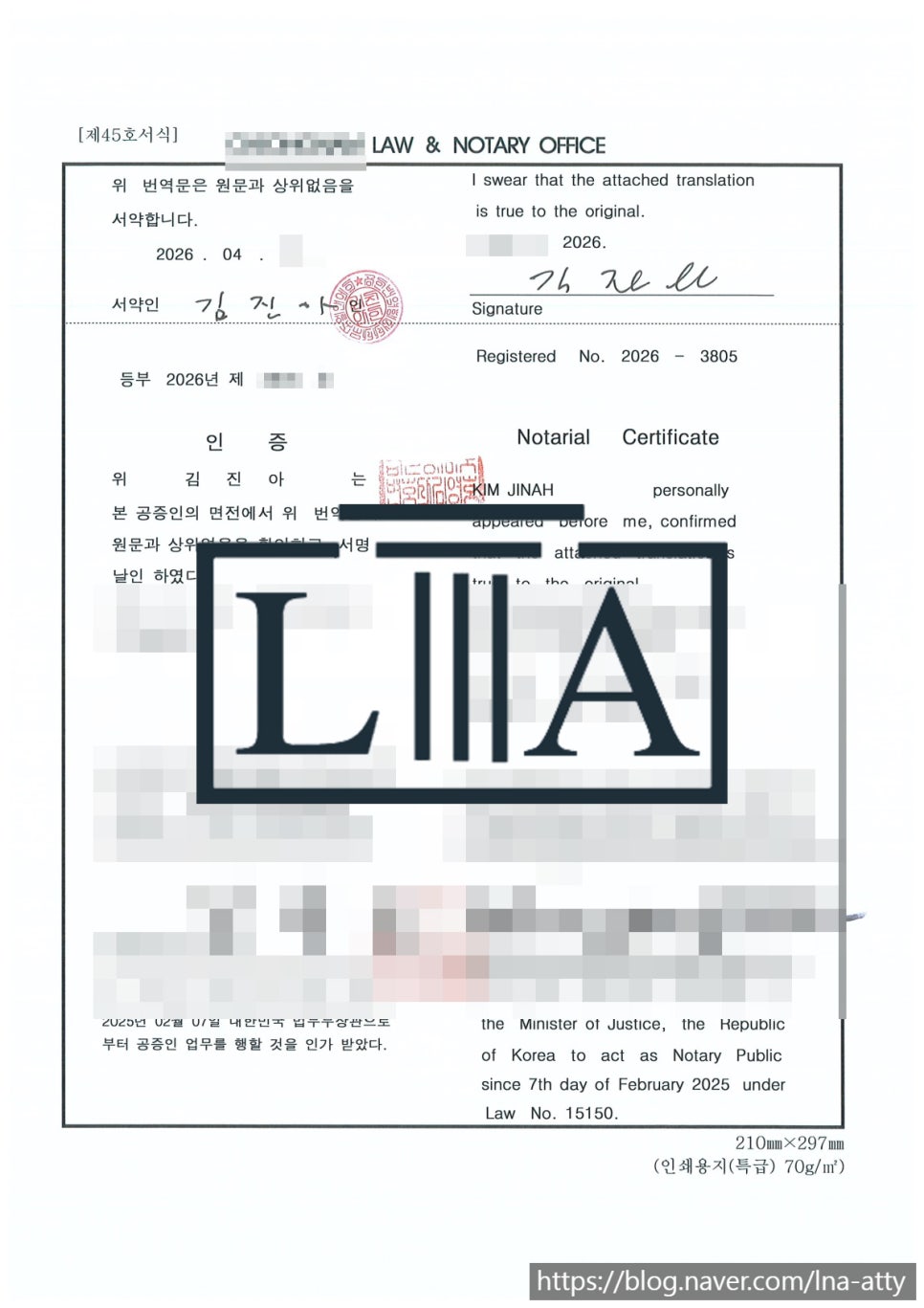
In a case like this, involving both naturalization and a name change, consistency in name notation and personal details across every document is critical — and reflecting that consistency accurately throughout the translation itself matters just as much. After the client's final review of the translation, this office proceeded with notarial commission of the translation.
The Right Document Combination, Correctly Certified
Get in touch about thisFrequently Asked Questions
Does Korea issue a birth certificate?
No — Korea doesn't have a standalone birth certificate system. Birth facts are recorded in the family relation registry, and 기본증명서 + 가족관계증명서 submitted together is the standard way to establish birth fact for a foreign institution.
Can I just use the Supreme Court's English family relation certificate?
It depends — the Supreme Court's own site notes this English version isn't a direct translation of the Korean-language certificate. For submissions requiring a complete, precise translation, getting the Korean original professionally translated is more reliable.
What's the difference between a notarized translation and a 번역확인증명서?
A notarized translation certifies the translator's statement that they did the translation, without necessarily stating their qualifications on the document. A 번역확인증명서 states the translator's identity, license, and qualification basis directly, along with an accuracy attestation.
Which one do I need for my specific submission?
If the receiving institution requires a formal public document or an apostille/embassy legalization chain, a notarized translation is typically the right choice. If it wants certified translation backed by a verifiable qualified translator's identity, a 번역확인증명서 fits better — this office confirms the requirement before choosing.