Sending a minor abroad without both parents?
Four ways to prepare a legally credible parental travel consent letter — translating a Korean consent form, drafting an English one from scratch, or backing either with a Certificate of Attestation confirming the parent's signature itself, in person or fully remote.
The Right Method for Genuine Parental ConsentWhen a minor travels abroad without one or both parents, most destination countries and airlines expect a parental travel consent letter proving the parent(s) or legal guardian authorized the trip — but which preparation method actually holds up depends on what you're trying to prove.
Four ways to prepare it
| Method | Starting document | How credibility is reinforced | What it actually proves |
|---|---|---|---|
| 1 | Korean-language consent form | 외국어번역행정사's translation verification certificate (번역확인증명서) | Translation accuracy |
| 2 | Korean-language consent form | Notary office's certified translation | The translator's identity and signature, backing the translation |
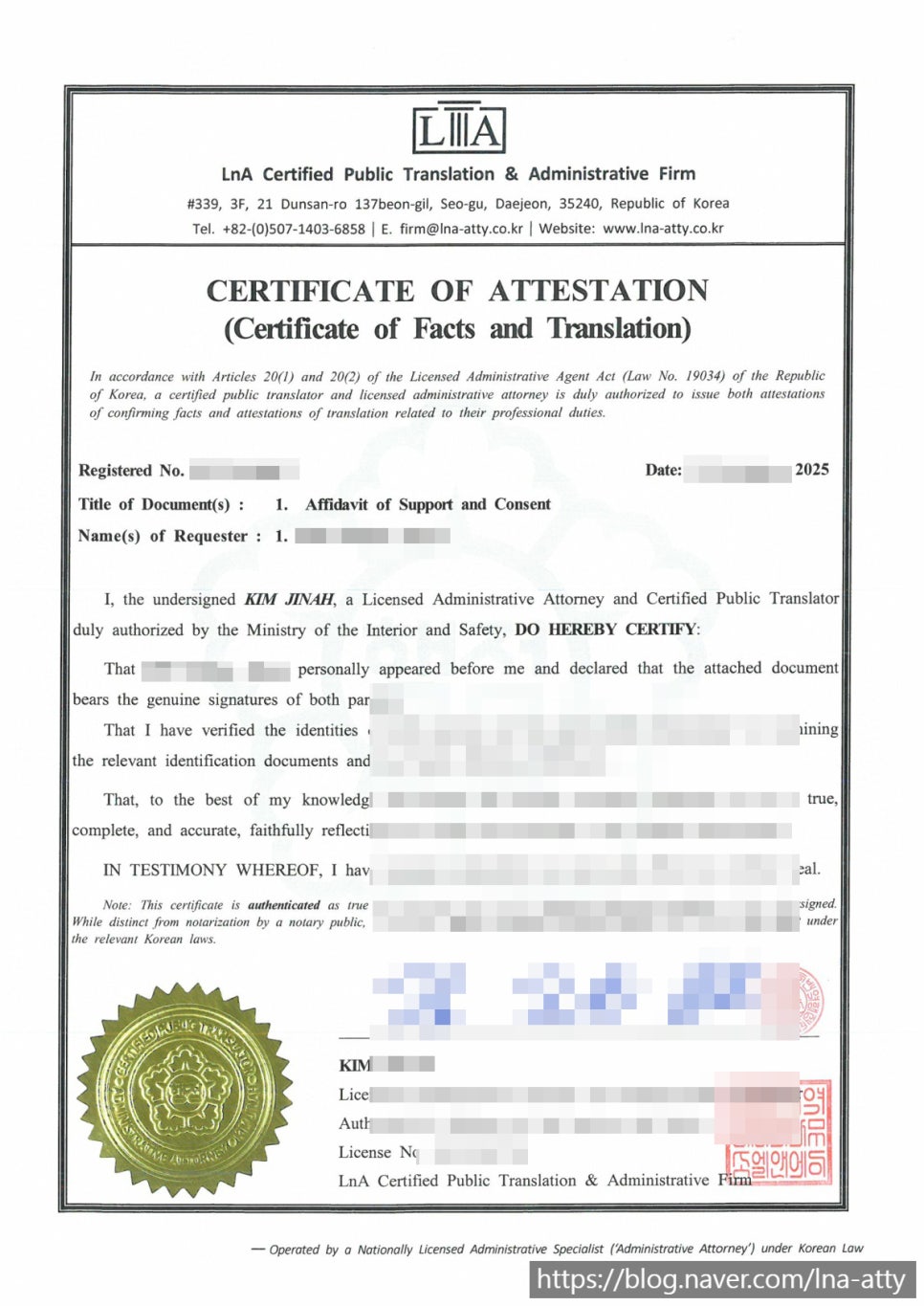
| 3 | English-language consent form | 외국어번역행정사's Certificate of Attestation | That the signed consent form itself is genuine |
| 4 | English-language consent form | Notary office's signature notarization (requires a Korean translation) | The signing act itself, legally guaranteed |
All four are formally valid, but they don't all get at the same thing. Methods 1–2 focus on the translation being accurate. Methods 3–4 focus on the parent's signature act itself being genuine — which is closer to what a parental consent letter is actually meant to prove.
What a Certificate of Attestation actually is
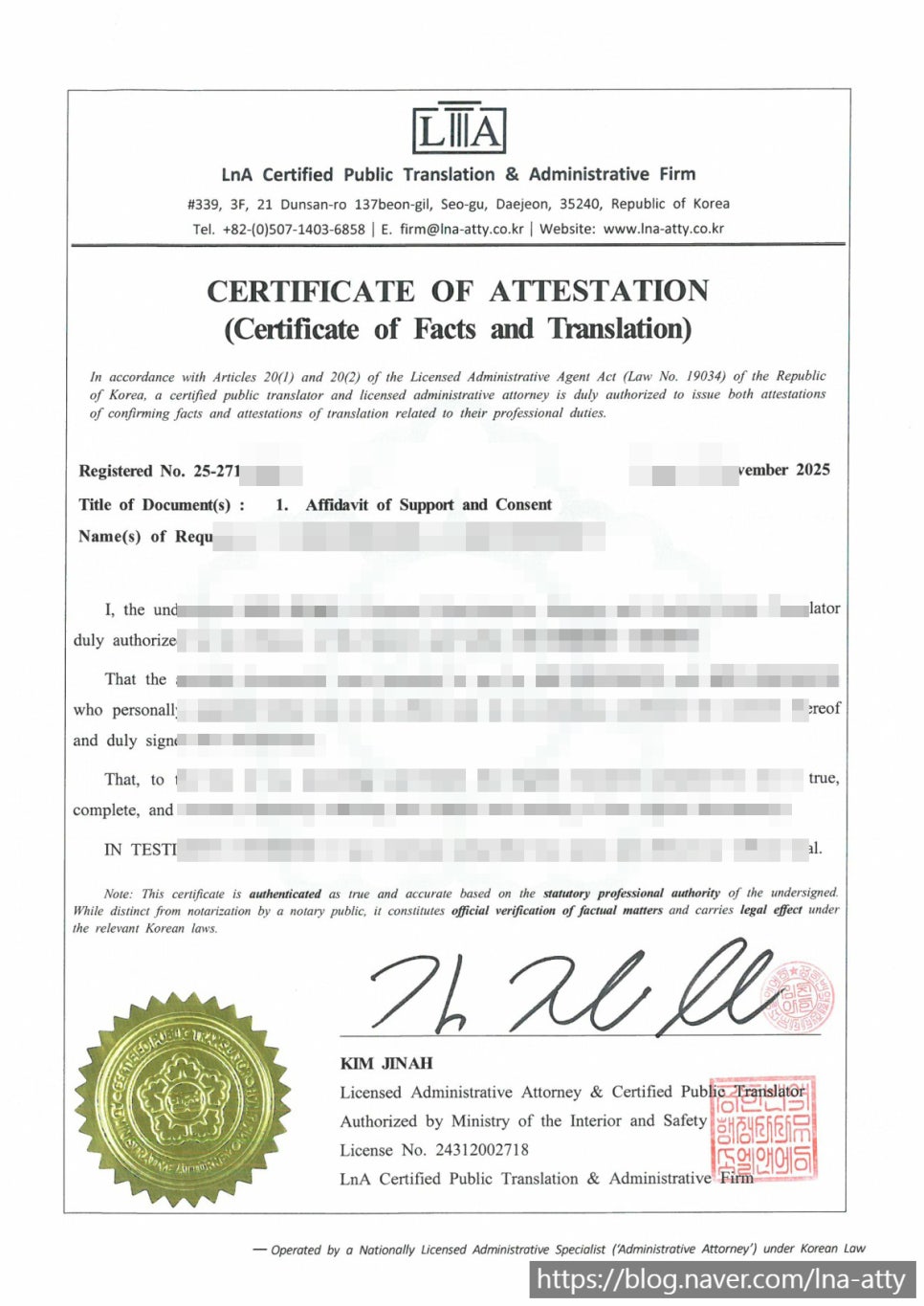
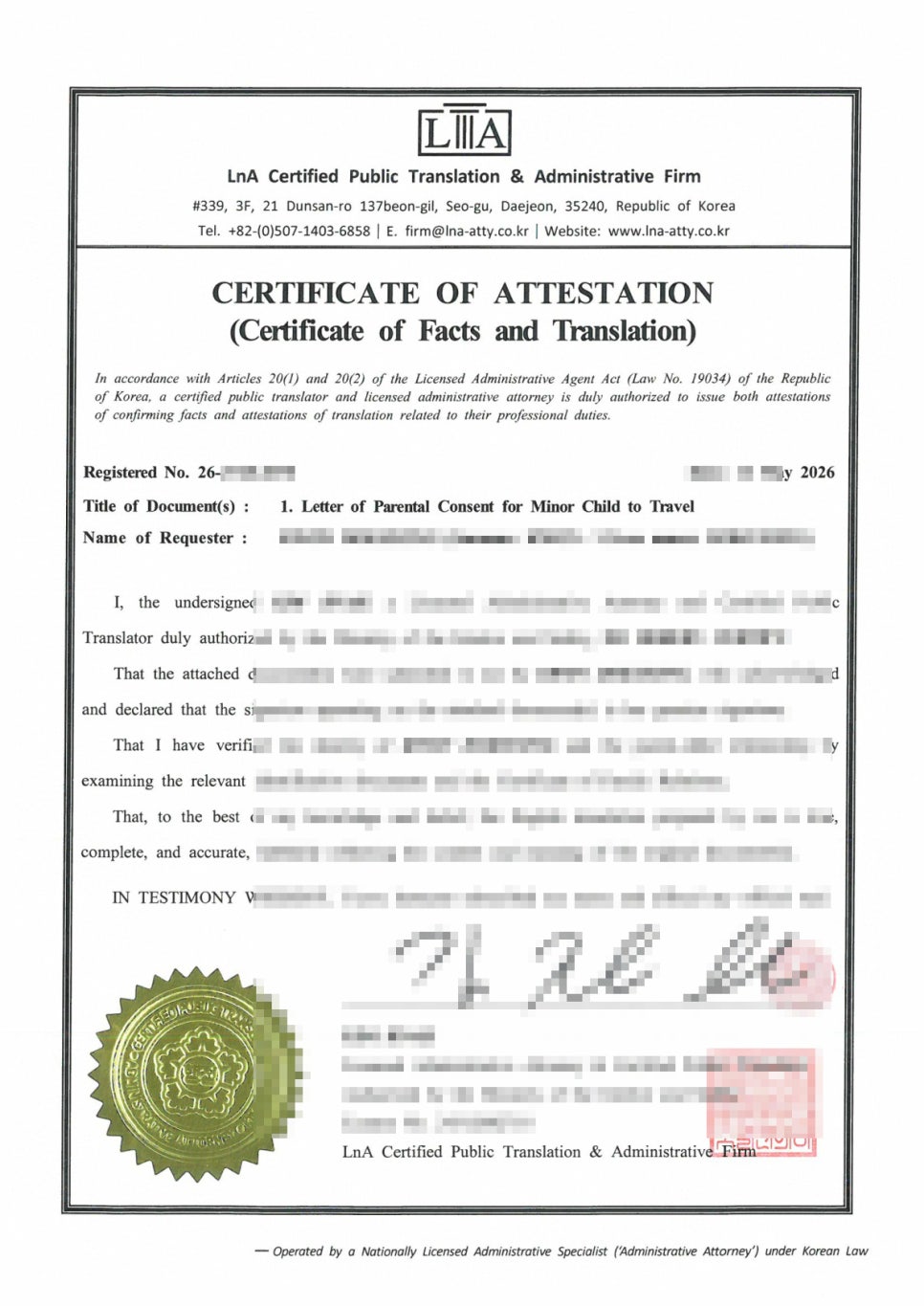
A Certificate of Attestation, issued under 행정사법 제20조 제1항 (a 행정사 may issue a certificate confirming facts related to their own work) and 행정사법 시행령 제21조 (limited to facts arising from that work), confirms the fact that a signed document was presented to the 행정사 — a practical, lower-cost alternative to a full notarization that a wide range of foreign institutions accept in practice.
Disclaimer: a Certificate of Attestation isn't a substitute for formal notarization or signature certification — it's issued under the administrative agent's own responsibility, and final acceptance depends on each receiving institution's own policy. Use of the document, and its outcome, is the user's responsibility.
Three ways this office can help
- Draft the consent letter (remote-friendly) — provide the destination country, child and chaperone details, and a country-appropriate English consent form is drafted and emailed back for the parent to sign and submit (with notarized signature if the destination requires it).
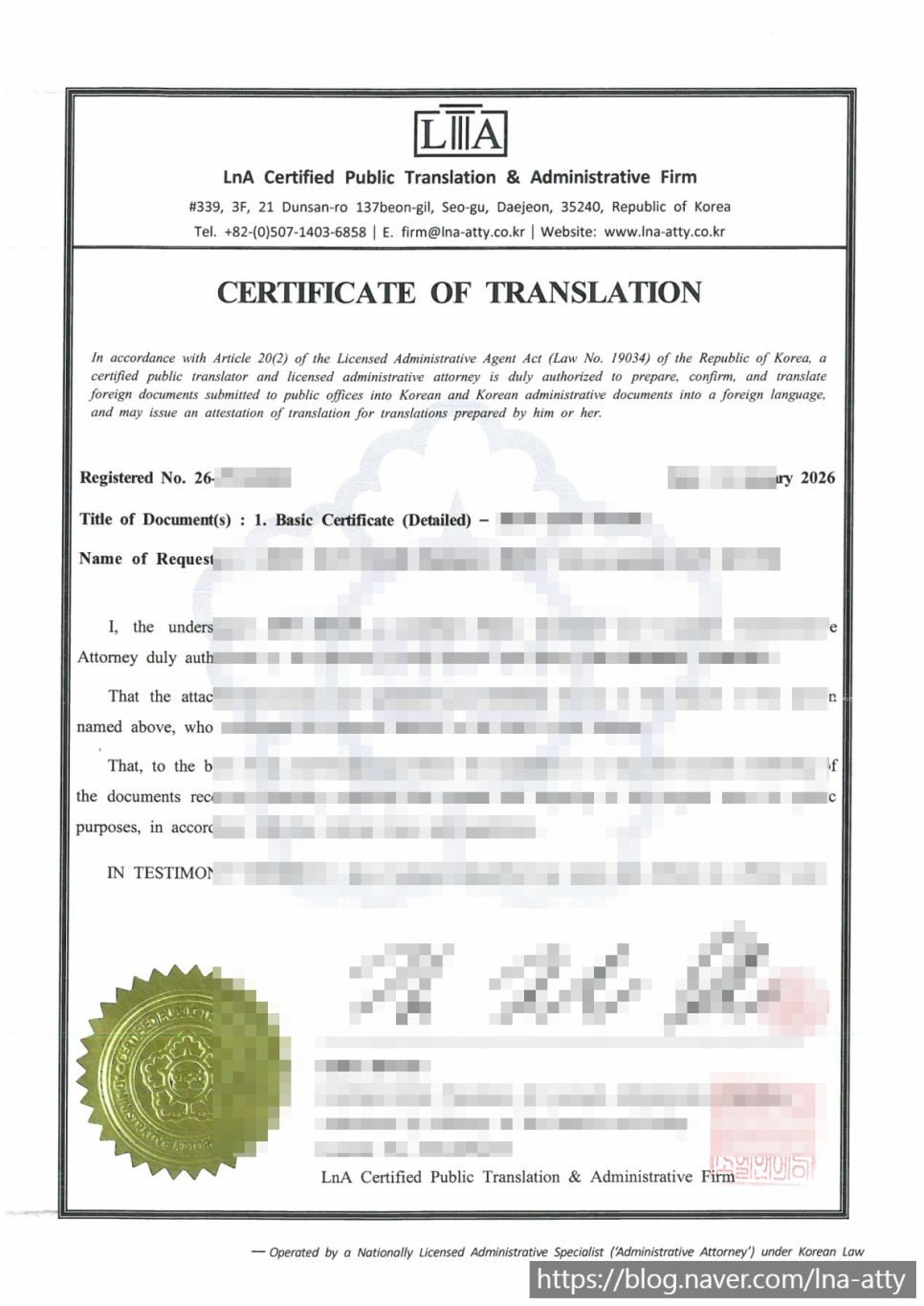
- Translate + certify an existing letter (remote-friendly) — send a scan or photo of an already-prepared Korean consent letter; it's translated and a 번역확인증명서 is issued and mailed. (Note: this verifies translation accuracy only, not the authenticity of the original document.)
- Certificate of Attestation — either in person (parent visits the office with ID and a family relation certificate to sign on the spot) or fully remote (signed original + supporting documents mailed in, a phone call confirms the parent's signature for the record, then the certificate is issued).
Information to have ready
- Travel details: destination country, arrival date, accommodation
- Child's info: name (Korean/English), passport number
- Parent's info: name (Korean/English), contact
- Chaperone's info: name (Korean/English), passport number
- Departure date and local accommodation
- Where to send the completed document
Case study: a niece traveling to Japan without her parents
An aunt planning an independent trip to Fukuoka, Japan with her elementary-school-age niece — without the child's parents — needed a parental travel consent letter and asked how to prepare it most safely.
Japan: not a legal requirement, but a strong recommendation with real consequences
Per the Korean Embassy in Japan, an unaccompanied minor cannot use accommodation alone in Japan — the consent letter is what proves the accompanying guardian (aunt, uncle, etc.) has been delegated authority over lodging and the trip generally by the legal guardian. Per the Japanese Embassy's own guidance, Japanese authorities check for genuine parental consent specifically to prevent international child abduction or unlawful transport when a minor travels without a parent. The letter isn't a strict legal requirement, but it's strongly recommended by multiple Japanese embassies/consulates, and airlines, immigration screening, and lodging providers frequently ask for it in practice — without one, screening can get difficult or, in the worst case, delay entry.
Documents typically needed for a minor's entry: the minor's and chaperone's passports, a copy of the parents' passports (photo page with signature), and an English-language family relation certificate issued for the minor child.
LnA's "premium safety certification" approach: smarter and more economical than notarization
A parental consent letter's entire purpose is proving the parent's true consent — so this office's process is built around that:
- The original consent letter is written in the parent's native language — ensuring the parent fully understands the content, so the true intent behind their signature is clear to the receiving country
- Certified translation under 행정사법 제2조 제1항 제3호/제4호 — the native-language original is translated with statutory backing for content accuracy
- Certificate of Attestation under 행정사법 제20조 제1항/제2항 — confirms the genuineness of the signature on the original consent letter itself
This dual legal basis — content accuracy plus signature genuineness — maximizes the document's credibility while skipping the cost of formal notarization, using a 행정사's own statutory authority to reach a comparable level of credibility at a more reasonable cost.
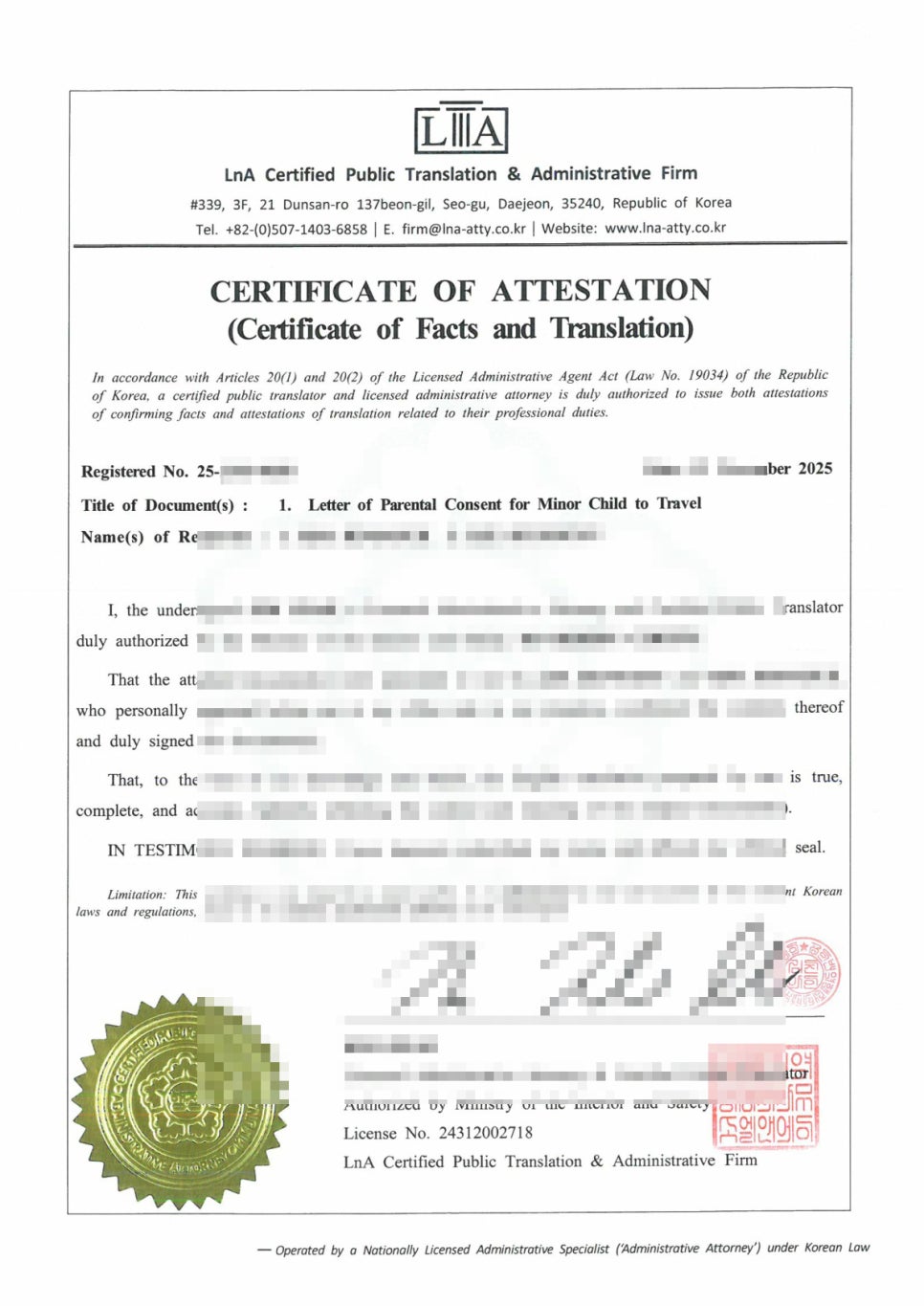
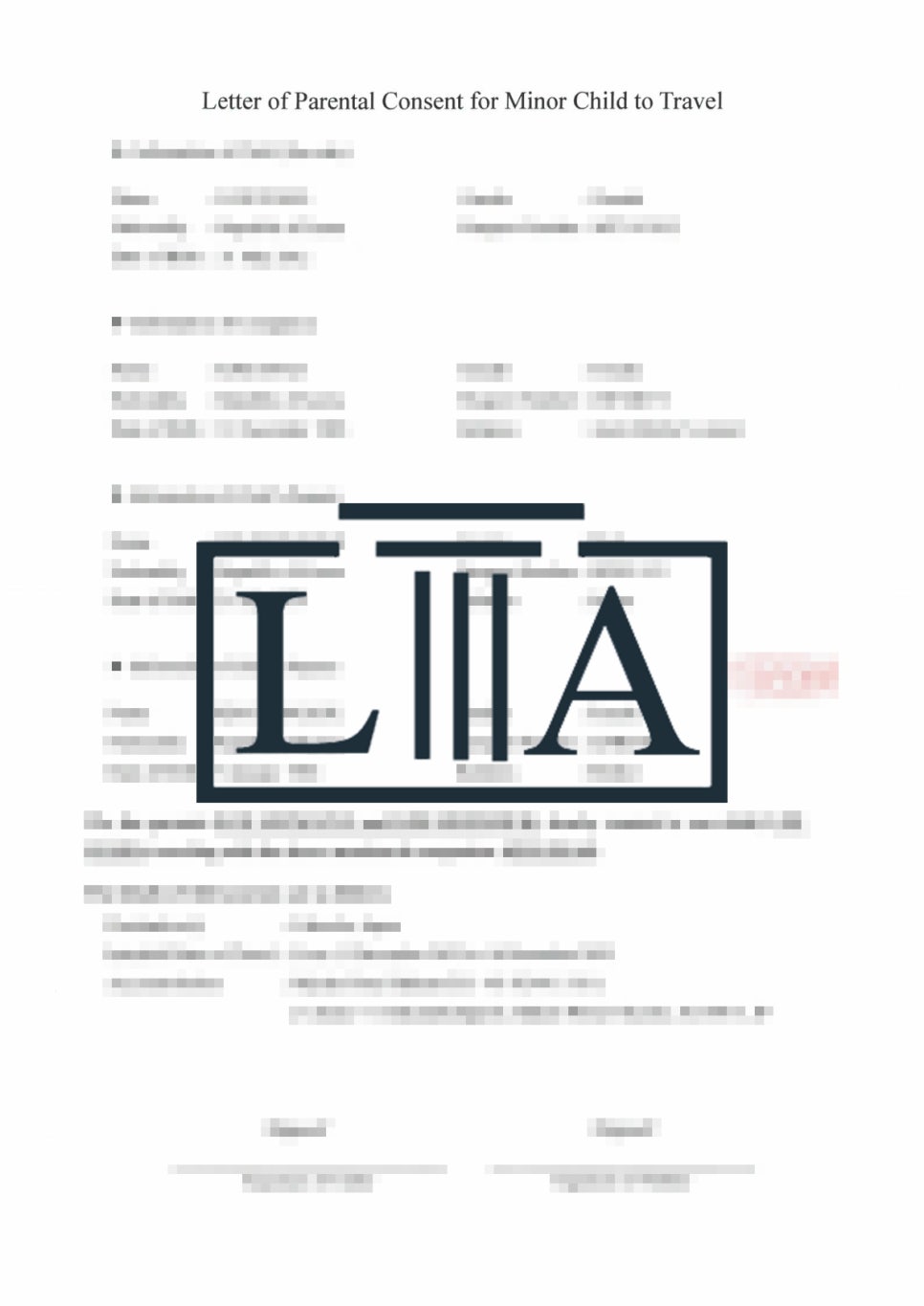
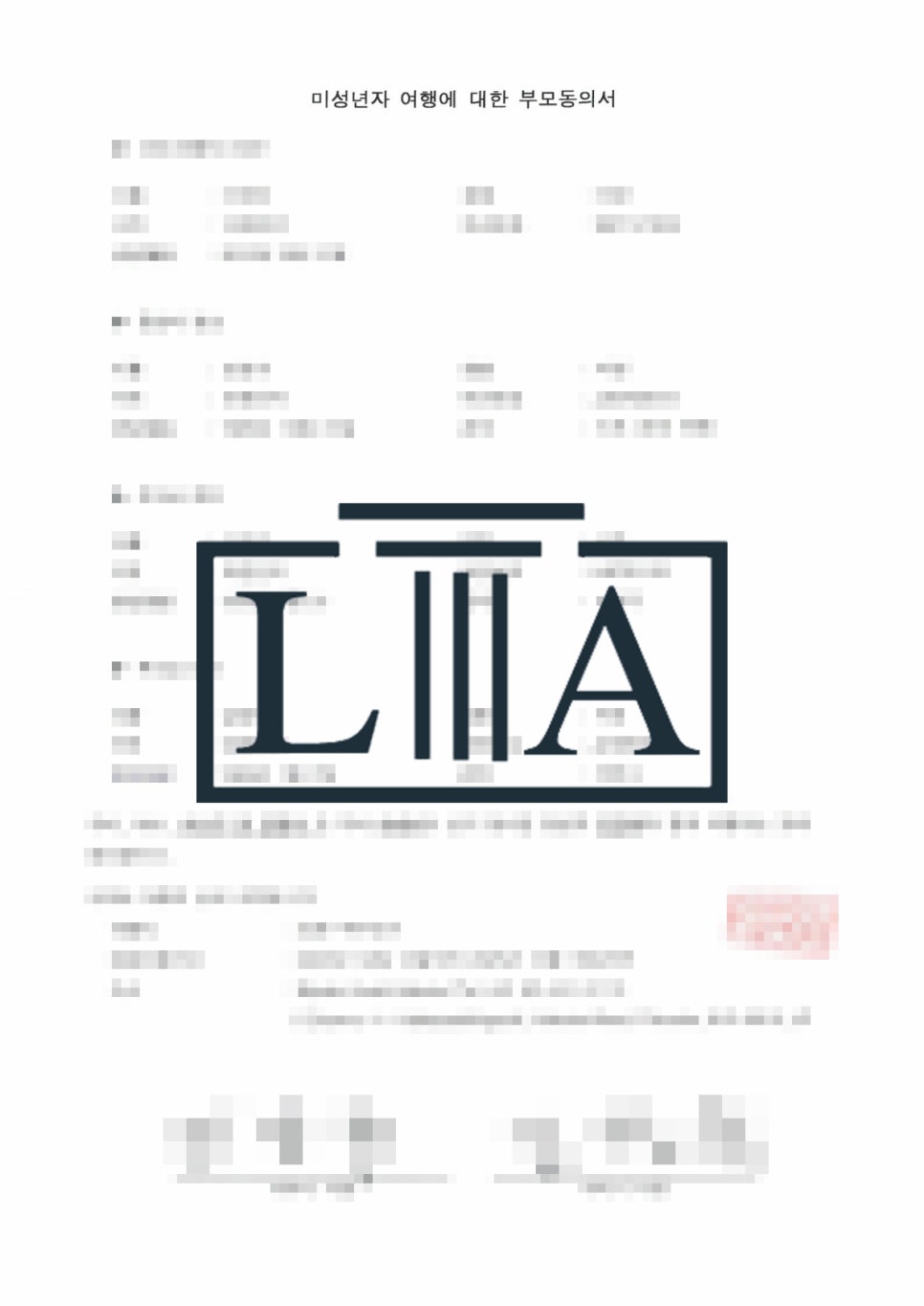
For this case, since the niece's parents live locally, the parent-language consent form was sent first; the parents filled it in and brought the signed original in person, where both parents' signatures were verified on the spot and the certified translation (already prepared in advance) was bound together with it — issuing the Certificate of Facts and Translation the same day.
Case study: a church group trip to Da Nang, Vietnam
A group of parents preparing a church-organized trip to Da Nang, Vietnam asked about consent letters for their minor children.
Four independent sources, one consistent answer
"Is a parental consent letter legally required to enter Vietnam?" — not a legal requirement, but strongly recommended by multiple official sources, each confirmed directly from their own guidance:
- Korean Embassy in Vietnam (immigration FAQ, as of 2024-08-19) — recommends carrying a parental authorization letter (English or Vietnamese translation) when entering with a non-parent guardian; does not require notarization
- Vietnamese Embassy in Thailand — an Authorization Letter isn't mandatory, but is strongly recommended to speed up processing
- Vietjet Air (Vietnamese low-cost carrier) — a minor under 14 traveling with someone other than a parent/guardian must have an Authorization Letter; notarization isn't specified
- Vietnam Airlines — requires an Authorization Certificate for a foreign-national child's companion on international flights to Vietnam
Every source independently converges on requiring the authorization letter itself, to confirm guardian accompaniment and the delegation of authority. An airline's "must have" condition is a particularly hard requirement — missing it can mean denied boarding, not just extra questions at immigration.
Why a freely-drafted consent form isn't recommended, even without a notarization requirement
None of these official sources explicitly demand notarization — but a form the parent freely drafted and signed on their own carries very weak credibility as a document. In international legal and administrative usage, "Authorization" specifically means an official approval and grant of authority from someone with legal standing to grant it — for the letter to actually function as that, the third party receiving it (an immigration officer, for instance) needs to be able to trust the content's authenticity and credibility.
A form the parent simply signed with no outside verification gives the immigration officer no way to confirm the signature is genuinely the parent's — leading to low trust, and a real risk of the officer raising questions, delaying screening, or in the worst case denying entry. Only a consent letter with the parent's true consent verified by an official third party (a 행정사 or a notary) reliably raises credibility during immigration screening or airline document review.
Documents needed
- An English-language family relation certificate (issued for the child)
- A copy of the parent's passport
If at least one parent enters together with the child, no additional documents are needed (though if the parent and child have different surnames, bring documentation proving the parent-child relationship).
Canada's IRCC: two different terms, two different legal weights
Canada's own immigration authority (IRCC) is unusually precise about this — its guidance uses two distinct terms for a minor's consent document depending on who's accompanying the child, and the word choice itself signals how much formality the document needs.
Documents by travel scenario (children under 18 are minors in Canada, following the same entry rules as any visitor):
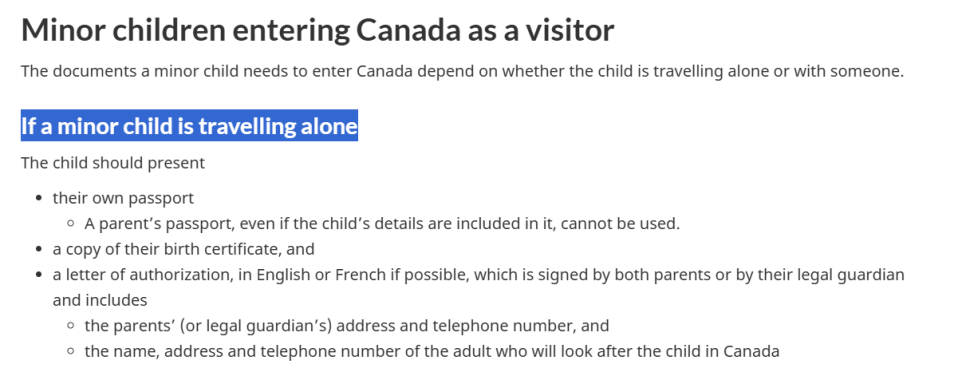
- Minor traveling alone: own passport, birth certificate copy (for Korea, an English family relation certificate), and a Letter of Authorization — signed by the parent/legal guardian with address/phone, naming the adult who'll take responsibility in Canada; notarization not required
- Minor traveling with only one parent: the child's passport plus a Letter of Authorization signed by the non-traveling parent, with that parent's address/phone and a signed copy of their passport or national ID
- Minor traveling with a non-parent/non-guardian adult: the accompanying adult needs a Written Permission Letter with the parent/guardian's contact info and the companion's details, plus a signed copy of the parent/guardian's passport or ID; notarization isn't required, and the document may not even be checked at entry — but is strongly recommended
Why the term itself matters
- "Letter of Authorization" (used when a parent, or a legal guardian, or a lone-traveling child needs to establish authority) means an official grant of authority from someone with legal standing — not a mere permission, but the legal decision-maker formally authorizing the trip on their own authority. Since proving that the true authority-holder's genuine intent is behind the document is the whole point, having it certified by a 행정사 (or notarized) is the practically safer, more credible route.
- "Written Permission Letter" (used when the accompanying adult is not the parent/guardian, who still holds primary legal authority) is framed by IRCC around simple consent and permission — its narrower purpose is confirming in writing that a third-party adult is allowed to accompany and temporarily supervise the child.
IRCC states outright that "the letter does not need to be certified" for the Written Permission Letter — but immediately follows with a pointed warning: "it is strongly recommended that you bring them. The minor child will not be admitted to Canada if the officer is not convinced that the parents or legal guardians have authorized their stay." The real message: if the officer isn't convinced the consent is genuine, entry gets denied — which is exactly why maximizing the document's credibility through certification is the practically safest choice, regardless of the technical non-requirement.
Notary vs. 행정사 certification: a genuine choice, not a fixed answer
When the receiving institution doesn't explicitly require notarization, choosing between a notary's certification and a 행정사's certification comes down to your own priorities:
| 행정사 certification | Notary certification | |
|---|---|---|
| Legal basis | 행정사법 | 공증인법 |
| Document issued | Certificate of Attestation (translation + fact certification) | Notary's Notarial Certificate |
| Credibility level | Sufficient credibility for submission to an administrative body | Certifies the document's formal genuineness with full legal evidentiary weight |
| Cost & time | Most efficient — reasonable cost, fast turnaround | Most conservative — higher cost, potentially more time |
| Best for | Getting a credible document prepared quickly at a reasonable cost | Prioritizing maximum document security above cost considerations |
Rush case: less than 24 hours before departure, accommodation still undecided
A client requested an urgent parental consent letter with under 24 hours before departure — for a Japan trip where the child's chaperone was a friend's mother, the itinerary was set, but accommodation hadn't been booked yet.
What's actually reliable about unaccompanied-minor entry to Japan
Confirmed facts specific to this scenario: immigration screening itself rarely raises problems over a missing consent letter, but Japanese law restricts several legal acts for minors — most relevantly, a minor cannot check into lodging alone. So while a parental consent letter isn't a strict legal requirement, it's strongly recommended precisely because of the lodging restriction, not the immigration checkpoint itself. Practical tip: most Japanese lodging providers require a parental consent letter at check-in for a minor guest — checking the specific property's required format and certification method before travel is the safest approach.
Preparing a standard-form letter when the hotel isn't booked yet
When accommodation isn't confirmed yet, this office prepares a standard-form consent letter accepted broadly across Japanese lodging providers, rather than waiting on a property-specific form. It includes:
- The legal guardian's explicit consent to the minor's overseas travel and use of lodging
- The chaperone's relationship to the family and the purpose of accompanying the child
- Confirmation that the parents bear responsibility (including financial and other legal liability) for anything arising during the minor's stay at the lodging
This is the most practically safe approach when a property-specific form can't be secured in advance.
The credibility detail people miss: signature matching
As a 외국어번역행정사, verifying identity is central to making a parental consent letter credible — and signature consistency is a detail people frequently overlook. Two situations come up often in practice:
- The parent's passport signature field is blank
- The consent letter's signature doesn't match the passport signature
Since lodging providers and immigration screening sometimes cross-check signatures, this office enforces:
- If the passport is already signed: the consent letter's signature must exactly match the passport signature.
- If the passport signature field is blank: sign the consent letter first, then sign the passport identically, and only then prepare the passport copy.
A signature mismatch can raise unnecessary doubts about the document's authenticity at the destination.
How this rush case was actually handled
- Confirmed the destination country's specific requirements, then prepared a case-appropriate consent letter and its English translation
- Guardian signature verification: the father visited this office in person to verify his signature; the mother, unable to visit, was verified as the same person via ID presented remotely
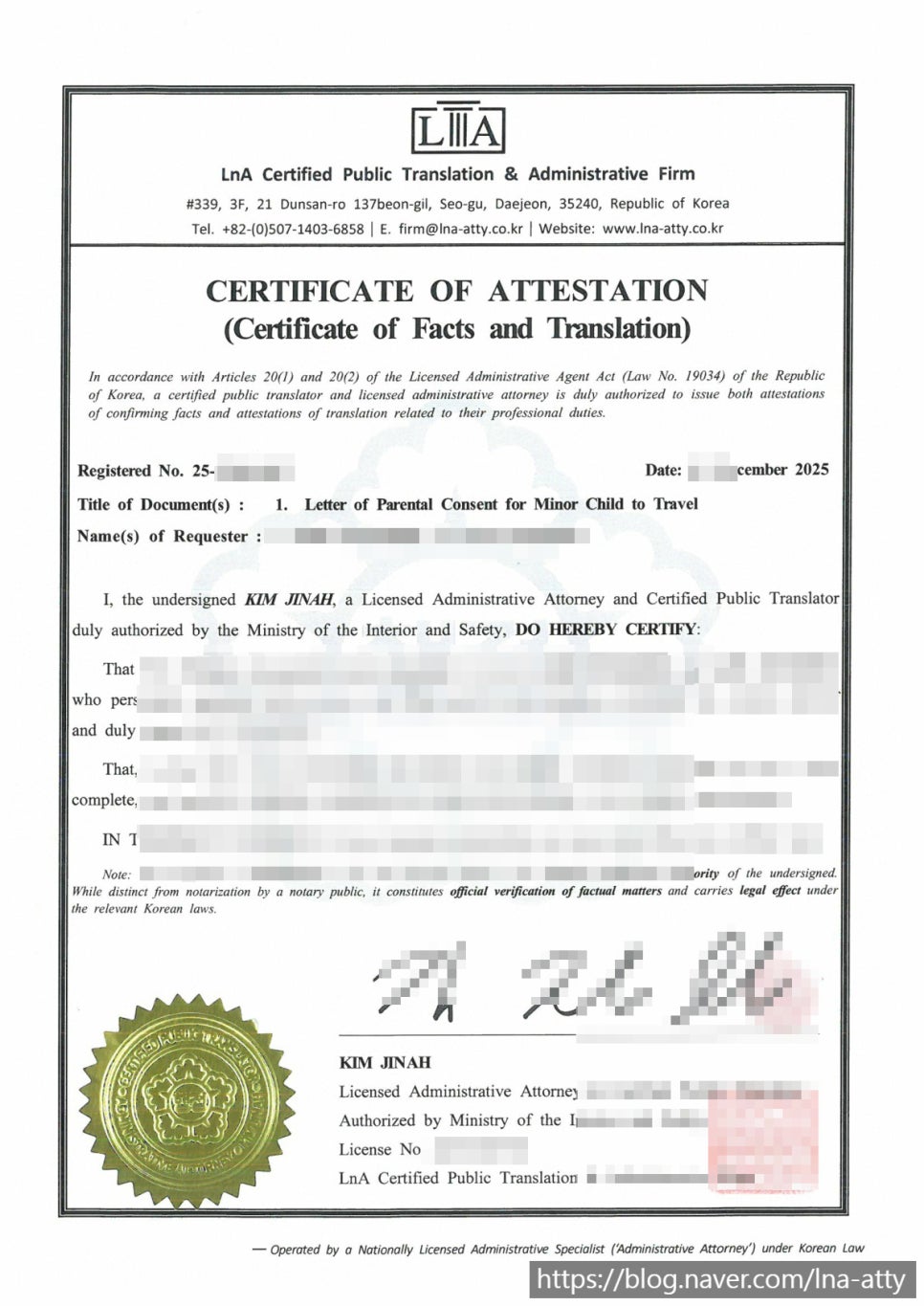
- Translation and Certificate of Attestation issued under this office's own statutory authority
Every step was completed quickly enough to keep the departure schedule on track. The core principle even under time pressure: build the document on official information, not unverified internet advice — accurate, credible paperwork minimizes the odds of a problem arising at the destination.
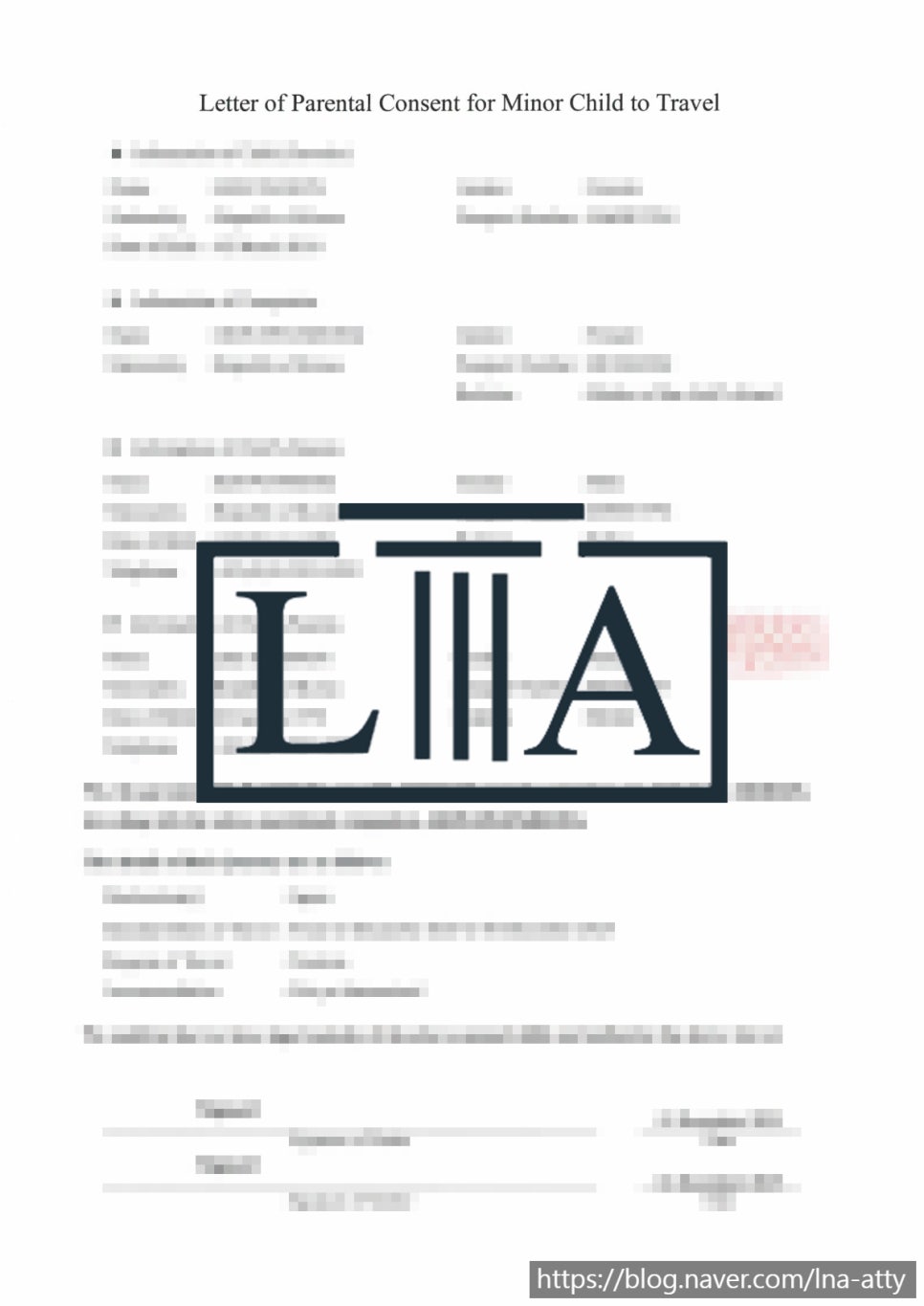
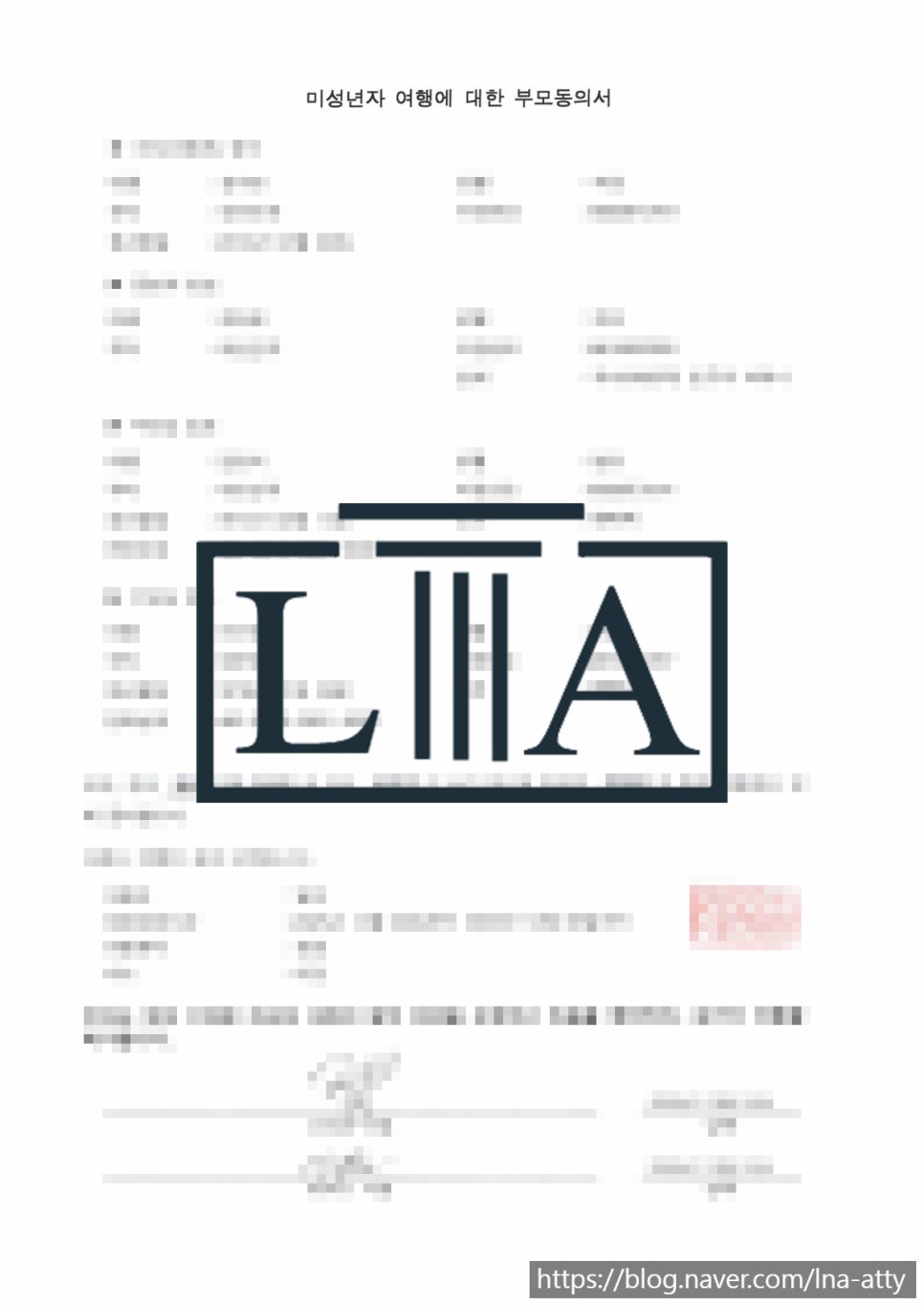
A grandmother-accompanied trip — reviewing a client-drafted consent form, not just stamping it
A mother preparing for her child's winter-break trip to Da Nang, Vietnam — accompanied by the grandmother, not a parent — had already downloaded and filled out an English parental consent template found online herself. Rather than simply notarizing or certifying that self-drafted document as-is, this office applied the same review standard used on every consent letter it handles: confirming the parent's signature is genuine, confirming the parent-child relationship, and only then issuing the certification.
The review and verification process
The client visited the office in person and confirmed, in front of a licensed 외국어번역행정사, that the signature on the consent form was her own genuine signature. The office also collected copies of both parents' ID and the child's family relation certificate, cross-checked that the names and relationship stated in the consent form matched those official records, and recorded that confirmation directly in the certificate itself. The self-drafted English content was also translated into Korean and given back to the mother to review, so she could confirm in her own language that what she was signing said exactly what she intended before the certification was finalized. The final output combined a translation and a Certificate of Attestation (사실확인증명서) in one document.
Why this matters even for a document the client already prepared
A signed consent letter alone doesn't establish who actually signed it or whether that person is genuinely the child's parent — this office's role isn't to rubber-stamp a client-provided form, but to independently verify both facts against ID and family-registry documents before certifying anything, regardless of whether the document was drafted from scratch or brought in already filled out.

A child detained at US entry — a mother's own certificate wasn't enough
A real, urgent case: a mother traveling alone with her minor child was stopped during US entry screening. She had prepared only a Korean Supreme Court-issued English family relation certificate, with no separate parental consent letter — believing that, as the mother physically present, it wouldn't be an issue. Because the mother and child had different surnames (common in Korea, since children generally keep the father's surname even after a parent's remarriage or name change), and both mother and child had a name-change history that made the parent-child relationship harder to trace on paper, the CBP officer immediately demanded "proof of the parent-child relationship based on birth" — and the child was moved into protective custody procedure pending that proof. The grandmother in Korea, contacted urgently by the mother from the US, reached out to this office directly.
Why the English family relation certificate alone wasn't sufficient
The Supreme Court's English family relation certificate is a newer, deliberately simplified certificate created to prove birth and marital relationships for the high foreign demand that exists for such proof — precisely because it's simplified, it doesn't fully capture a birth-based parent-child link when a name-change history is also involved. US entry screening works in two steps: first confirming the birth-based parent-child relationship, then confirming the current custody/legal-guardian relationship — so screening explicitly asks for proof going back to birth, not just a current-state snapshot. This is especially true post-divorce, when a parent travels without the other spouse's consent — the evidentiary bar rises further.
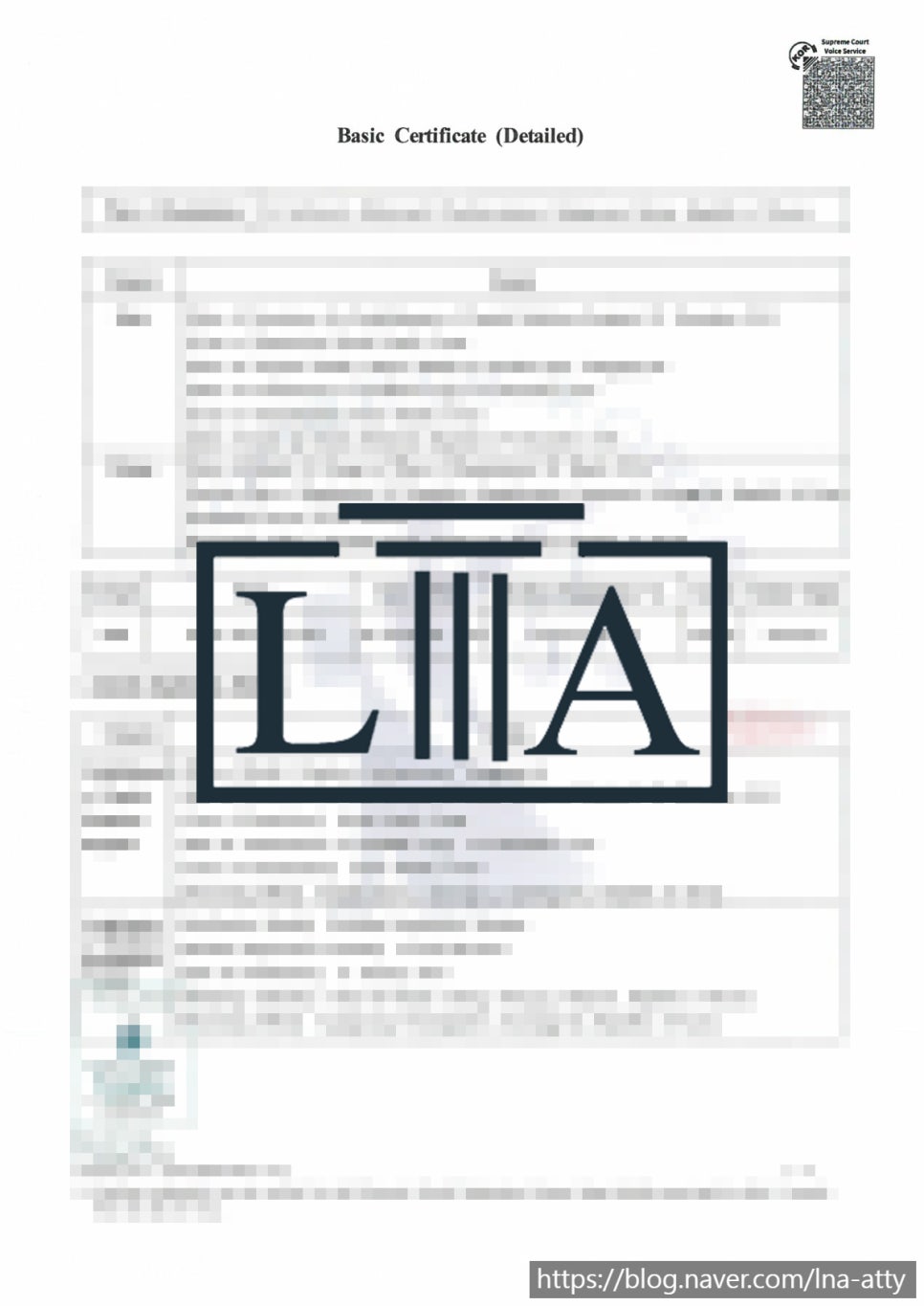
The document that actually resolves this: 기본증명서(상세) (Detailed Basic Certificate)
In a case this complex — divorce plus a name-change history overlapping — the single most reliable piece of evidence is Korea's 기본증명서(상세), which shows, in one connected document: the fact of birth, the custody designation and any subsequent changes, and the full name-change history (former name matched against current name). Without all of this information told as one coherent, connected narrative, clearing entry screening becomes very difficult.
Reframing the parental consent letter for a sole-custody case
Divorced households aren't rare today, so how should a parental consent letter be prepared in a sole-custody situation? Here, the letter functions less like a standard "consent" and more like a sole-custody declaration — the key content is whether it clearly establishes that the signer is the child's sole legal guardian, is signing in that capacity, and is lawfully traveling with the child without infringing on any other legal guardian's rights. This case's document set: a parental consent letter explicitly stating sole custody, 기본증명서(상세), the English family relation certificate, and name-change history documentation.
An urgent remote resolution
Given the urgency, this office completed translation and issued the 번역확인증명서 quickly. The grandmother received the physical original documents in person; since the mother in the US wasn't comfortable using her phone for this, the completed certified translation was converted to PDF and JPEG files and delivered remotely to her in the US.
The underlying principle
A similar-looking situation doesn't guarantee a similar outcome — much depends on the individual entry officer's discretion and the specific circumstances at the time. This case wasn't a matter of "having no documents" — it was a matter of the documents on hand not fully proving the birth-based relationship the officer needed to see. If divorce, sole custody, or a name-change history applies to your situation, preparing more than the standard document set — with professional guidance — is strongly recommended.
Follow-up: proving the current protective relationship, not just the parent-child one
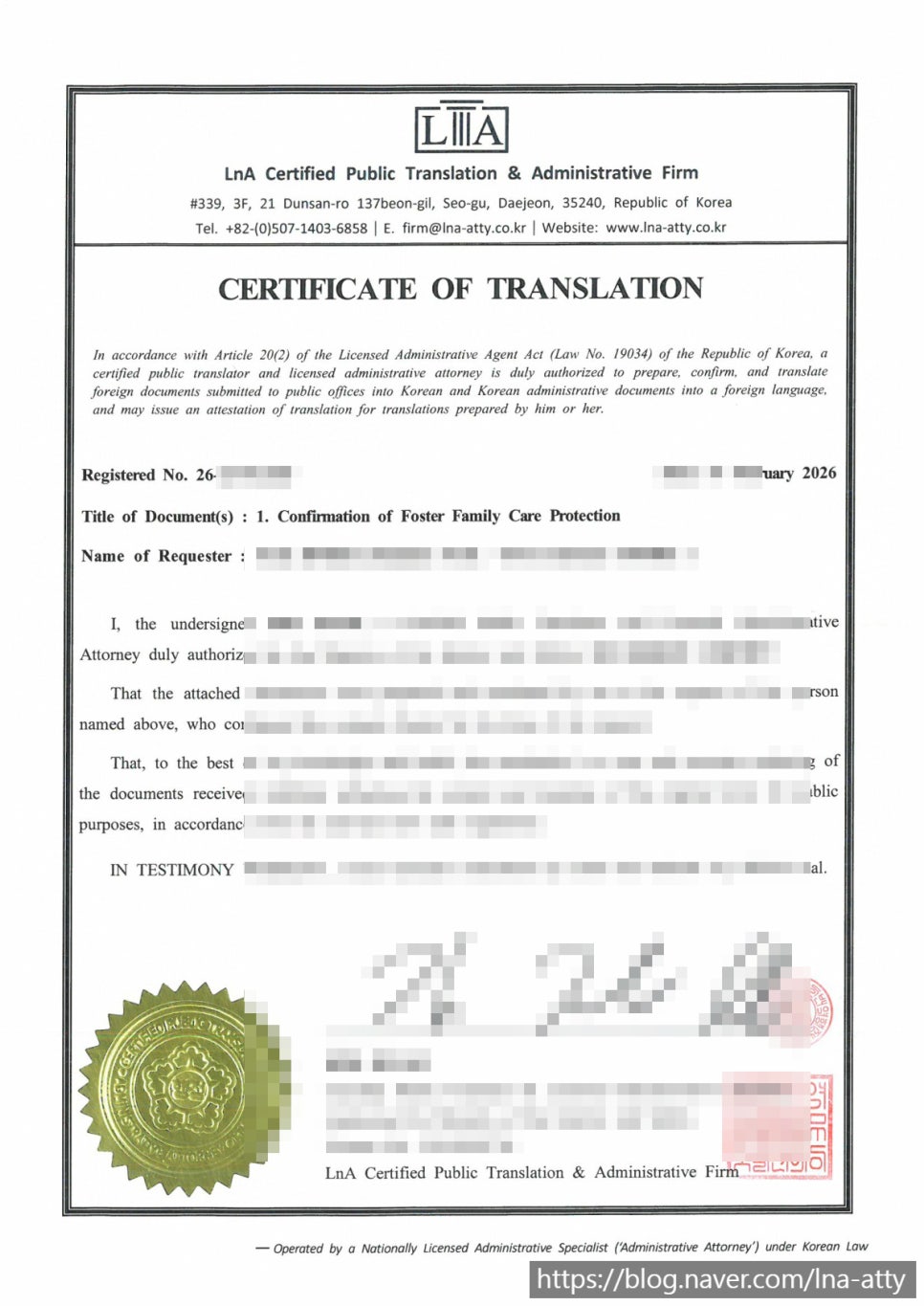
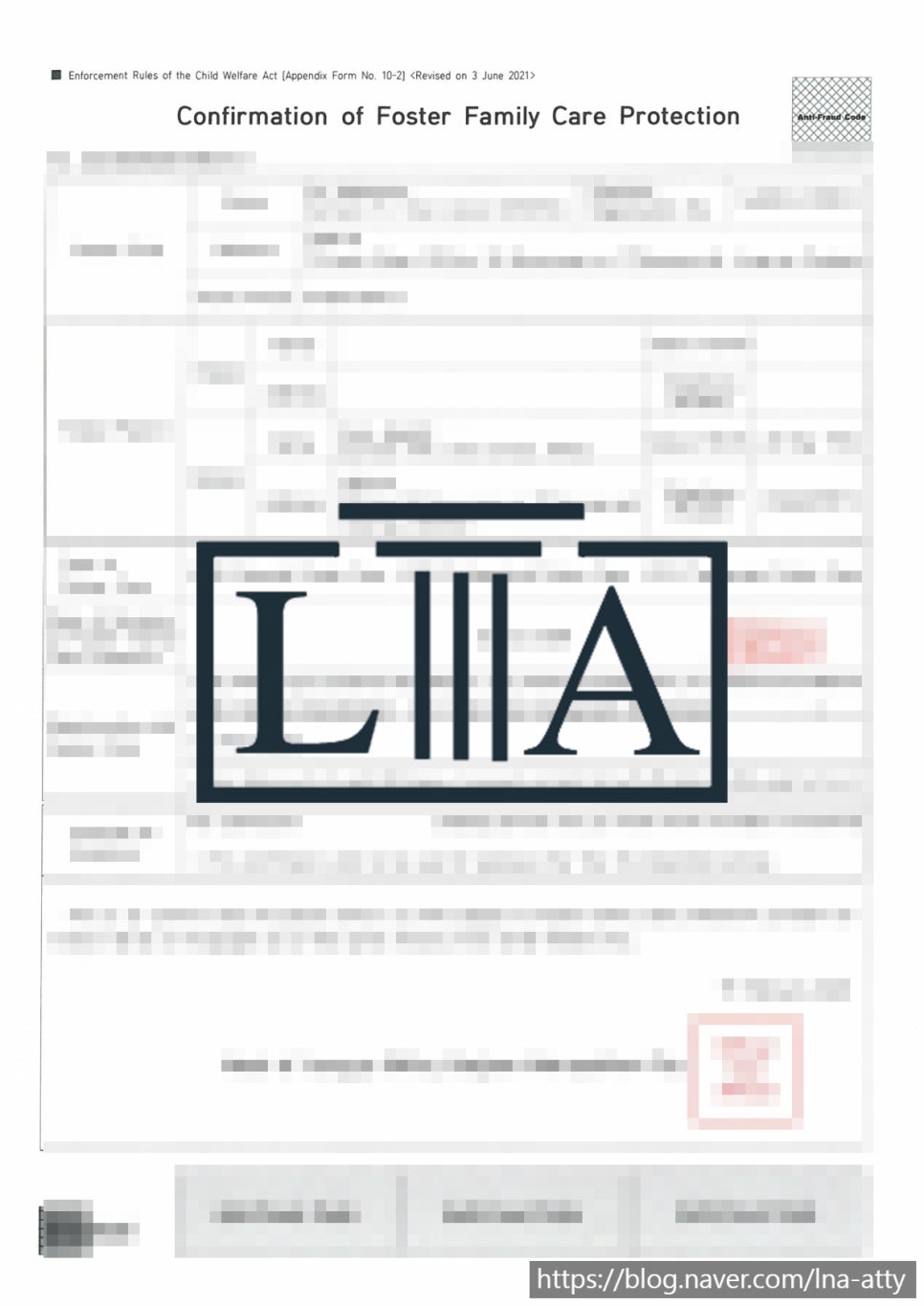
Even after submitting the 기본증명서(상세) documenting the birth-based parent-child relationship (the case above), US authorities came back with an additional request: clearly proving the current custody/protective relationship as well. This office translated and certified a 가정위탁보호 확인서 (Foster Care Confirmation Certificate) to address it.
What a Foster Care Confirmation Certificate is
Under Article 15 of Korea's Child Welfare Act, this certificate is issued by the head of a local government to confirm that a child is currently in family foster care. It documents the foster child's identifying details, the type of foster placement (general/specialized/temporary), the date the placement decision was made, the relationship to the foster caregiver, and the legal basis. Family foster care (가정위탁) is an administrative child-protection arrangement — placement is determined and time-limited by administrative decision, not a court order.
When this document gets requested
- When immigration screening requires proof of a child's current custody status and actual living arrangement
- When the caregiver isn't a parent but a foster caregiver, and a school needs proof that the foster caregiver holds real authority over the child's schooling and daily life
- When establishing the legal protective relationship is required to enroll a child in overseas medical insurance or access welfare services
Term choice: "위탁보호자" as "Foster Parent," not "Guardian"
Some translations render 가정위탁보호자 literally as "Guardian." But that risks real confusion under US law: in the US, foster care is an administrative protective/placement arrangement, while guardianship is a court-ordered arrangement. Using "Guardian" risks implying a transfer or deprivation of parental rights that Korean family foster care doesn't actually involve — Korea's 가정위탁 system doesn't transfer or strip parental authority. This office translated the term as "Foster Parent," aligned with how the concept is actually used in US practice — a role clearly distinct from an adoptive parent, referring to someone performing a protective caregiving role under the foster-care system.
The underlying principle
This document was prepared to precisely reflect the statutory text's structure, clearly state the foster-placement type and protective relationship, and use terminology that avoids any misunderstanding of the underlying administrative protection concept — completed for submission to US authorities on that basis.

What usa.gov's own official guidance actually requires — and what "notarized" really means
As US entry screening has tightened, inquiries about parental consent letters for a minor traveling to the US have surged. usa.gov's own official guidance for non-U.S. citizen children specifies steps meant to prevent child trafficking and unlawful abduction — the officer's real concern is whether the letter was actually written with both parents' genuine consent.
Is literal US-style notarization required?
Not necessarily. When the US government's guidance uses the word "notarized," it doesn't mandate American-style notarization specifically — the US notary system and Korea's own notarization/administrative-certification system aren't equivalent to begin with, and the guidance itself states notarization is preferred, not required. Read functionally, "notarized" is really asking whether a credible third party confirmed that the person genuinely signed, that they genuinely intended to consent, and that the document is authentic — a request to substantively verify the document, not a demand for one specific country's notarization format.
This office's 5-step Certificate of Attestation process
- Both parents (or the non-traveling parent) visit the office in person.
- Parent ID and parent-child relationship documents are reviewed.
- The consent letter is drafted, and the non-accompanying parent's genuine consent is confirmed in person.
- English translation.
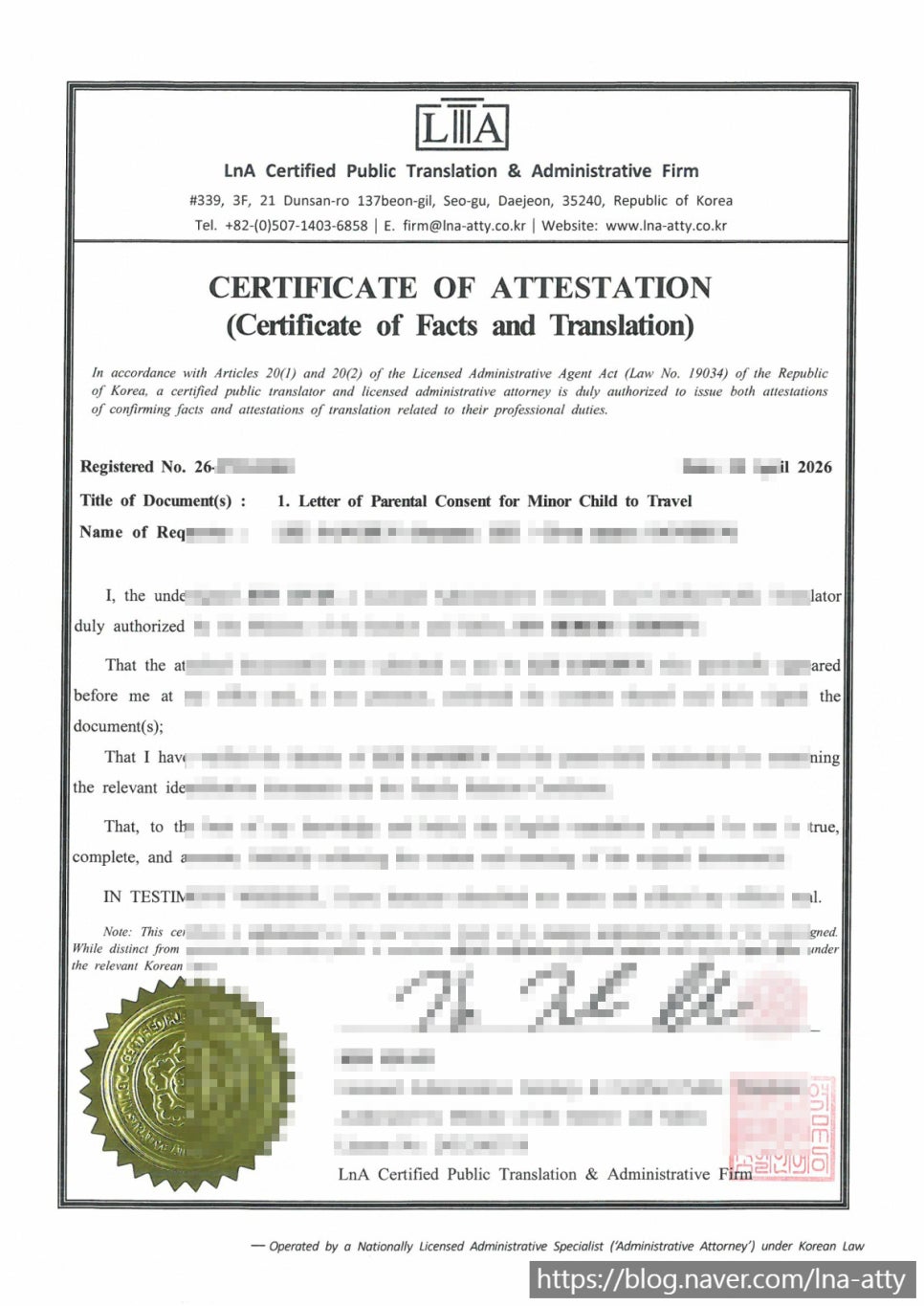
- Translation and signature-fact certification.
In short: the non-accompanying parent actually appears at the office, and this office issues a Certificate of Attestation confirming the signer's identity and their genuine intent to consent — functionally matching exactly what US practice cares about (identity of the signer, genuine consent confirmed) and fulfilling the intent behind the US government's "Acknowledgment" request.
A real case: mother and child traveling without the father
A client visiting last month had a trip planned with the mother and child traveling to the US without the father, requiring proof of the father's consent. Both parents visited the office together; after carefully reviewing the documents provided, this office drafted the father's consent letter and completed the signing procedure. No further contact since suggests the trip went smoothly.
The underlying principle
The US government's own guidance describes this as a recommendation, but in practice, an entry officer's discretion means missing documentation can still delay or deny entry — especially for a minor traveling alone, a single accompanying parent, or a case involving international marriage, divorce, or custody circumstances. Preparing a parental consent letter in advance is the safer choice in all of these situations.

Only one signature possible, though both parents are listed on the family relation certificate
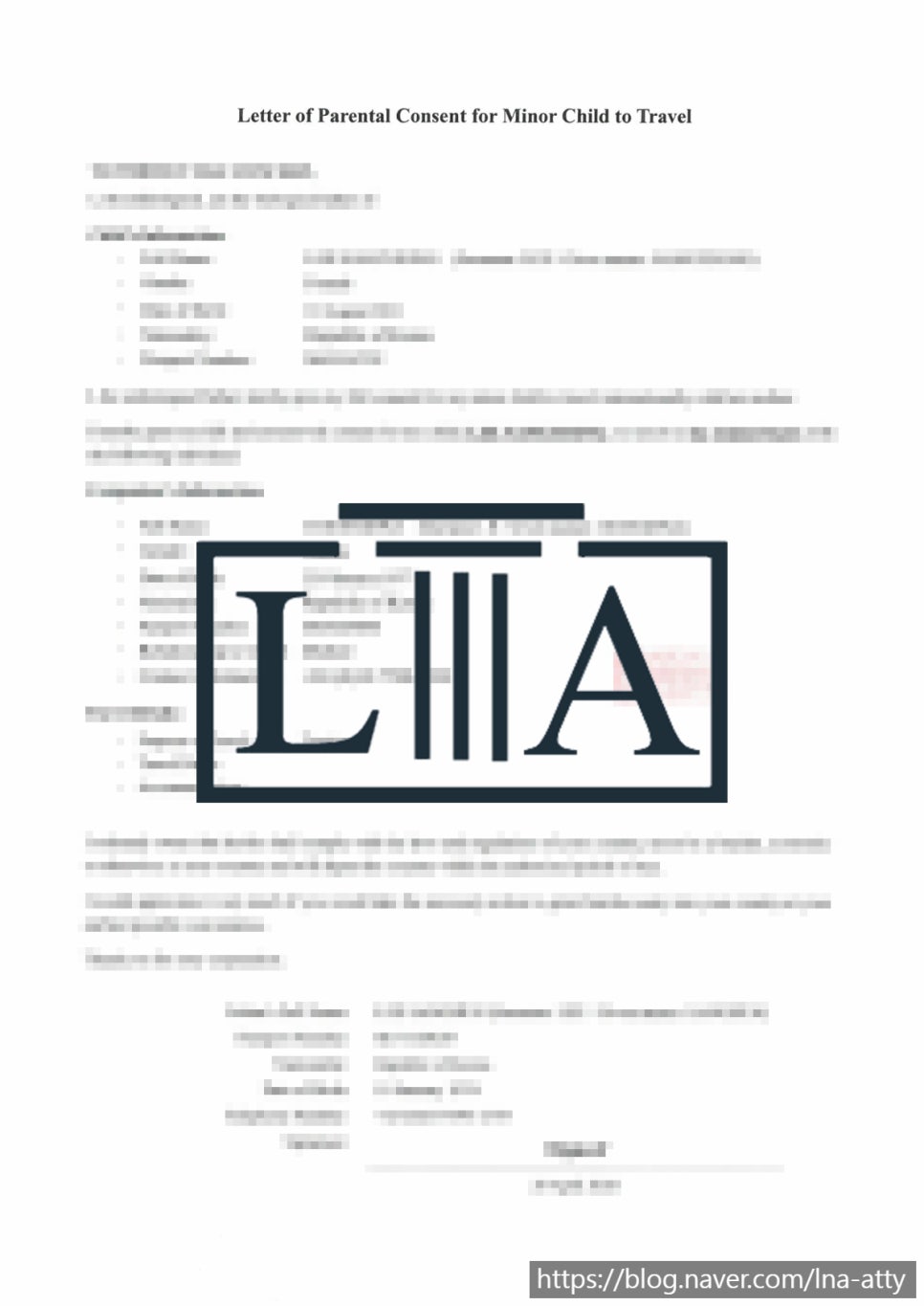
A recent request stood out from the usual case: the family relation certificate listed two parents, but the actual travel situation meant only one signature could realistically appear on the consent letter — the mother was traveling with the child while the father, departing separately, would receive the child later in the US.
Why a single signature can read as a red flag to a US officer
The US treats minor protection and child-crime prevention with extreme strictness. Seeing one parent's signature missing, an immigration officer reviewing the document could reasonably wonder whether the other guardian's consent exists at all. This office designed the document specifically to resolve that doubt before it could even arise.
A consent letter isn't a template — it's built around the actual travel logistics
This office doesn't treat a parental consent letter as a form to fill in with names. Who's accompanying the child, which parent is signing, and who will receive the child locally can all change how the document itself needs to be structured — this office weighs all of that through consultation and builds each case's document differently.
What this case's document specifically did
- Clearly stated within the consent letter itself the reason the father couldn't sign in person alongside the mother.
- Included the father's information as the parent who would receive the child in the US, so the actual travel arrangement connected naturally and legibly to the document's content.
The underlying principle
A parental consent letter's real substance goes beyond language translation — it's about genuinely verifying the parents' authentic intent and identity. This office doesn't just confirm translation accuracy; it also verifies factual consistency within what the submitted materials can establish, then issues a Certificate of Attestation reflecting that. Considering the consent letter's actual submission purpose and real-world use case — not just the form itself — is what this office considers the real weight and professionalism behind the document.

The Right Method for Genuine Parental Consent
Get in touch about thisFrequently Asked Questions
Do I need a notary, or is a translation certificate enough?
It depends on what the destination country/airline actually asks for — a 번역확인증명서 confirms translation accuracy, while a notarized signature or Certificate of Attestation confirms the signing act itself. Many receiving institutions accept the latter as sufficient proof of genuine parental consent.
What is a Certificate of Attestation, exactly?
A document issued under 행정사법 제20조 제1항, confirming the fact that a signed document was presented to a licensed 외국어번역행정사 — a practical alternative to full notarization, widely accepted by foreign institutions in practice, though it isn't a substitute for formal notarization.
Can I do this entirely remotely, without visiting the office?
Yes — mail in the signed original, family relation certificate copy, and passport copy, complete a phone verification call, and the Certificate of Attestation is issued and mailed back, scan sent first for speed.
I don't have a consent letter yet — can you draft one?
Yes — provide the travel and traveler details and a country-appropriate English consent letter is drafted and sent by email, ready for the parent to sign.
Is a Certificate of Attestation guaranteed to be accepted everywhere?
No — acceptance depends on the receiving institution's own policy; it's widely accepted in practice but isn't a universal legal guarantee, and responsibility for how the document is used rests with the user.