Need a CRBA translated for use in Korea?
Certified English-to-Korean translation of a Consular Report of Birth Abroad (CRBA) and similar foreign vital records — for school enrollment, health insurance dependent registration, and other Korean institution submissions when no Korean family relation certificate exists.
Accurate English-to-Korean Translation for Korean InstitutionsA U.S. citizen family living in Korea occasionally needs the reverse of the usual case — not a Korean document translated for a foreign institution, but a foreign vital record translated into Korean for a Korean institution to accept.
What a CRBA is
A Consular Report of Birth Abroad (CRBA) — full name: Consular Report of Birth Abroad of a Citizen of the United States of America — is issued by a U.S. embassy or consulate to a U.S. citizen child born overseas. It carries the same legal effect as a birth certificate for U.S. passport applications and citizenship proof.
Under U.S. jus sanguinis (citizenship by descent) rules, a child born anywhere gains U.S. citizenship if at least one parent is a U.S. citizen (with additional requirements if only one parent is a citizen).
Why CRBA matters specifically in Korea
If both parent and child hold U.S. citizenship with no Korean nationality, Korean authorities have no 가족관계증명서 (family relation certificate) to issue for them — there's no Korean family registry entry to draw from. In that situation, the CRBA becomes the key document proving the parent-child relationship, since it lists the child's name, birth date, and birthplace alongside the parents' names.
When Korean institutions ask for a CRBA
- School enrollment — international schools or general Korean schools when enrolling a child
- Health insurance registration — registering as a dependent under an employed parent's coverage, or under regional (self-employed) coverage
- Other administrative matters — foreigner registration, real estate registration, and other legal filings
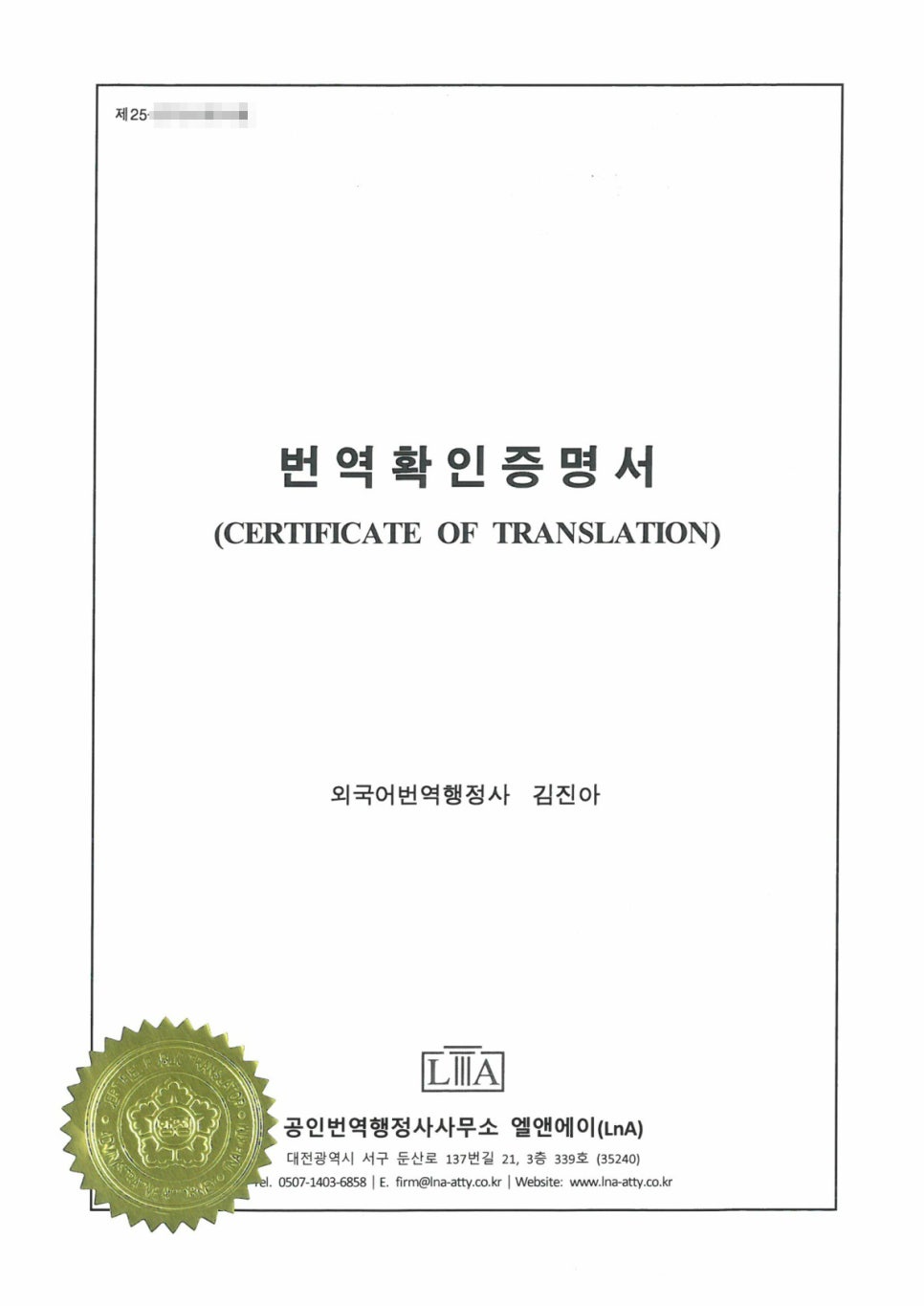
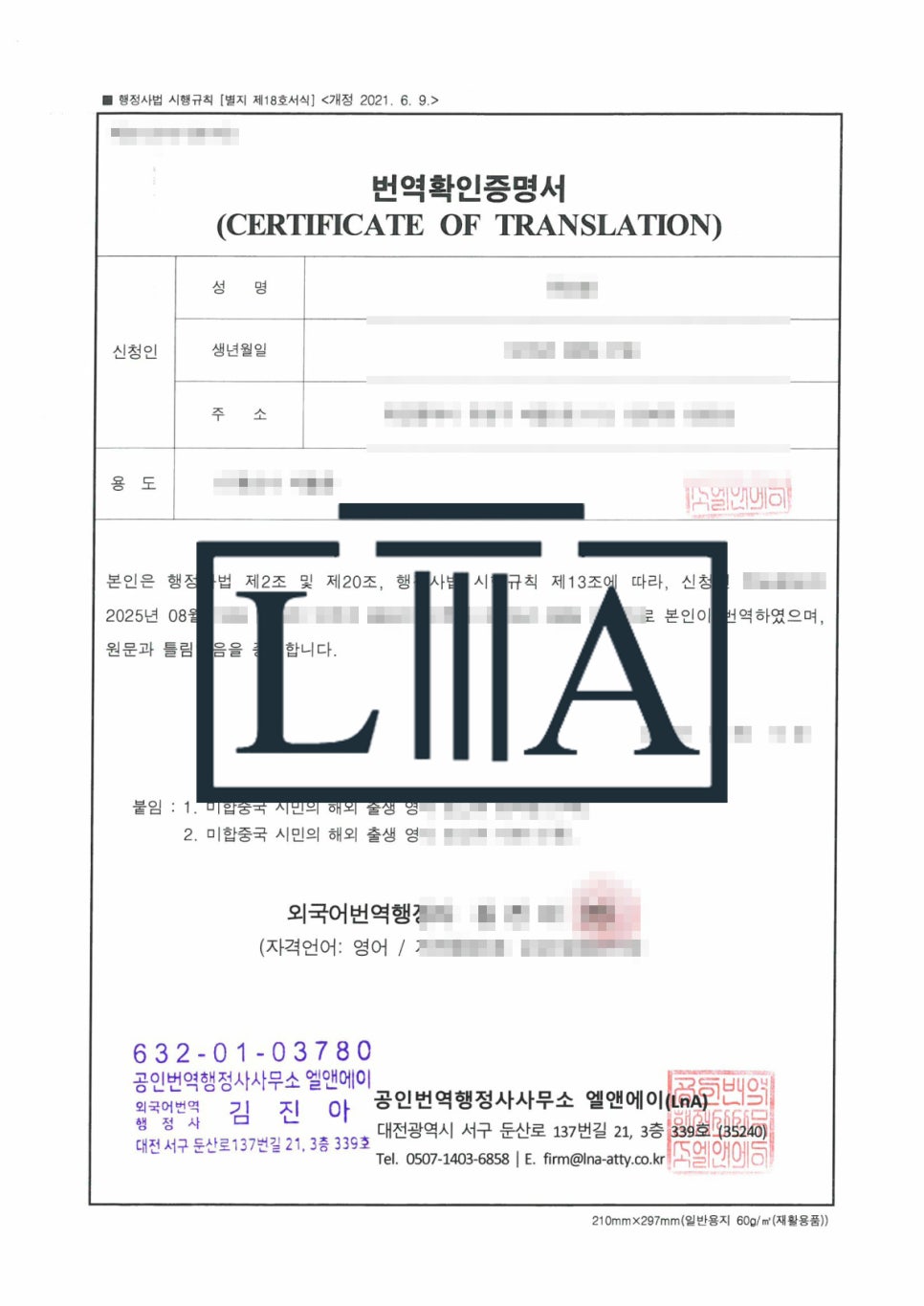
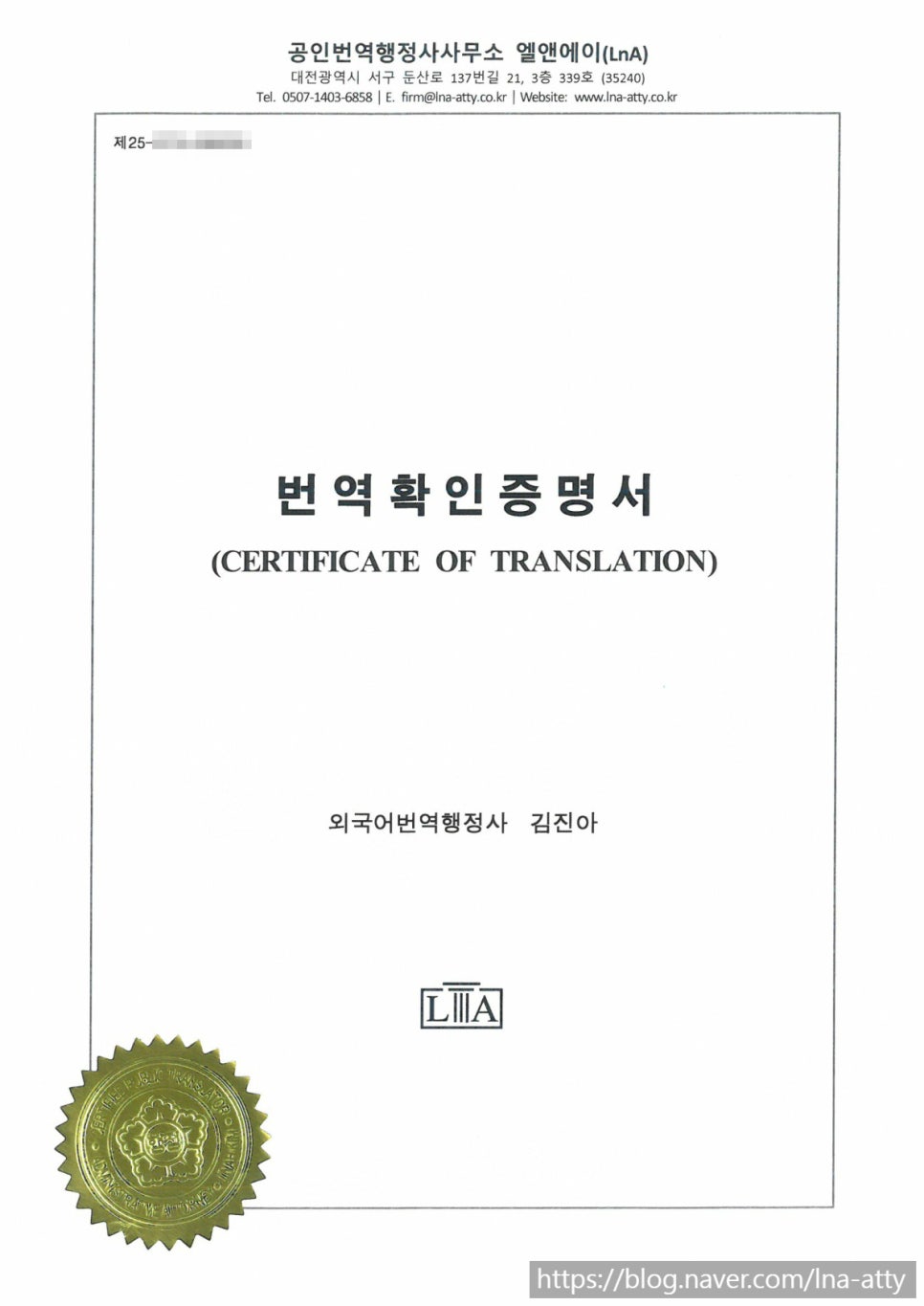
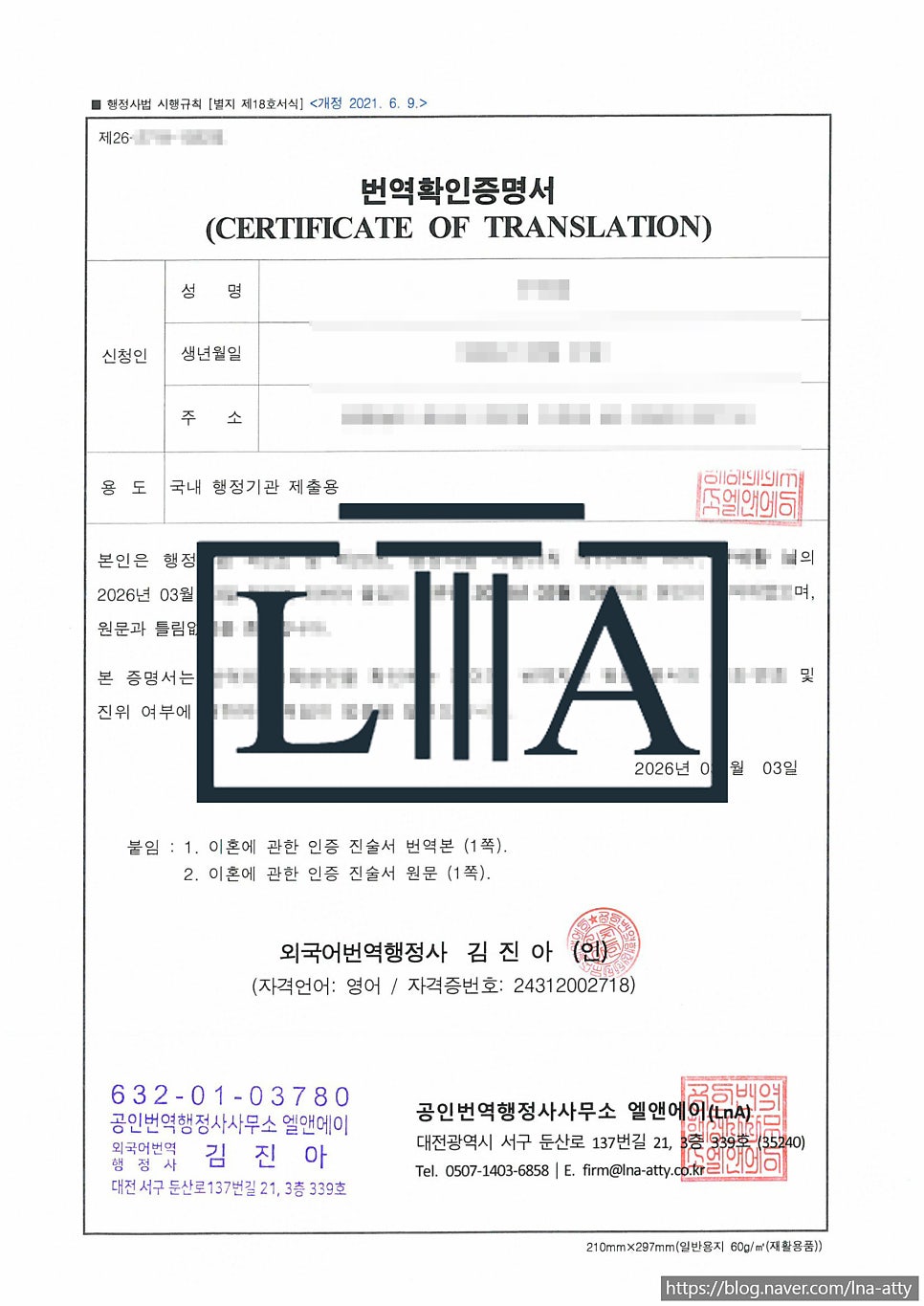
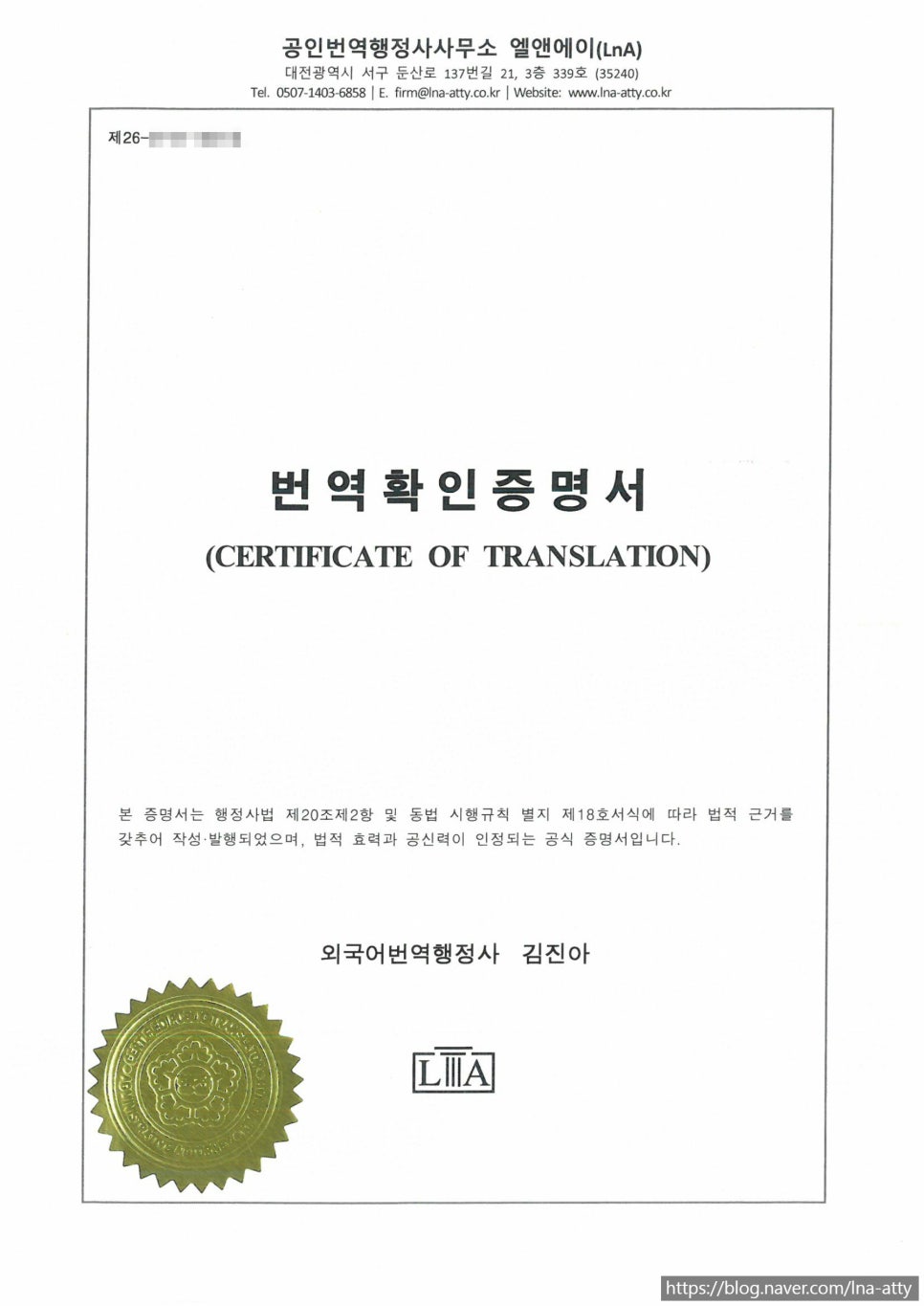
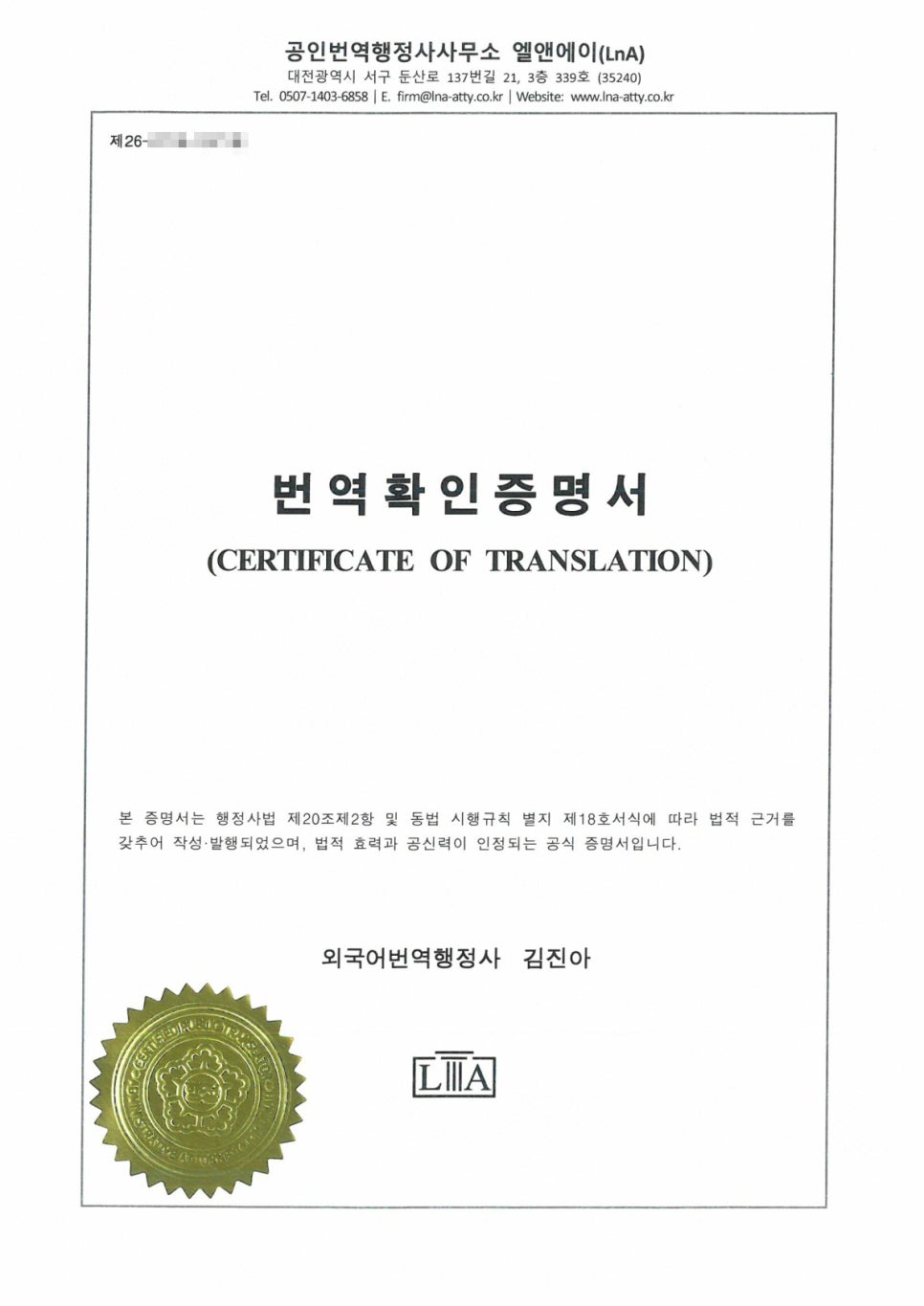
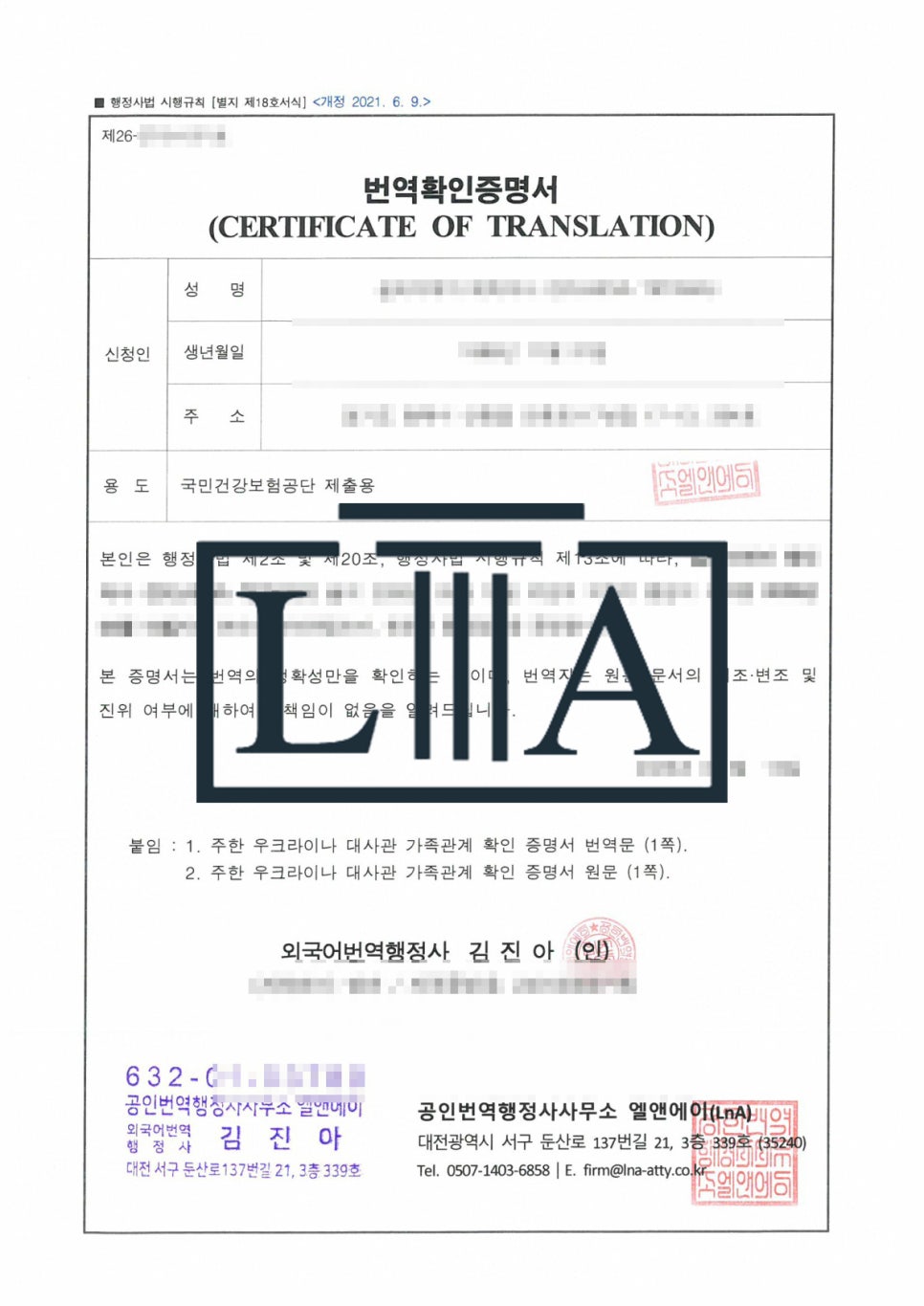
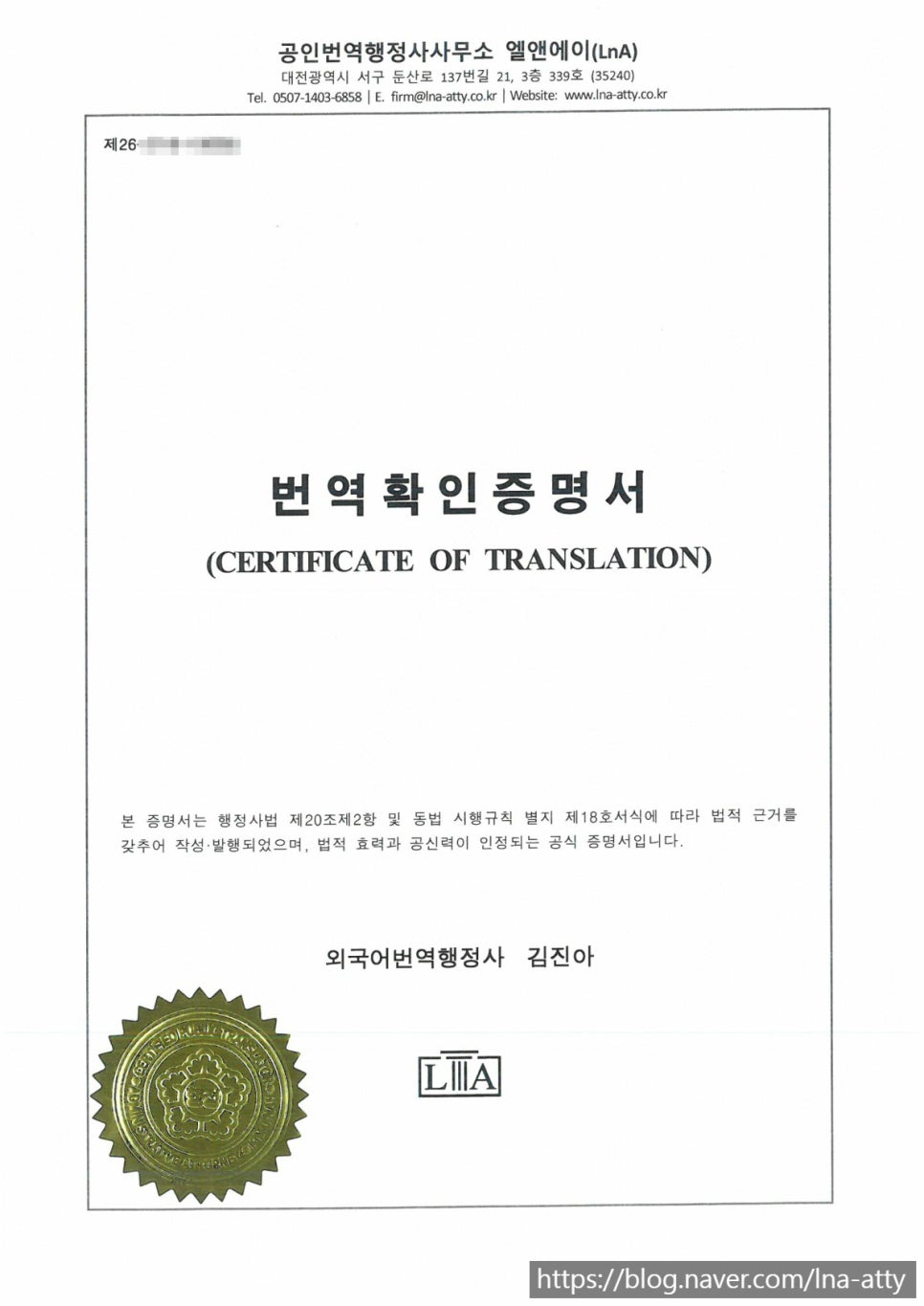
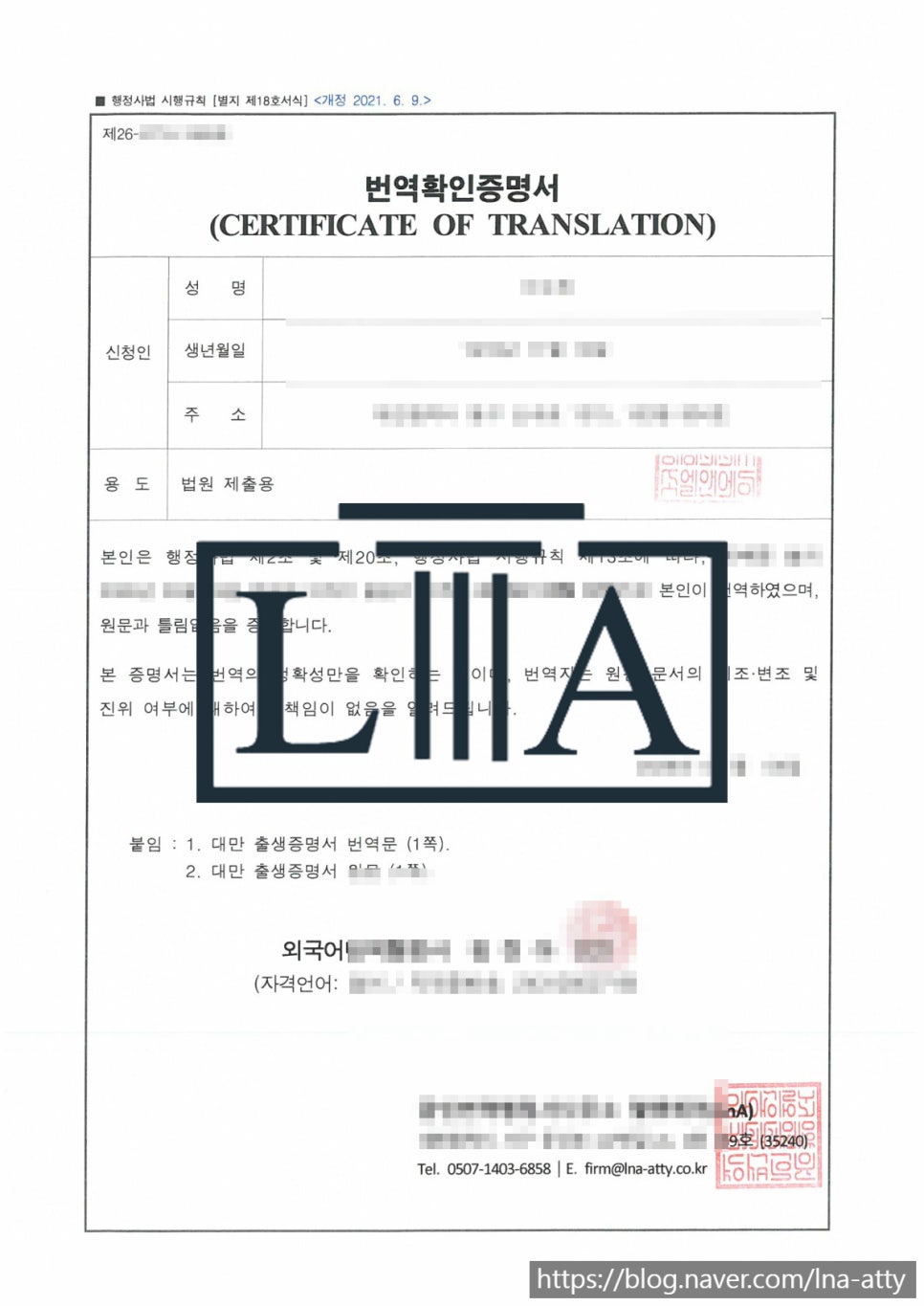
Most Korean government offices require both the English original and a translation issued by a 외국어번역행정사 with a 번역확인증명서 attached (some institutions may instead accept a notary office's notarized translation).
Translation precision points specific to CRBA
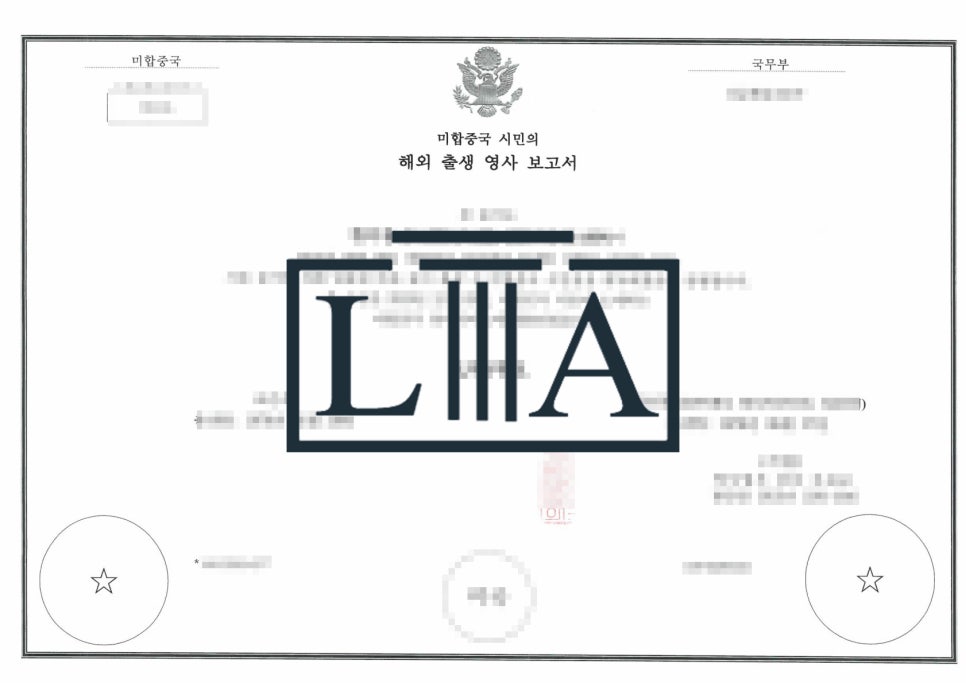
- Official terminology — "United States of America" translates to "미합중국," "Department of State" to "국무부," using the correct official Korean government terminology, not a casual rendering
- Name formatting — when both an English and Korean name appear, the correct format depends on the document's purpose and what the receiving institution requires: for domestic submissions, the name registered with Korean authorities (e.g. alien registration) generally takes priority, with the English name added alongside when matching the original document matters
- Term choice — "Consular Service" is more accurately translated as "영사 서비스" (consular services, broadly) rather than "영사과" (consular department specifically), to preserve the source term's broader meaning
Getting a document like this accepted by a Korean institution depends on matching both the receiving office's required format and procedure — not just producing an accurate translation.
Another common case: a Virginia Marriage Register for NHIS dependent registration
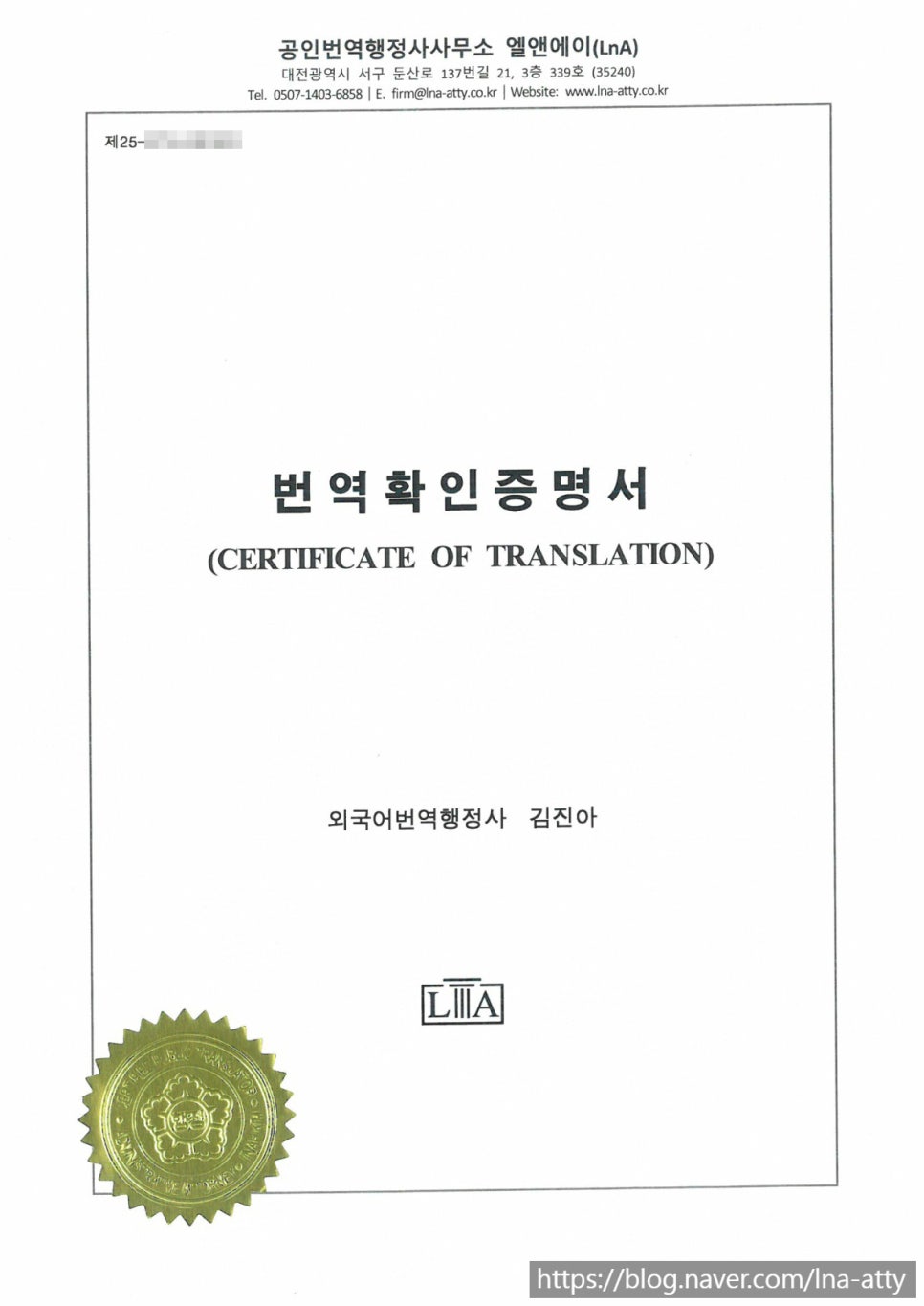
A U.S.-citizen professor at a national university in Daejeon needed to register a spouse as a dependent with the National Health Insurance Service (NHIS) — one of the required documents was a Virginia Marriage Register, translated and issued with a 번역확인증명서.
Virginia's system differs from most other U.S. states: instead of separate license and certificate documents, the entire marriage process is recorded on a single integrated document. A Virginia Marriage Register combines:
- Marriage License — the permit obtained before the marriage
- Marriage Certificate — proof the marriage was legally completed
- Plus the Clerk of Court's certification, all on the same record — making the Register itself the authoritative English document for both domestic and foreign submissions.
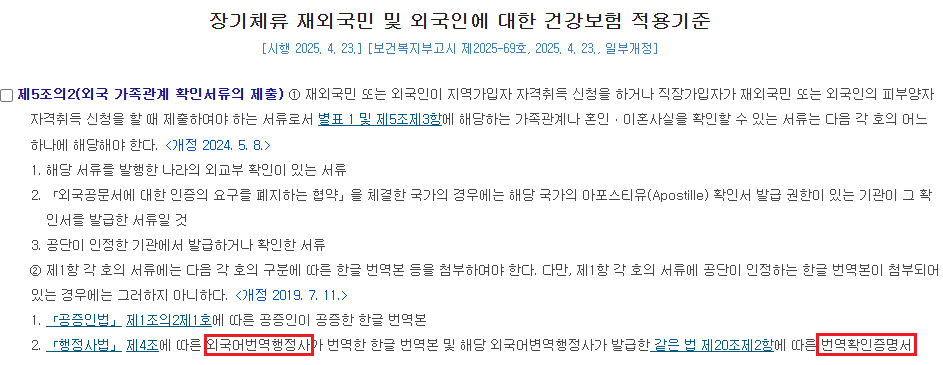
NHIS's requirement for foreign family-relation documents is set out in the Ministry-level administrative rule Health Insurance Standards for Long-Term Resident Overseas Koreans and Foreigners (Art. 5-2), which calls for a Korean translation together with a certifying document — the same 번역확인증명서 standard covered above.
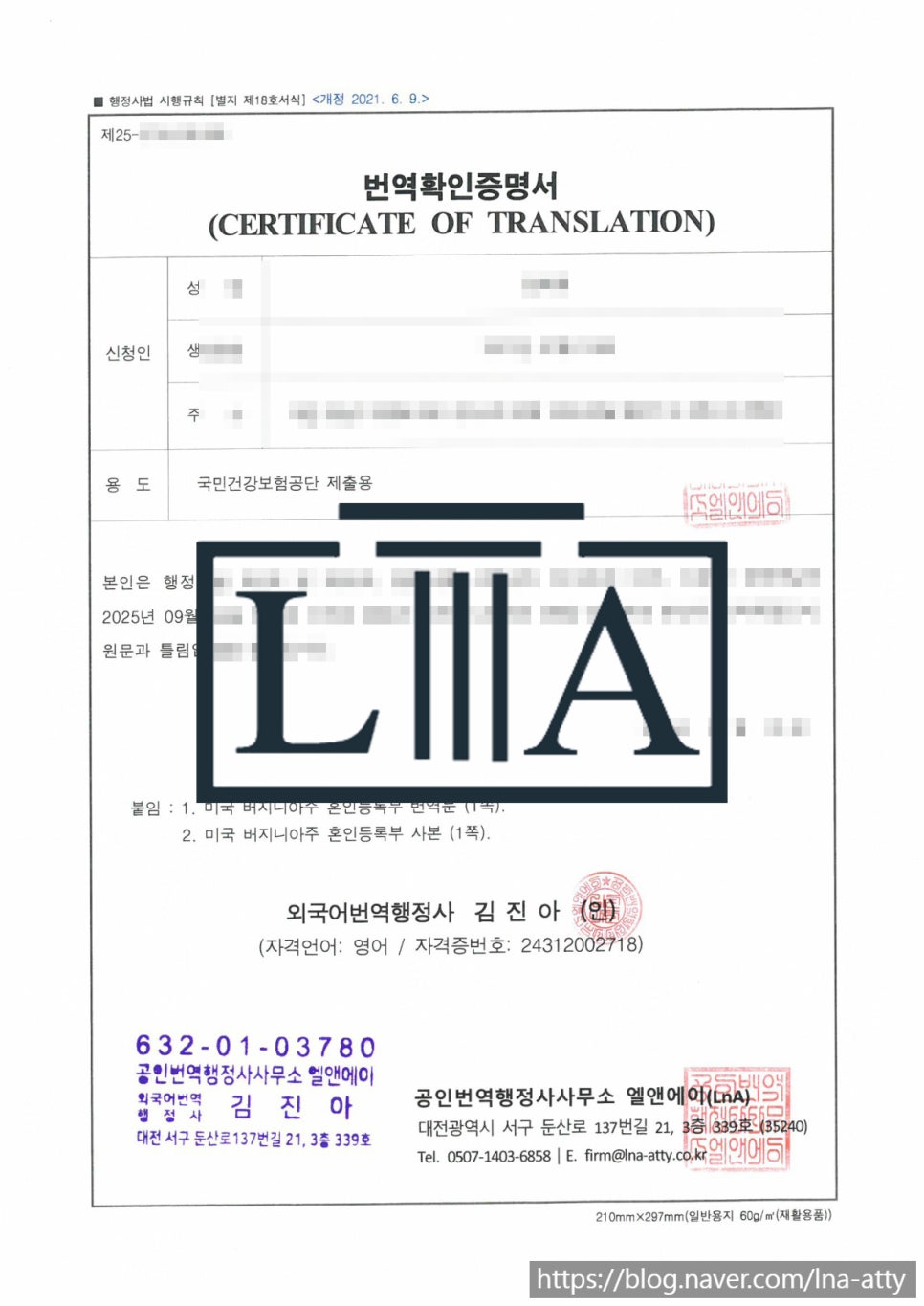
Apostilled originals: a later E-1 visa case with the same Virginia Marriage Register document had one added wrinkle — the original was apostille-certified, so the 번역확인증명서 covered the apostille along with the rest of the document, and this office also performed 원본대조필 (verified-against-original stamping) after examining the physical original. Whether 원본대조필 is actually needed depends on the specific receiving institution's requirement, confirmed during consultation — and since it's part of a 행정사's statutory 사실확인 duties under 행정사법 제20조, it carries no separate fee when bundled with the translation.
NHIS dependent registration: the general document checklist
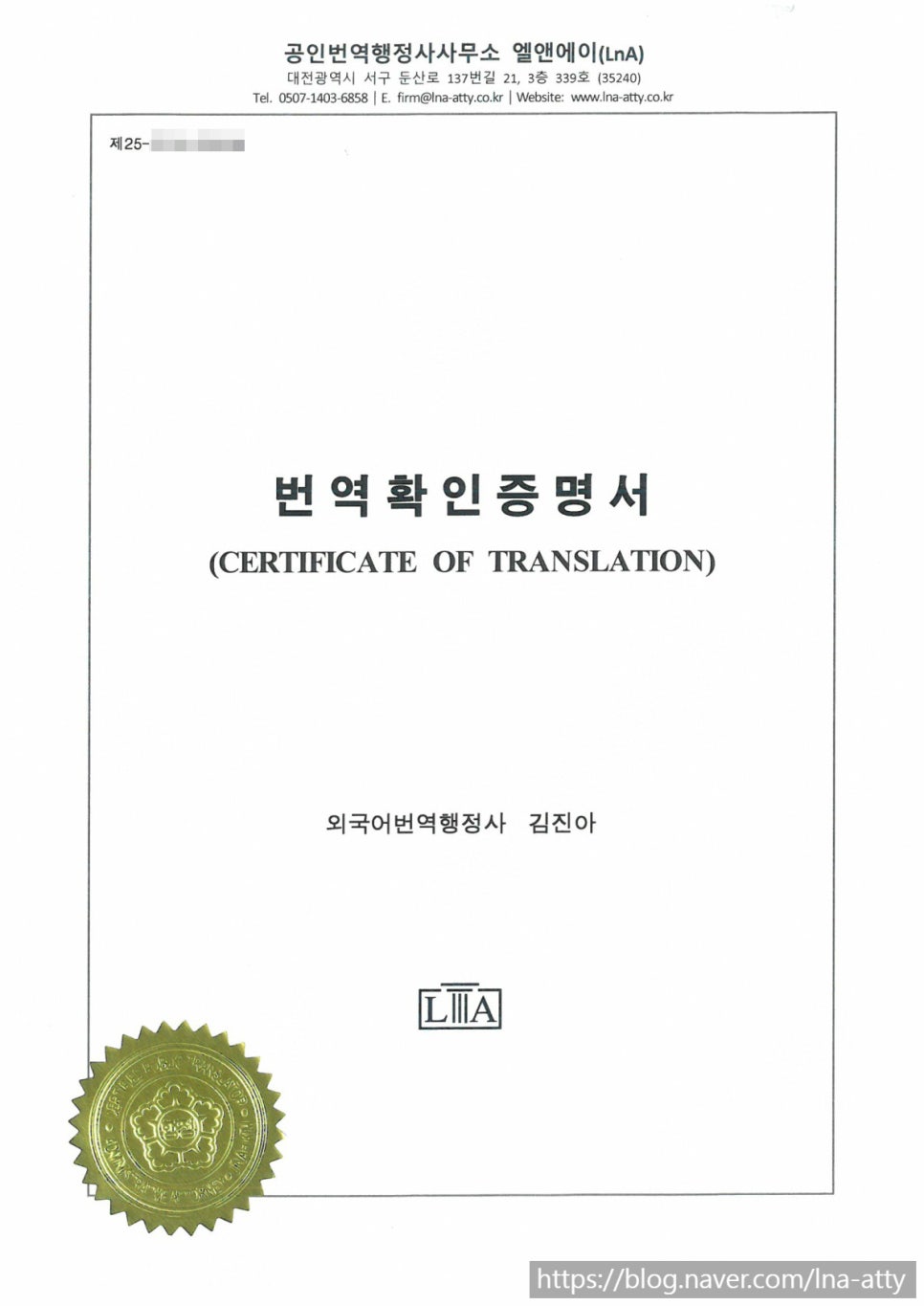
Beyond the Virginia case above, NHIS foreign-dependent registration comes up in other family situations too — an E-1 visa holder registering a child born in the U.S. (a North Carolina birth certificate, in this case) needed the same translation-plus-번역확인증명서 treatment.
NHIS's baseline document set for registering a foreign family member as a dependent is:
- The dependent's own passport copy and alien registration card
- A birth certificate (or other family-relation document)
- Proof of the main applicant's own health insurance eligibility (e.g. a certificate of employment, or a health insurance eligibility confirmation)
Beyond this baseline, NHIS may request additional supporting documents depending on the applicant's visa status, family relationship, age, or income level. Every document must ultimately be submitted in Korean — any foreign-language original needs a certified, credible translation to accompany it.
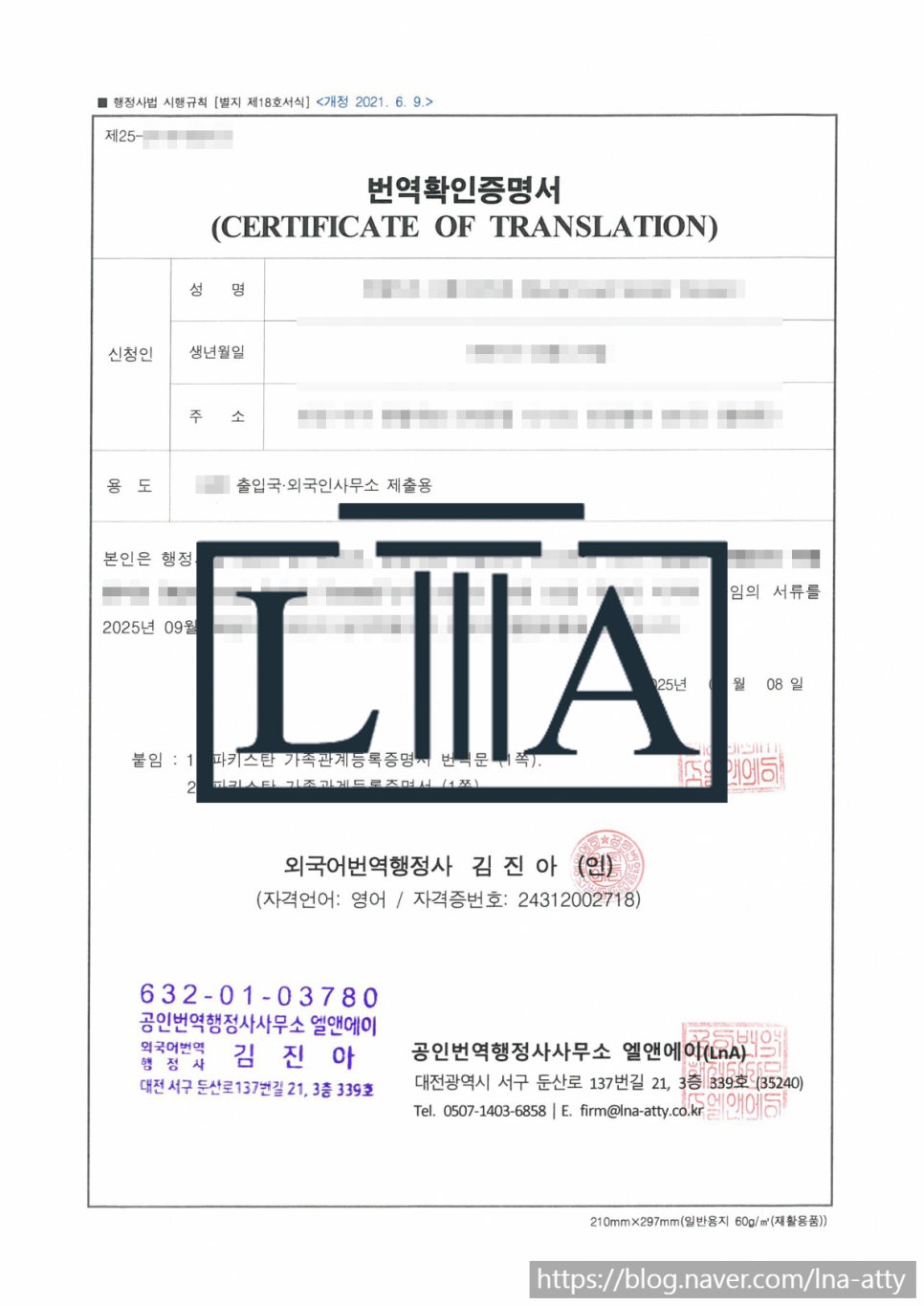
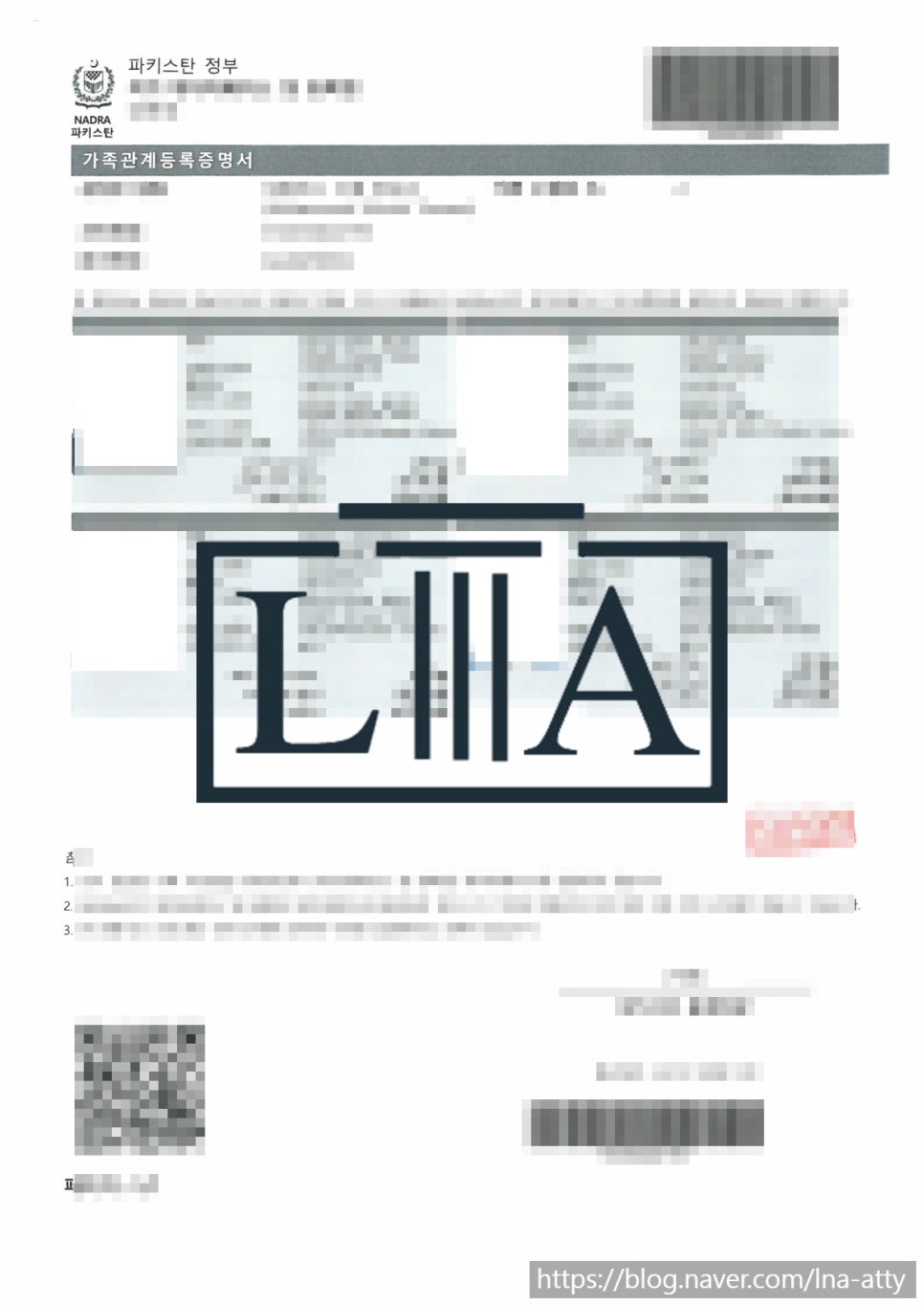
Naturalization applications: a Pakistani Family Registration Certificate (FRC)
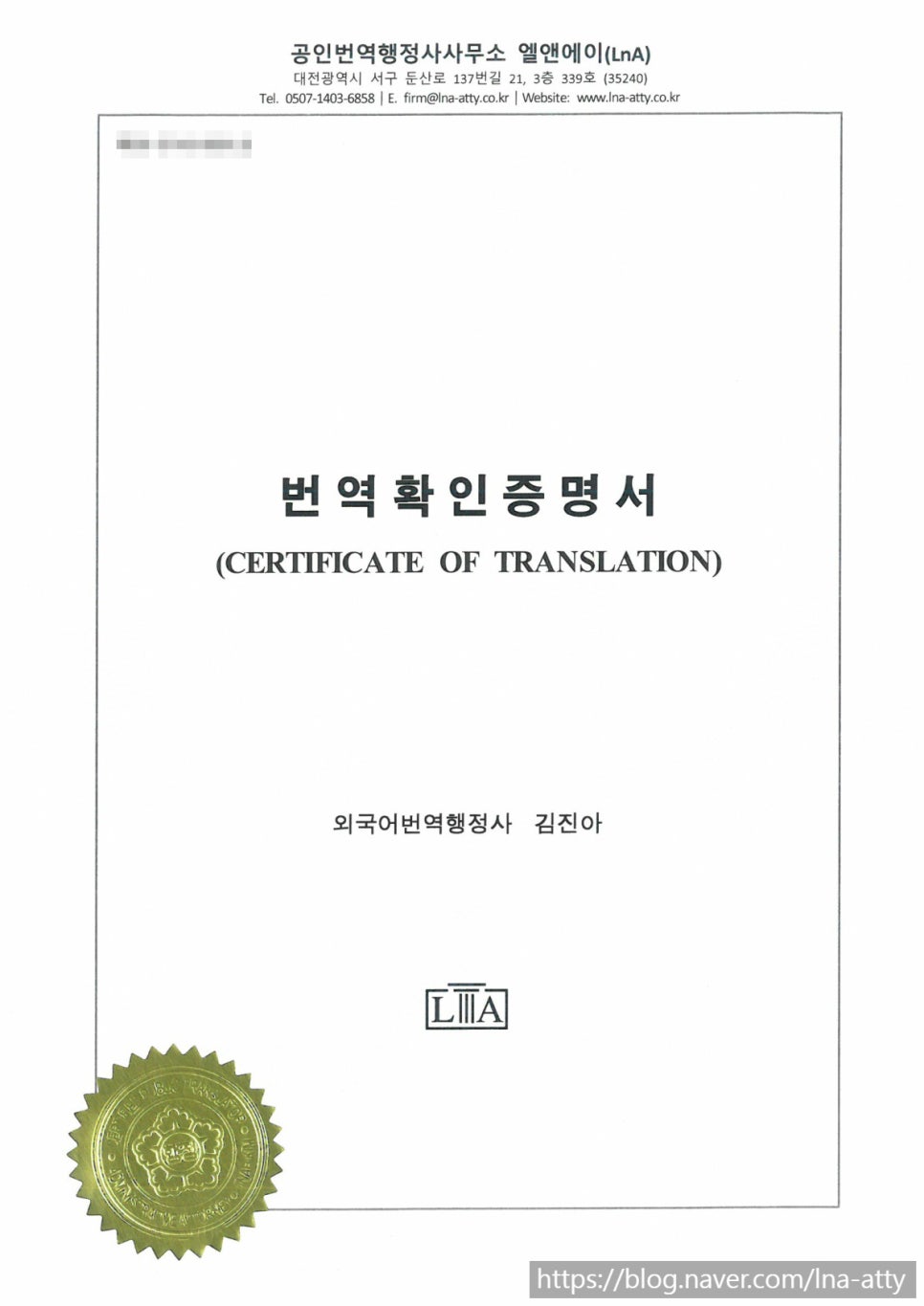
A client working at a Korean company after graduating from a Korean university — applying for naturalization (귀화) — needed a certified translation of Pakistan's Family Registration Certificate (FRC), an official family-relation document, as supporting evidence for their identity and family status.
Naturalization applications (general, simplified, or special 귀화) all require a common core document set:
- Naturalization permit application form (prescribed form, color photo attached)
- Passport copy (including the visa page)
- Foreign registration or permanent residency card copy (front and back)
- A criminal record certificate issued by the home country
- Proof of financial standing
Beyond this baseline, applicants are often asked for additional supporting documents depending on their individual circumstances — the FRC fell into this category here.
Pakistan's official languages are Urdu and English, and official documents are typically issued in English alone, or bilingually in English and Urdu. This particular FRC was bilingual — the translation preserved the original document's layout while translating it, and was issued together with a 번역확인증명서 in the statutory format.
번역확인증명서 vs. 번역자확인서 — which one does immigration want?
Two different certifying documents can accompany a translation submitted to an immigration office:
| 번역확인증명서 | 번역자확인서 | |
|---|---|---|
| Basis | Statutory form under the 행정사법 Enforcement Rules (Attached Form No. 18) | An internal form immigration offices (Hi Korea) provide for administrative convenience |
| Who can issue it | Only a 외국어번역행정사 | Not restricted to a licensed 외국어번역행정사 |
| Legal effect | Recognized as an official public-effect document when submitted to a public institution | An internal-format document with largely the same fields as the 번역확인증명서 |
Immigration offices generally exercise administrative discretion in accepting submissions, so different regional offices may lean toward one form over the other. In this case, this office confirmed the preference directly with the handling office's Nationality & Visa team before finalizing the translation-plus-번역확인증명서 combination.
When a notary office can't help: a Canadian birth certificate on special security paper
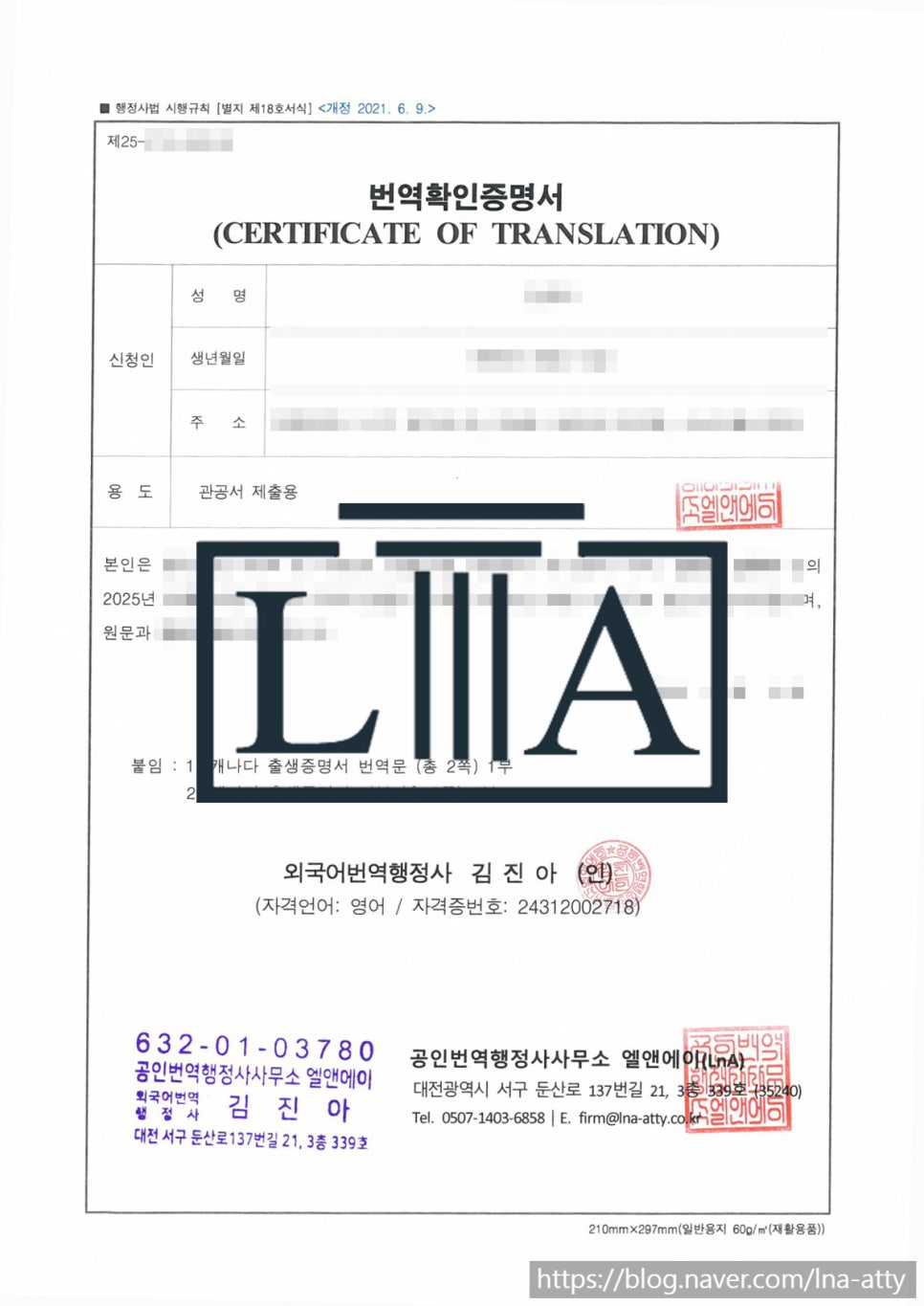
A client needed to register the birth of a child born in British Columbia, Canada at their local Korean 행정복지센터 (community welfare center) — which required both the birth certificate original and a certified translation physically bound to it as one document, so the original and translation's identity could be objectively proven (matching pages stamped with an interleaving seal, 간인, across the whole bound set).
Two options normally exist to establish that binding: (1) a notary's certified translation, or (2) a 외국어번역행정사's 번역확인증명서. This case ran into a problem with both — until it didn't.
Why the notary office couldn't do it
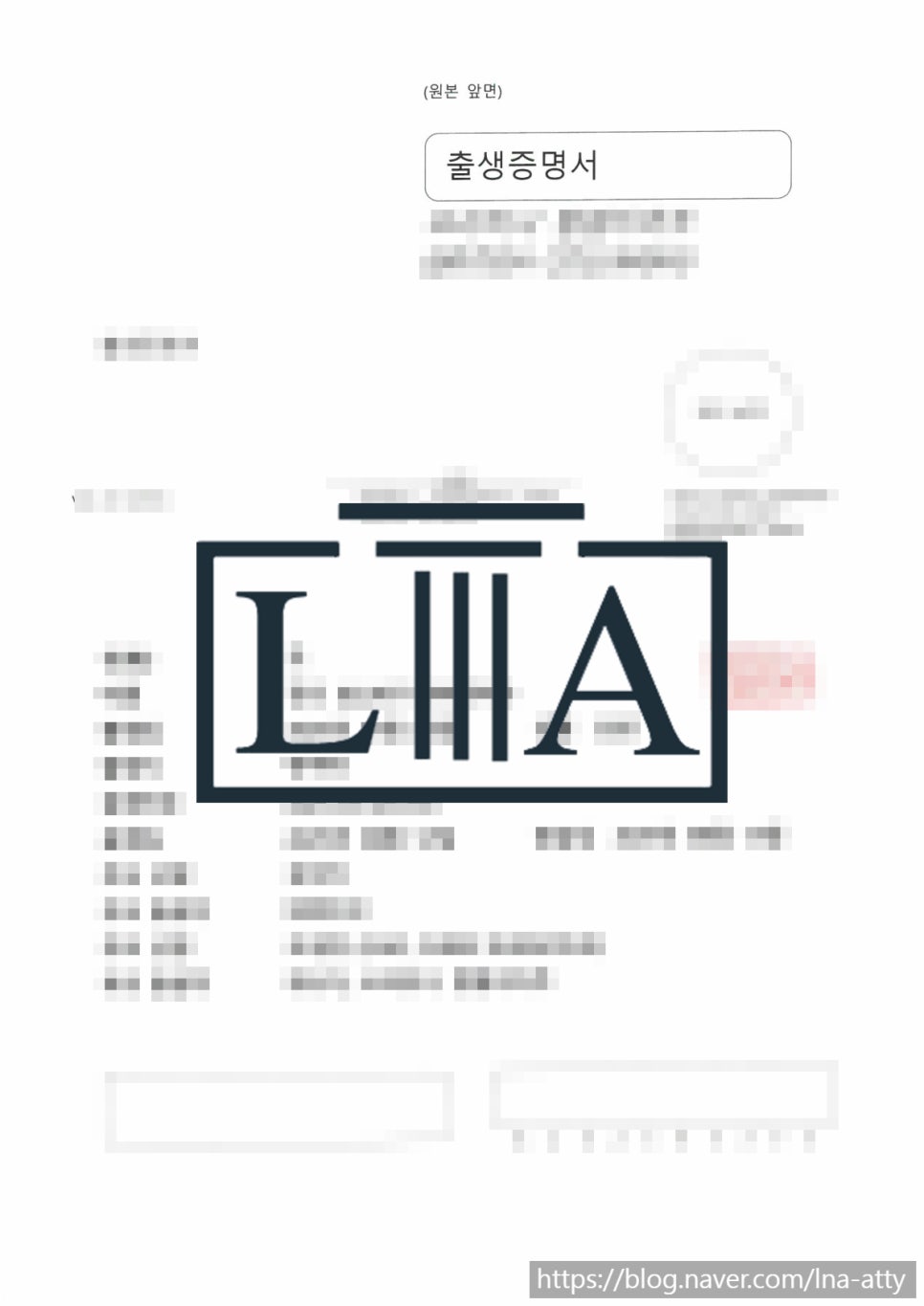
The client's original BC birth certificate turned out to be a palm-sized card printed on special security paper, double-sided — a format that physically can't be bound or interleaf-stamped (간인) directly. That meant the certification would have to run through a copy of the original instead, and the copy would first need to be proven identical to the original.
Here's the catch: a Korean notary has no authority to perform copy-certification (원본대조공증) on a document issued by a foreign government. A notary can only certify that a copy matches an original for privately-authored documents (사서증서) — not official public documents (공문서), and a foreign government's birth certificate is squarely the latter. So a notary office could only get as far as "declaration-notarized copy + translation" — which doesn't establish the physical original-to-translation identity the 행정복지센터 actually required.
The 외국어번역행정사-exclusive fix
Under 행정사법 제20조, a 외국어번역행정사 can examine a client's original document and certify that a copy matches it — 원본대조필. This office:
- Color-copied both sides of the original birth certificate without damaging it, and stamped it 원본대조필.
- Bound the 원본대조필-stamped copy together with the certified translation as a single document, interleaf-stamping (간인) every page to prove the set's integrity.
The resulting 번역확인증명서 carried the same evidentiary weight as the original itself — and the client completed the birth registration at the 행정복지센터 without issue.
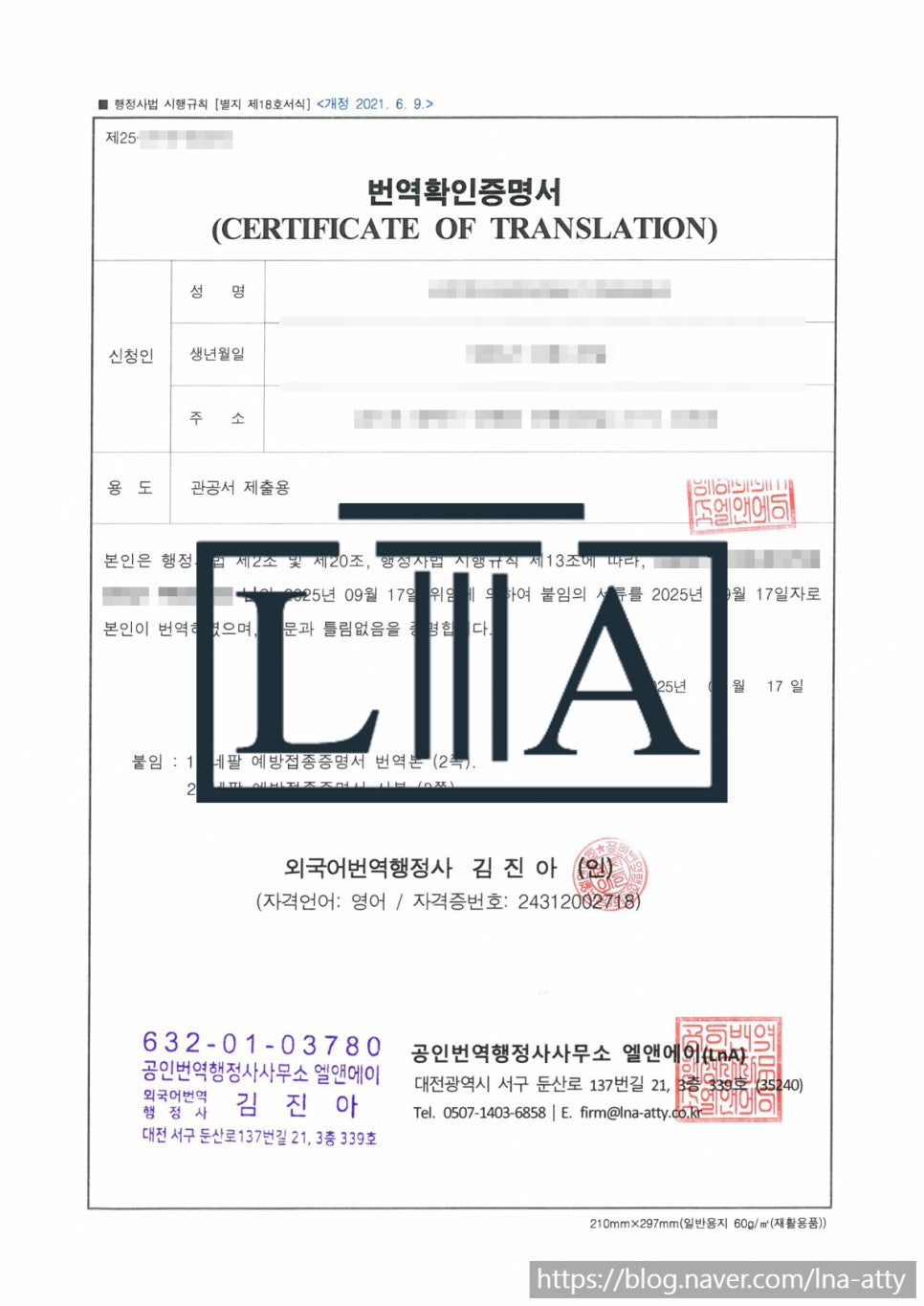
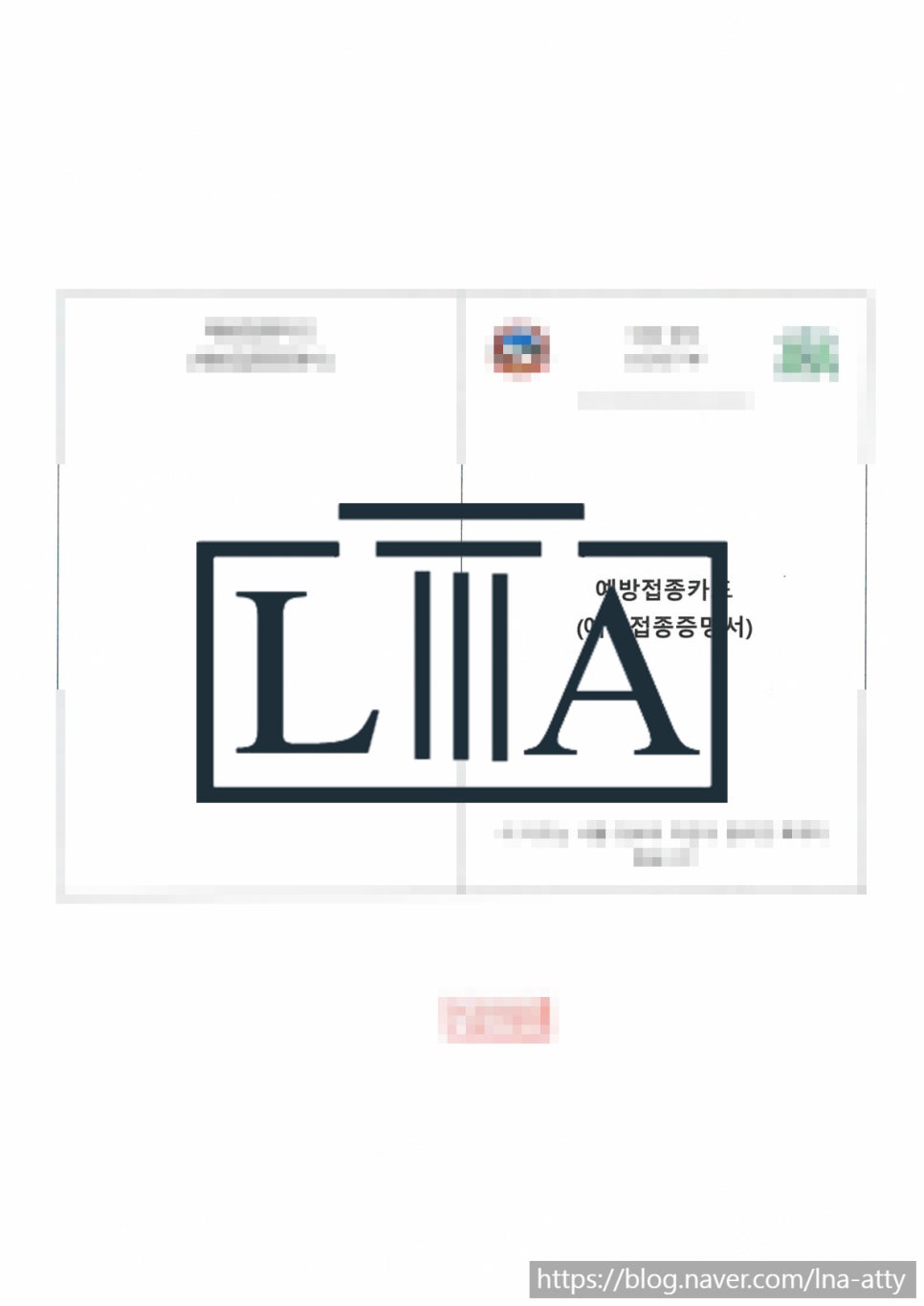
A Nepali vaccination certificate, registered with a Korean 보건소
A family needed to register their child's overseas vaccination record — a vaccination certificate issued in Nepal — with a Korean 보건소 (public health center).
Why a health center needs the foreign record translated
A child vaccinated abroad needs that history registered in Korea's National Immunization Program (NIP) — this ensures the child's vaccination record shows up correctly on the certificates later required for school and kindergarten enrollment. Since vaccine types and dosing intervals abroad don't always match Korean standards, the health center also reviews the record to determine whether supplemental vaccinations are needed. To formally register a foreign vaccination history in the national system, a health center requires a translation and 번역확인증명서 (or notarized translation).
Nepal's documents: Nepali-English bilingual, but don't skip the translation
Nepali is Nepal's only official language, but English functions as a de facto secondary language — official documents like vaccination cards are often issued bilingually in Nepali and English. Even so, for submission to a Korean health center, the entire document needs to be translated without omission and attached to the 번역확인증명서 — skipping sections already in English can get the submission rejected by the receiving office.
Nepal's calendar system: Bikram Sambat (BS)
Nepal uses its own calendar system, Bikram Sambat (BS), roughly 56–57 years ahead of the Gregorian (AD) calendar. If a vaccination date or birth date on the original document is recorded in the Nepali calendar, transcribing it as-is won't be administratively recognized in Korea.
For example: Nepali calendar 080-02-17 → Gregorian May 31, 2023
Dates need to be accurately converted to the Gregorian calendar for a Korean health center to accept the submission — which makes calendar conversion an integral part of the translation itself, not a separate step.
Registering a US divorce in Korea's family registry — and a document-type trap to avoid
A law firm referred a case involving an overseas Korean who had divorced their American spouse in Missouri and needed to register the foreign divorce in Korea's family registry system (외국판결에 의한 이혼신고). This office translated and certified the Missouri divorce documentation.
Foreign divorces aren't automatically recognized in Korea
A divorce finalized abroad doesn't get automatically recognized in Korea — it must meet certain requirements: the foreign court had proper jurisdiction, the defendant received proper service or otherwise responded to the proceeding, the judgment doesn't violate Korean public policy, and reciprocity exists between that country and Korea (상호보증). A foreign-judgment divorce registration is filed at the community welfare center covering the registration base or residence, and generally requires: the divorce report form, the original/certified copy of the divorce judgment (or an equivalent divorce certificate), a certified translation of those documents with a certifying document from a 외국어번역행정사, and the party's own identification.
The document trap: "Certified Statement Relating to Divorce" isn't the court's Divorce Decree
The document translated in this case was Missouri's "Certified Statement Relating to Divorce" — not the court-issued Divorce Decree, but a basic divorce-fact certificate issued by Missouri's Department of Health and Senior Services (DHSS), containing only basic information like names, date, and county. It certifies that the divorce occurred, without stating any of the judgment's substantive content — functionally equivalent to a "Certificate of Divorce." This type of document goes by different names state to state — Divorce Certificate, Certified Statement Relating to Divorce, Divorce Verification Letter — but is essentially the same kind of document everywhere. It's distinct from the formal court-issued Divorce Decree — for purposes like remarriage, immigration, or property division, a separate certified copy of the actual Divorce Decree must be obtained from the relevant county court.
| Certified Statement Relating to Divorce | Divorce Decree | |
|---|---|---|
| Issuing authority | Health department (Bureau of Vital Records) | The relevant county's Circuit Clerk (court) |
| Content | Name, date, county (basic info only) | Full judgment content (property, custody, etc.) |
| Use | Proof the divorce occurred | Complete legal proof (required for immigration, property, inheritance, etc.) |
How this case was completed
Given the client's urgency, this office quickly confirmed the basic information and completed the translation, issuing the certified translation certificate with the scanned copy sent first and the physical original following by next-day courier.
The underlying principle
How a foreign divorce/family document gets submitted and translated depends on the document's specific type and legal character — correctly distinguishing whether something is a court judgment or an administrative-agency-issued certificate is essential, which is why this kind of work benefits from an experienced 외국어번역행정사 who understands the submission's actual purpose.
A Nepali marriage confirmation for NHIS dependent registration — two different procurement paths
A Nepali worker living in South Chungcheong Province needed their marriage relationship confirmation document translated to register their spouse as an NHIS dependent.
What NHIS's own regulations require
A foreign worker registering a spouse or child as a dependent generally needs a marriage relationship certificate, birth certificate, or similar document (with a Korean translation attached) — and if NHIS's internal system can't verify the relationship on its own, the related documents must be submitted directly. NHIS's own standard — Article 5-2 of the Health Insurance Standards for Long-Term Resident Overseas Koreans and Foreigners — explicitly requires that a foreign-language document submission come with a certified translation, and specifically identifies a translation certificate issued by a party licensed under 행정사법 as meeting NHIS's own official submission standard.
Two different paths, depending on where the document is obtained
Path 1 — Obtained in Nepal. The document is issued in English (or translated and notarized into English) by a local Nepali government office, then authenticated (confirmation stamp/sticker) by Nepal's own Ministry of Foreign Affairs. Once that authenticated document reaches Korea, this office provides the Korean translation and issues the certified translation certificate (번역확인증명서) for submission.
Path 2 — Obtained while in Korea. Workers currently residing in Korea can instead have the document issued in English directly by the Nepali Embassy in Seoul. This office then translates that document into Korean and issues the certified translation certificate the same way.
This particular client's case used the second path — a document issued directly by the Nepali Embassy in Korea — allowing this office to move quickly.
The underlying principle
As a firm specializing in legal and administrative document translation, this office reflects Nepali documents' proper nouns and personal details with zero margin for error, and — given the practical difficulties many foreign workers face navigating this process on-site — provided the translation and certified translation certificate promptly.
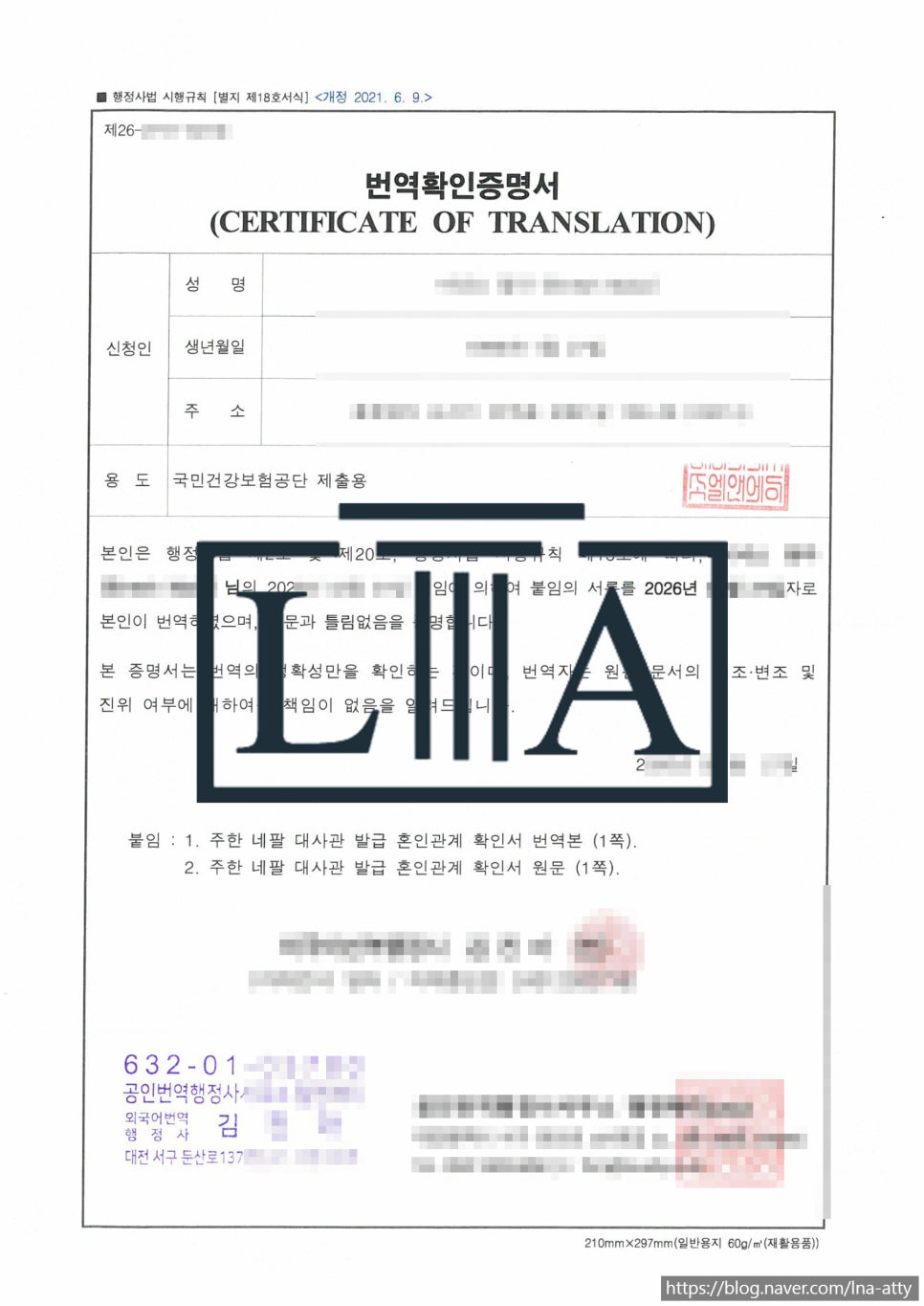
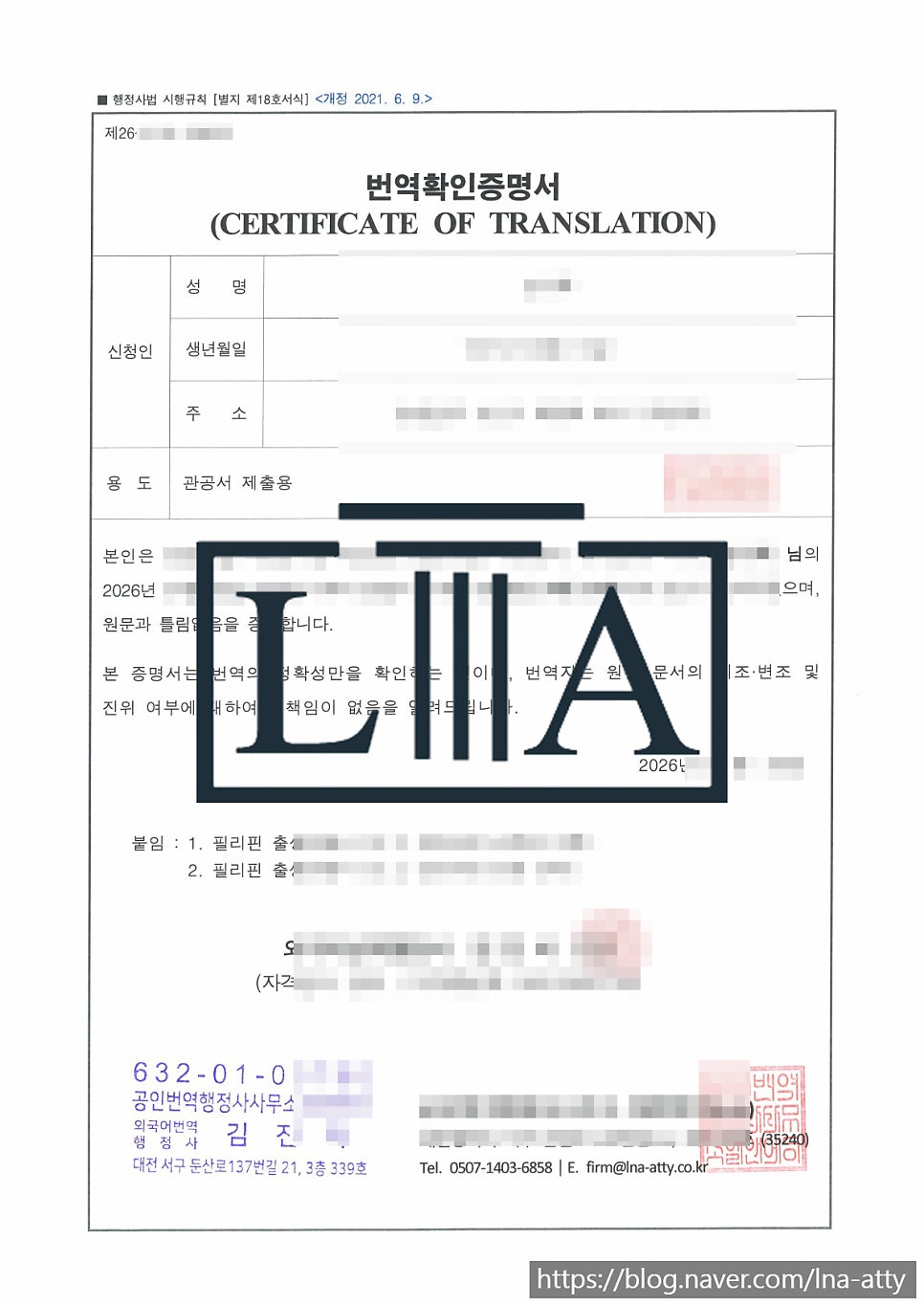
A Philippine birth certificate, for registering a child born abroad with the local 시청
A child born abroad to a Korean parent — even with the joy of a new arrival, many parents find the administrative process for securing the child's legal rights in Korea unfamiliar and daunting. This case translated a Philippine (PSA-issued) birth certificate for exactly that filing.
Korea's overseas-birth registration basics
If either parent is a Korean citizen, the child's birth must be reported within 1 month of the birth date. The person filing is the child's biological father or mother; filing location options include the community center covering the parents' address, any city/district/eup/myeon office nationwide, or a Korean overseas diplomatic mission (if filing directly from abroad); processing generally takes about 3 business days. Required documents: the birth report form (provided on-site), the filer's ID, the original local (here, Philippine) birth certificate plus its Korean translation, and — for a dual-national child — proof of the foreign nationality (e.g. passport).
Why Philippine PSA documents are unusually demanding to translate
Philippine administrative documents are structurally far more complex than many other countries' equivalents, making this a notably difficult translation to execute well — it requires first fully understanding the document's structure, then translating item-by-item to match it precisely.
Precision requirement: the foreign parent's Hangul name must match existing Korean administrative records exactly
When Romanizing a foreign parent's name into Hangul, it must exactly match how that name is already recorded in Korean administrative systems (alien registration card, marriage relation certificate, etc.) — even a single-letter mismatch can create administrative confusion. This office confirmed the precise spelling through close communication with the client before finalizing the translation.
Layout matching for reviewer convenience
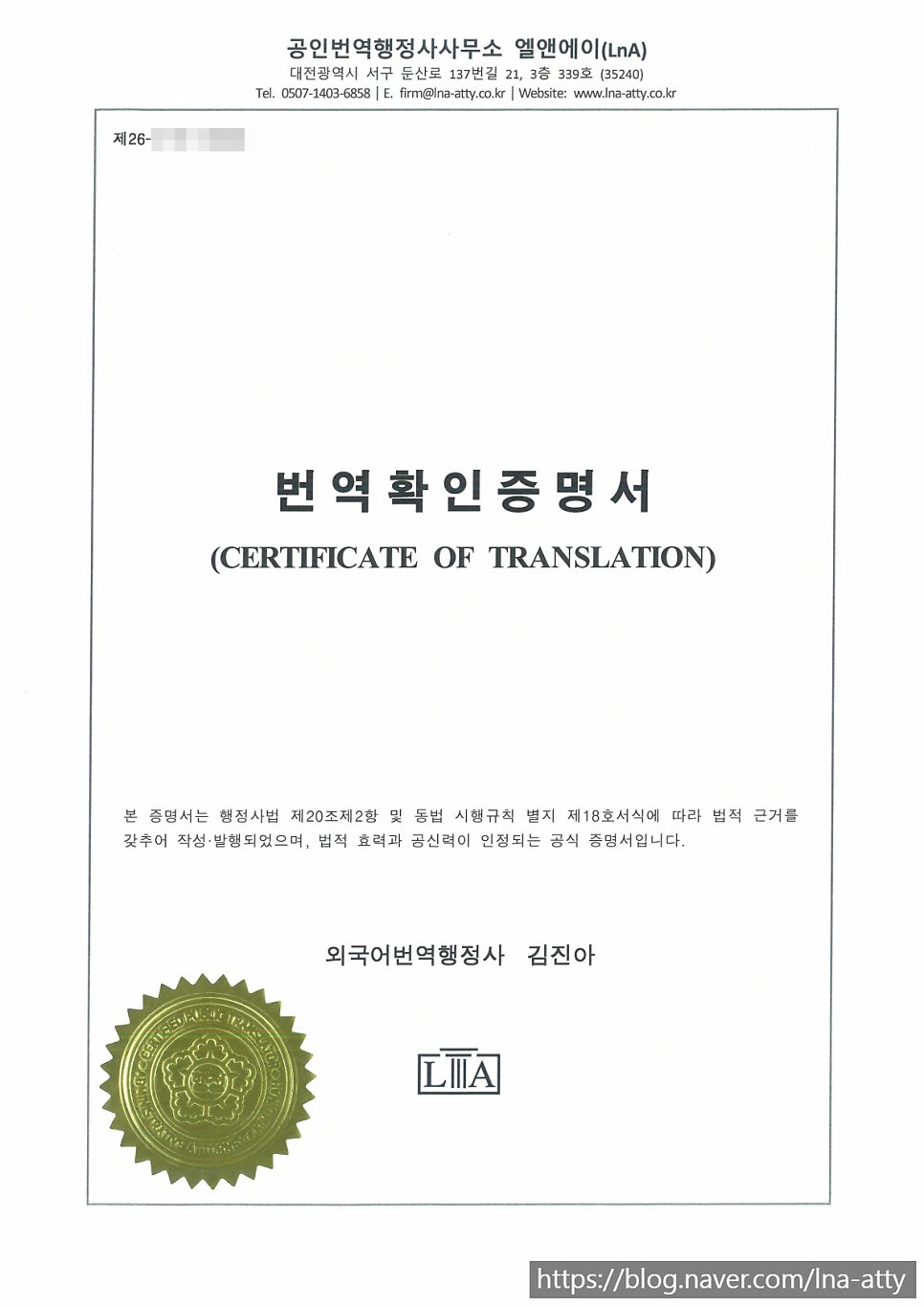
Arranging each signature field and data item on the translated birth certificate to closely mirror the original document's layout matters — it lets the reviewing official cross-check the translation against the source at a glance. After thorough review and translation, this office delivered the document safely along with the certified translation certificate issued under 행정사법.
The underlying principle
A translation submitted to a government agency isn't mere reference material — it functions as an official document in its own right. That's exactly why 행정사법 reserves this work for a properly licensed professional, and why performing it without that qualification is a criminal offense. This office analyzes the submission's purpose, reviews the specific requirement, and structures the document in a form that's actually acceptable for filing.
An Indian marriage certificate for NHIS dependent registration — the apostille step
For an Indian-national worker's spouse to be registered as an NHIS dependent, the same 번역확인증명서 requirement applies as with other countries — but India is a Hague Apostille Convention member, which adds a step: a document issued in India for submission to a Korean public institution (like NHIS) must first be apostilled before translation. This client provided a scanned copy of the already-apostilled document, letting the case proceed without delay. Since the client wasn't comfortable communicating in Korean, this office conducted the entire consultation and process in English, then delivered the completed translation by sending scans to the client and employer first, with the physical original available for pickup in person.
An embassy-issued Ukrainian family relation certificate: when apostille isn't needed at all
A Ukrainian-national client in Pyeongtaek needed to register a spouse as an NHIS dependent, and provided a Certificate of Family Relationship issued directly by the Ukrainian Embassy in Korea — based on Ukraine's own Ministry of Justice marriage registry records, and bearing the embassy's official seal and the consul's signature.
Why this document skipped the apostille step the Indian case needed
A document issued inside the origin country (like the Indian marriage certificate above) generally needs an apostille before a Korean institution will recognize it. But a certificate an embassy in Korea issues directly for submission to a Korean institution is different: because it already carries the sending country's own embassy seal and consular signature, it's accepted with only a 외국어번역행정사's certified translation and 번역확인증명서 — no separate apostille required. Distinguishing which category a given foreign document falls into, before advising a client on next steps, is itself part of the job.
Handled fully remotely
As with the Pyeongtaek case here, this office regularly receives a high-resolution scan or photo of the document to be submitted, completes the translation and review immediately, sends the finished 번역확인증명서 as a PDF first, and mails the physical original by registered mail — letting clients anywhere in the country submit on schedule without an in-person visit.
A Taiwanese hospital birth certificate for a domestic family court — a same-day walk-in
A client walked in without an appointment, urgently needing a Taiwanese hospital-issued English birth certificate translated and certified for submission to a Korean family court (가정법원) — a use case distinct from the health-insurance and school-enrollment submissions covered above. Court submissions carry their own strict formatting and accuracy expectations, since the document becomes part of the case record.
Five places a foreign birth certificate translation commonly goes wrong
Errors this office watches for on every birth certificate translation, court-bound or not:
- English name spelling that doesn't match the passport
- Misspelled parent names
- Date-format confusion (day/month/year ordering)
- Mistranslated hospital or issuing-institution names
- Information that doesn't match what's already on file in the Korean family registry
For a court or administrative submission specifically, cross-checking these details against the client's other submitted documents matters as much as the translation itself.
How the same-day turnaround worked
Because the document was court-bound, this office cross-checked the name, date of birth, and parent information against the client's ID documents before starting. Work then proceeded in sequence: analyzing the Taiwanese hospital's original format and matching proper nouns (hospital name, physician name, address), double-checking the English name and date of birth against the passport, and completing a precision translation to the standard a judicial submission requires. Given the document's manageable length and reasonably clear content, both translation and certification were completed the same day.
Accurate English-to-Korean Translation for Korean Institutions
Get in touch about thisFrequently Asked Questions
What is a CRBA?
A Consular Report of Birth Abroad — a document a U.S. embassy or consulate issues to a U.S. citizen child born overseas, carrying the same legal effect as a birth certificate for U.S. passport and citizenship purposes.
Why can't I just get a Korean 가족관계증명서 instead?
If neither parent nor child holds Korean nationality, there's no Korean family registry entry for them, so no 가족관계증명서 can be issued. The CRBA is the document that proves the parent-child relationship in that situation.
When would a Korean institution ask for a CRBA?
Common cases include school enrollment, registering as a dependent for health insurance, and other administrative filings like foreigner registration or real estate matters.
Do I need a notarized translation or a 번역확인증명서?
Most Korean government offices accept a certified translation with a 번역확인증명서 from a 외국어번역행정사; some institutions may specifically require a notary office's notarized translation instead — this office confirms which one your receiving institution needs.
Why does official terminology matter so much for a CRBA translation?
Government and institutional names like 'United States of America' (미합중국) or 'Department of State' (국무부) have specific, established Korean equivalents — using the correct official terms, not a casual translation, is part of what makes the translation acceptable to Korean institutions.